Daedalus Brand Guidelines
A luthier’s approach to the loudspeaker cabinet.
Aa
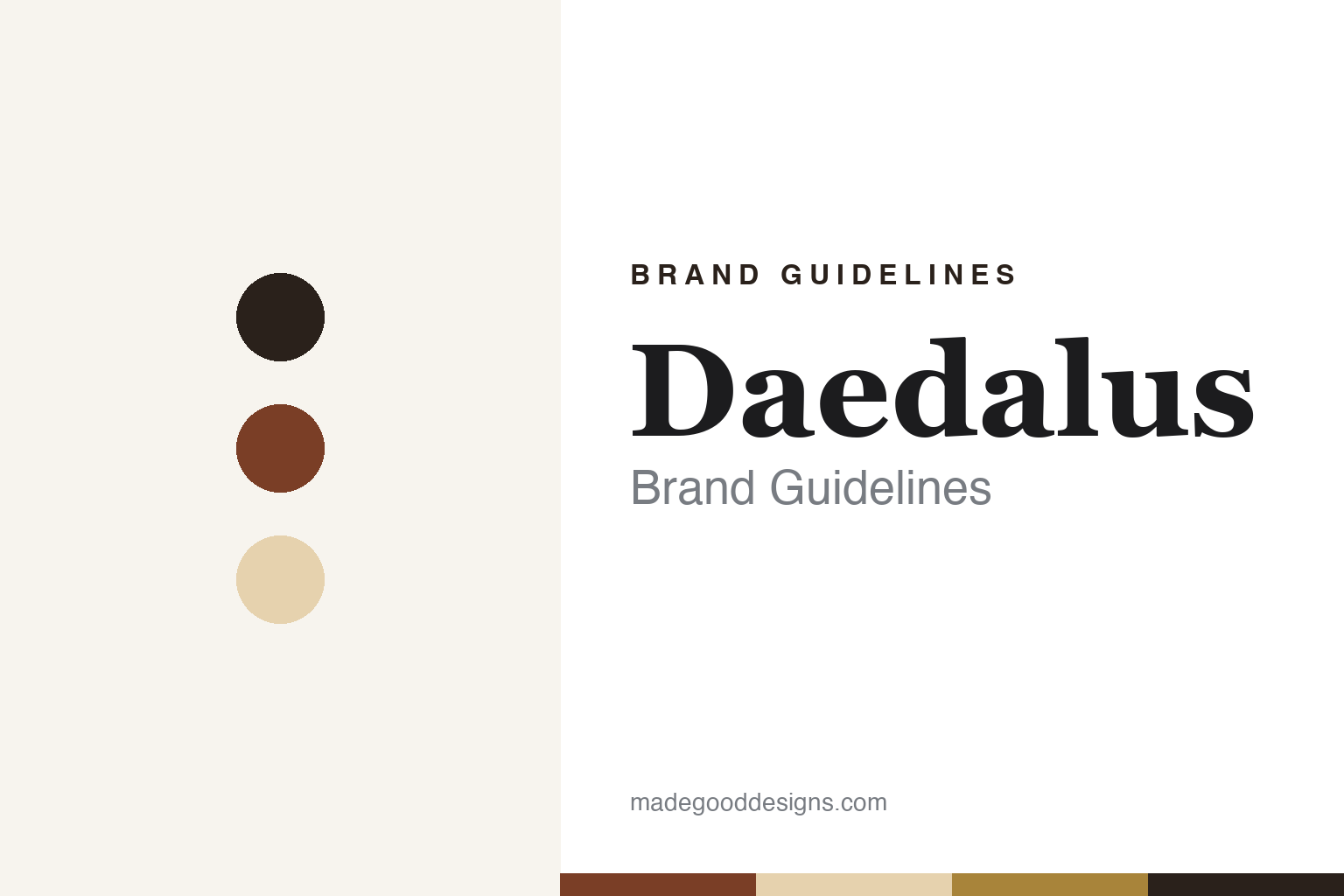
Two constants: a Daedalus cherry, walnut and brass palette and a Luthier serif register. Abstract homage — not a Daedalus Audio product or mark; no loudspeaker, logo or nameplate is reproduced.
An amplifier for acoustic guitars
A musician’s workshop before it was a hi-fi brand.
Daedalus Audio is a small American loudspeaker maker based in Ferndale, Washington, near the Canadian border north of Bellingham. Its founder, Lou Hinkley, started the business in 1992, but not as a hi-fi company. Its first name was Daedalus Cabinets, and its first products were amplifiers and speaker cabinets for acoustic instruments. Hinkley told Positive Feedback in 2019 that he had played guitar since he was 13, after first hearing a John Lee Hooker record, played professionally in his twenties, stopped to raise a family, and built houses for about ten years before starting Daedalus “making speaker systems for professional acoustic instruments.” He named Lou Reed, the folk guitarist Martin Simpson and the String Cheese Incident among his customers; we have not checked that list independently.
The oldest archived copy of the company website, from December 1998, presents “Daedalus Cabinets — Acoustic Instrument Amplification,” offering guitar amplifiers, PA and monitor speakers and studio furniture, with testimonials from luthiers including the Froggy Bottom Guitars workshop, whose catalogue was quoted as saying that “Lou Hinkley at Daedalus is THE man to amplify your guitar.” The company says that within a year of its founding Acoustic Guitar magazine had called its cabinets the “audiophile approach to acoustic amplification,” a phrase the 1998 site already used; we did not see the original article. The same page explained the name with a dictionary entry: Daedalus, the craftsman and inventor of Greek legend who built the labyrinth in Crete and the wings with which he and his son Icarus escaped — a fitting patron for a business built on woodwork. Hinkley writes on the current site that, as a musician returning to performance in 1992, he found “not a single decent speaker system for acoustic instruments,” and that he had been a woodworker most of his life and had built speakers since his teens.
Colour
Solid hardwood, high sensitivity and no horns.
The turn to home audio came around 2000, Hinkley told Positive Feedback, and the company says its first home speaker, the DA-1, launched in 2002. The professional range has since shrunk to two models, the W-803 and SR-823, built when the schedule allows. The home range is split, in Hinkley’s words, into the Athena series, built around an 8-inch Daedalus woofer, and the Apollo series, built around a 10-inch one. The latter runs from the Apollo and Apollo 11 to the ZEUS, a two-part tower over six feet tall with its drivers in a D’Appolito array; a ZEUS v.3 with a new 6.5-inch midrange made its debut at Capital AudioFest in 2021. The site also lists the Muse, Poseidon, Ulysses, Argos and a BOW subwoofer.
Construction is the signature. The company says every cabinet is made of solid North American hardwood three-quarters of an inch thick, with “no veneers or MDF,” dovetail joinery and a hand-rubbed oil varnish that takes three to four weeks to apply. Cherry is standard; walnut, maple, quartersawn white oak and ebonized walnut cost extra, and Hinkley prefers a quartersawn walnut baffle. Knots are sometimes filled with brass, aluminium or stone in the spirit of Japanese kintsugi. Sensitivity is quoted at 95 to 99 dB, achieved, the company stresses, “without the use of horns.” Positive Feedback reported that the Muse Studio’s 8-inch woofer is a proprietary design made in the USA, its tweeter an Eton soft dome, and its crossover the work of the designer Guy Veralrud, using Duelund resistors and no electrolytic capacitors. In the US the speakers are sold only direct, with a 30-day home audition; the site lists dealers in Australia and Singapore.
Typography
Design and documentation.
The seven loudspeaker makers in this guide are small American companies, most of them built around a single designer. The oldest is Legacy Audio, which Bill Dudleston started in 1983 in Springfield, Illinois, where it remains. It sells through authorized dealers and online, and in 2025 it introduced Jay McArdle as its new owner and chief executive.
Two are in Utah. Tekton Design, run by Eric Alexander, gives its address as Orem and calls its business model “strictly direct-to-consumer.” Spatial Audio Lab, founded by Clayton Shaw, also sells direct, saying dealers “often want a double digit mark-up rate”; the company says Shaw sold its assets to Sam and David Whitt in 2023.
In the Midwest, Salk Sound, Jim Salk’s company, built speakers to order in Pontiac, Michigan, by its own account, and sold them direct. On 15 September 2023 it said it had stopped taking orders and sold its woodworking equipment.
On the coasts, Stereophile places Jeff Joseph’s Joseph Audio on Long Island, New York, and the company’s website sends buyers to dealers. Daedalus Audio, which Lou Hinkley founded in 1992, works from Ferndale, Washington; it says its speakers are sold only direct in the US, with dealers in Australia and Singapore.
The South has Volti Audio. Greg Roberts, who started out rebuilding Klipschorns in Maine, now builds horn loudspeakers in Baxter, Tennessee, selling almost entirely direct.
This guide sets out what can be checked about each brand — who founded it, who owns it, and what it says about where its products are made — and marks clearly what rests only on the company’s own word.
Aa
A luthier serif — warm, carved and unhurried. (Specimen set in Fraunces, a serif STAND-IN; NOT the Daedalus Audio logo.)
Daedalus Audio
Reviews, awards and a show of its own.
The trade press has been warm. Gary L. Beard reviewed the Muse Studio for Positive Feedback in July 2019, at a base price of $10,750 a pair in cherry, called the cabinets “gorgeous” and the inlay and joinery “stunning,” and ended “Most enthusiastically recommended!” The magazine gave the speaker one of its Writers’ Choice awards that November, calling Hinkley “Daedalus Audio’s master builder.” The company lists earlier Writers’ Choice awards from 2008 and 2012. In October 2019 John Richardson of Part-Time Audiophile reviewed the Apollo, at $18,500, driving its 96 dB sensitivity with a 10-watt tube amplifier; he praised “some of the best furniture grade cabinetry in the business” and judged the speakers reference-quality. He noted the appeal for listeners “who want the advantages of sensitivity but can’t manage horns.”
Hinkley has also shaped the show circuit. In May 2020 Positive Feedback published the announcement of the Pacific Audio Fest, a Seattle consumer show organised by Hinkley as show director with Gary Gill, founder of Capital Audiofest, as show manager. Hinkley said he had begun planning it in autumn 2019 and spoke of nearly thirty years as an exhibitor at music trade shows. Part-Time Audiophile covered Daedalus rooms at the festival in 2022, 2023 and 2024, often paired with Linear Tube Audio amplifiers.
For a design guide, Daedalus shows how a speaker brand can borrow its identity from instrument-making: solid timber chosen per client, visible joinery, inlays and a craftsman’s name in place of a corporate one. Compare Zu Audio, another high-efficiency American maker, and Klipsch, whose horns represent the route Daedalus avoids. For this guide we use cherry, walnut, maple and inlay brass with a serif, an unofficial interpretation; no product or logo is reproduced.
Explore & save
Keep Daedalus’s identity on hand — save it to a board in the Made Good inspiration library.
Daedalus Audio identity set
Pin the Daedalus cherry, walnut and brass palette and the Luthier serif register to your own board.