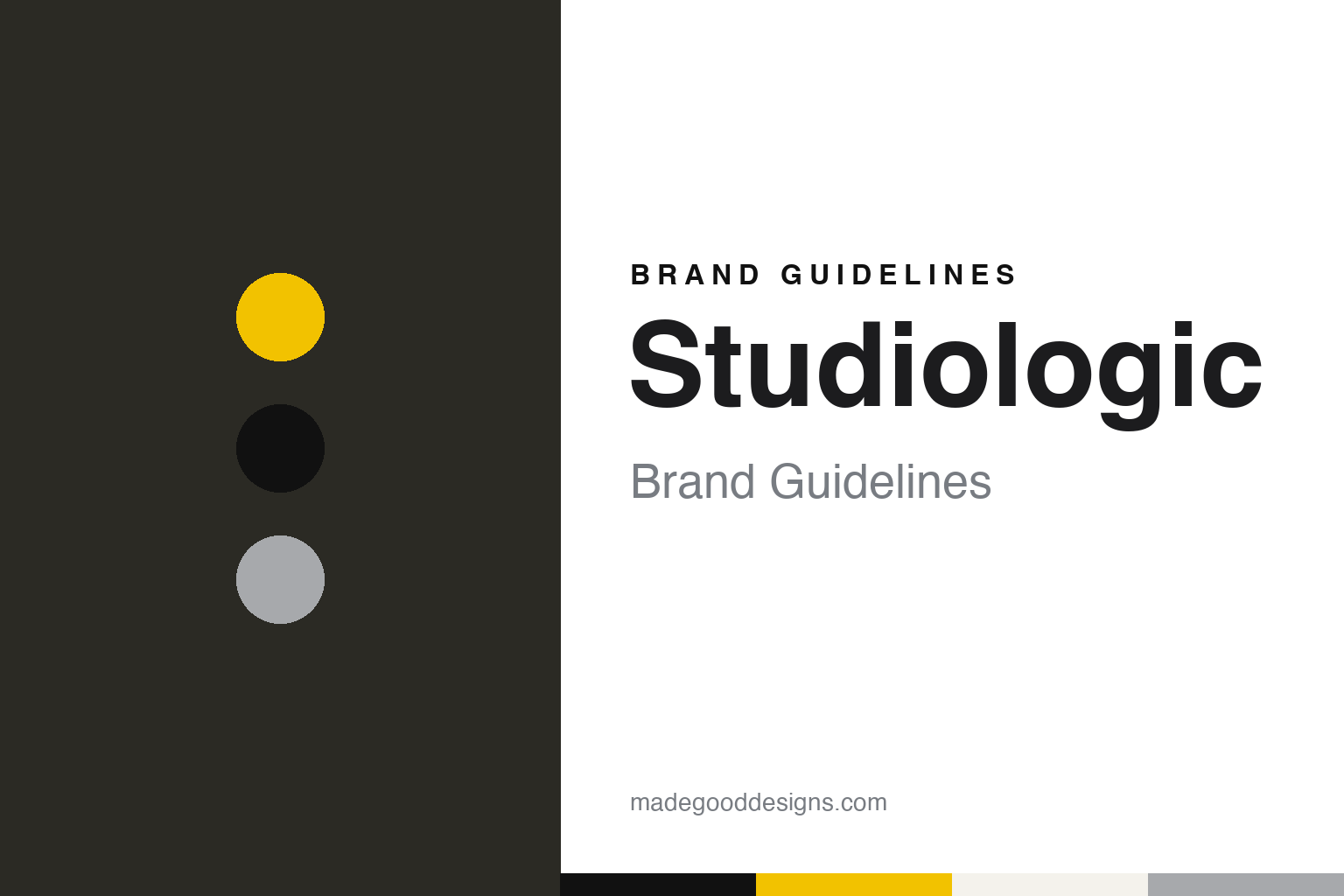
Studiologic Brand Guidelines
The keybed maker’s own label, from master keyboards to a yellow synth.
Aa
Two constants: a Studiologic yellow, black and silver palette and a Modern sans register. Abstract homage — not a Studiologic product or mark; no instrument, logo or nameplate is reproduced.
Fatar by stealth
A keybed maker’s own label.
Studiologic is not a stand-alone company. Sound On Sound’s Gordon Reid wrote in 2012 that it “isn’t a company in the conventional sense; it’s a trading name of Fatar, who are much better known for their keybeds and controller keyboards.” A decade later the same magazine’s Dave Gale called Studiologic “effectively Fatar by stealth.” The privacy policy of the Studiologic website names Fatar S.r.l. of Recanati as its data controller.
Fatar was founded in 1956 in Recanati, in the province of Macerata in Italy’s Marche, by Lino Ragni, according to English and Italian Wikipedia and the company itself. Fatar says the name is an acronym of Fabbrica Tastiere Ragni — the Ragni keyboard factory — and that the business began in a small home workshop and grew when Lino Ragni’s brothers Laurino, Paolo, Giuseppe and Claudio joined it. It places Recanati at the heart of what it calls “Italy’s Musical Instruments Valley,” a region it describes as home for decades to makers of accordions, guitars, pianos and electronic instruments; Italian Wikipedia treats Castelfidardo, Loreto and Recanati as a single musical-instrument district.
Fatar’s main trade is keyboards for other people’s instruments. Italian Wikipedia lists keybed customers including Ensoniq, Kurzweil, Roland, Clavia, Korg, Alesis, Wersi and Casio, and, in earlier years, Italian makers such as Farfisa, Elka, Crumar and Eko. English Wikipedia says Fatar patented its own hammer-action prototype in 1989 and introduced a conductive-rubber contact in 1990, and records that Waldorf’s Iridium Keyboard uses a Fatar keybed with polyphonic aftertouch. Fatar dates its own polyphonic-aftertouch keybeds to 2020 and 2022, and calls itself the maker with “the widest catalog of keyboard mechanisms in the world” — its own claim.
Colour
From the Studio 88 to the Numa.
Studiologic’s own timeline begins in 1986 with the Studio 88, which it calls “a pioneer in a new segment of digital musical instruments: the Masterkeyboard,” and lists a “Studiologic rebranding” in 1998. The trade press shows the earlier name. In July 1996 Sound On Sound reviewed the Fatar Studio 1176, “this Italian master keyboard,” noting that Fatar master keyboards had been “widely available in the UK for three or four years,” in a range topped by the 88-note Studio 2001.
The company lists the SL-990 XP and SL-990 Pro in 2003 and the VMK series in 2005. Reviewing the VMK176 Plus in February 2007, Sound On Sound noted that the Plus models were silver-grey where the earlier VMK188 had been black, and that the range put a weighted action into shorter keyboards; the 76-key model cost £449.99.
The Numa of 2008 changed the look. English Wikipedia describes it as built entirely from ABS plastic; Sound On Sound’s June 2008 review described a shiny black control panel that Fatar called “Gloss Metacrilato,” touch-sensitive controls and a translucent wheel lit by blue LEDs, and a “You Play” system that analyses 30 seconds of playing to build a velocity curve. The reviewer liked its looks but found the touch controls erratic. Studiologic says the Numa Nano of 2009 put 88 hammer-action keys into a 10-kilogram instrument, and that a new logo arrived in 2010 with the Numa Piano and Numa Organ, its move from controllers into instruments with their own sounds; it says both were nominated for best product at the MIPA awards in 2011.
The Sledge of 2012 — “the iconic yellow synth,” in Studiologic’s words — was “very yellow indeed,” Sound On Sound agreed. Its engine came from Germany: the panel carries a “Powered by Waldorf” logo, and Reid found that it “makes wavetable synthesis fun!” The Sledge is no longer listed on Studiologic’s product pages.
Later came the SL88 Grand and SL88 Studio controllers in 2015, the Numa Compact 2 in 2017, the SL Mixface control surface in 2019 and the Numa X Piano in 2021, by the company’s dates. Sound On Sound found the top Numa X Piano GT an 88-note, 21-kilogram instrument with a metal chassis; the lighter Numa X 88 and 73 use Fatar’s TP-110 action. The current range adds the Numa Compact, SL mk2 controllers and the Numa Player software.
Typography
Controllers and expression.
A controller keyboard makes no sound of its own: it sends MIDI, the standard that lets instruments and computers talk to one another. Dave Smith demonstrated it at the Winter NAMM Show in 1983, and the specification was published that August, English Wikipedia says. A newer extension, MIDI Polyphonic Expression (MPE), which lets each note in a chord be shaped separately, was adopted by the MIDI Manufacturers Association in January 2018.
Two makers here share an owner. Akai Professional and M-Audio belong to inMusic, the private group in Cumberland, Rhode Island. Jack O’Donnell, its founder, bought Akai Professional in 2004 or 2005 — sources differ — and inMusic took over M-Audio, founded in 1988 as Midiman, from Avid in July 2012.
The others are smaller. Nektar Technology is “California-based,” Sound On Sound wrote in 2019; the company dates itself to 2009. Keith McMillen Instruments, of Berkeley, California, announced in September 2024 that it was rebranding as Muse Kinetics. ROLI, maker of the Seaboard, is London-based; after its original company entered administration in 2021, a new company took over the brand, English Wikipedia says.
Two are European. Expressive E calls itself a French company founded in 2013, and its legal notice gives a registered office in Marseille. Studiologic is a brand of Fatar, the keyboard-mechanism maker founded in Recanati, in Italy’s Marche, in 1956; Fatar says it has factories in Recanati and in Tunisia.
This guide sets out what can be checked about each brand — who founded it, who owns it, and what it says about where its products are made — and marks clearly what rests only on the company’s own word.
Aa
A modern sans — the register of a keyboard brand. (Specimen set in Archivo, a sans STAND-IN; NOT the Studiologic logo.)
Studiologic
“The best touch thanks to the best keyboards.”
On where its instruments are made, the documented point is a single one: Sound On Sound reported in 2012 that the Sledge was built in Italy. Fatar describes itself today as “an integrated industrial group with two manufacturing sites”: Recanati, with 10,000 square metres and 80 employees handling research, design, prototyping, injection moulding, assembly and high-end keybeds, and Fatar International in Tunisia, with 5,000 square metres and 150 employees for “large-scale manufacturing and assembly.” Which Studiologic models come from which site is not stated on the Studiologic product pages we read, and we found no country-of-origin claim there.
The brand’s message centres on touch. Its chief executive, Marco Ragni, is quoted on its website: “Nowadays musical instruments are becoming consumer electronic goods. Studiologic tries to invert this trend, focusing on the user’s experience as the center of its own ideology of development.” Its mission lists “the best touch thanks to the best keyboards,” “the best design for easy and ergonomic control,” “the best technology of mechanics and sounds” and “high quality products at the right price.” Its flagship controller, the SL88 GT, uses what it calls the TP/400 Wood, “our finest keybed ever.”
Visually, the brand has had two signatures: the gloss black of the Numa line and the yellow of the Sledge. The website’s press area offers logos “in various sizes and color combinations,” but we found no published colour values or brand guidelines. The official site is studiologic-music.com, with Fatar at fatar.com; studiologic.it is an unrelated Italian site about flipbook software.
For a design guide, Studiologic shows how a component supplier can turn its own specialism, the feel of a key, into a consumer brand. Compare Nord, whose maker Clavia Italian Wikipedia names among Fatar’s keybed customers, and Arturia, another European maker of controllers and synthesizers. For this guide we use a Sledge yellow, gloss black and silver with a sans, an unofficial interpretation; no product or logo is reproduced.
Explore & save
Keep Studiologic’s identity on hand — save it to a board in the Made Good inspiration library.
Studiologic identity set
Pin the Studiologic yellow, black and silver palette and the Modern sans register to your own board.