ROLI Brand Guidelines
The London maker that replaced piano keys with a soft silicone wave.
Aa
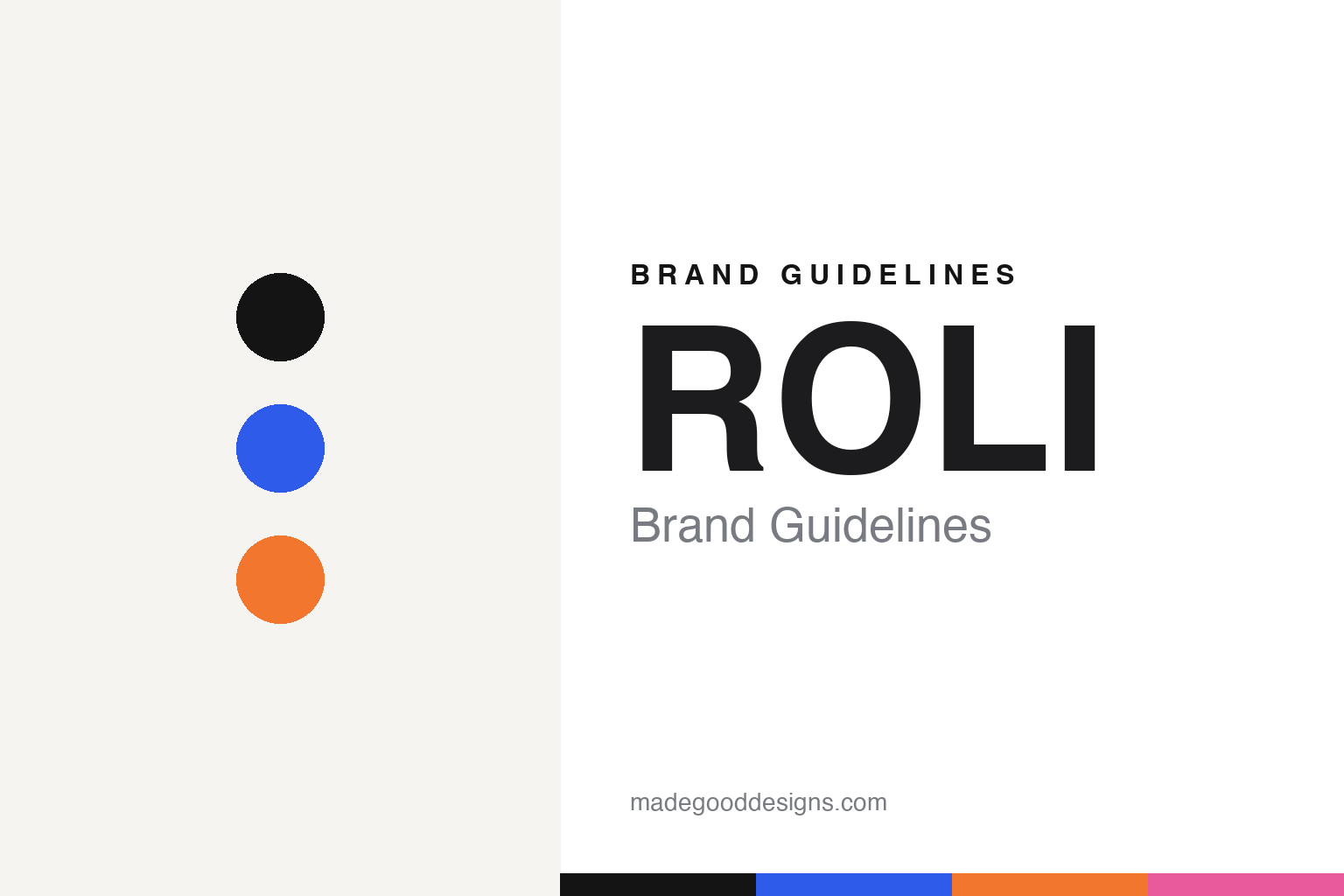
Two constants: a black ground with circle-of-fifths colour palette and a rounded geometric sans register. Abstract homage — not a ROLI product or mark; no instrument, logo or symbol is reproduced.
Lambde to ROLI
A jazz pianist at the Royal College of Art.
ROLI began in London in 2009. Its founder, Roland Lamb, is a jazz pianist who was studying on the Design Products course at the Royal College of Art, Dezeen reported in 2014; company materials later styled him co-founder. Companies House records show the company was incorporated in October 2009 as Lambde Ltd and renamed ROLI in May 2013.
The idea was to change the piano keyboard itself. “As a jazz pianist myself, I had always wished I could do more to shape a piano note’s pitch, timbre and continuous dynamics,” Lamb told Dezeen. The result was the Seaboard: in place of separate moving keys, a continuous surface of moulded silicone that ROLI calls the “keywave,” laid over pressure sensors, so a player can bend pitch by moving a finger sideways, deepen a note by pressing in, and shape the tone by sliding along the key.
The Seaboard Grand went on sale in September 2013, in 88-, 61- and 37-key versions with an onboard sound engine developed with the software house FXpansion, MusicRadar and New Atlas reported. In 2014 it won the product category of the Design Museum’s Designs of the Year, Dezeen reported.
Money followed. In May 2016 TechCrunch reported a $27 million Series B led by Foundry Group, with Founders Fund, and quoted Lamb saying staff had grown from about 20 to just under 100 since 2013. ROLI bought the JUCE audio-software framework in late 2014 and the music platform Blend in 2015, TechCrunch said, and later the plug-in maker FXpansion. In 2017 TechCrunch reported that Pharrell Williams had invested and joined as chief creative officer.
The range widened: the smaller Seaboard Rise in 2015; BLOCKS in 2016, a set of small magnetic controllers that, Sound On Sound noted, were sold through Apple Stores as well as music shops; and in 2019 LUMI, a light-up keyboard for beginners launched on Kickstarter, which TIME listed among its Best Inventions of that year.
Colour
Administration, then Luminary.
The growth was expensive. In the 18 months to June 2019 the company lost £34.1 million on revenue of £11.4 million, Engadget reported.
On 31 August 2021 the original ROLI company went into administration, according to Companies House. A new company, Luminary ROLI Ltd — set up in May 2021 and renamed that August — took on the intellectual property, the assets and about 70 staff, Engadget reported. Lamb led the new business, and MusicRadar, citing The Telegraph, reported that he had raised £5 million from Hoxton Ventures. “Our lead investor Hoxton Ventures was not prepared to fund Roli and wanted, rather, to invest in Luminary to drive forward the consumer opportunity,” Lamb said. The plan, he said, was to aim at beginners — “Peloton for piano.” The old company moved from administration to dissolution and was dissolved in December 2023.
The ROLI name carried on. The Seaboard Rise 2 arrived in 2022 and was listed by TIME among its Best Inventions of that year; the compact Seaboard M followed in November 2023 at $350, TechCrunch reported. In July 2024 the company folded LUMI into the ROLI brand, renaming LUMI Keys as ROLI Piano M and the LUMI app as ROLI Learn, its blog said.
Then came cameras. Airwave, launched in October 2024, uses infrared cameras above the keyboard to track the player’s hands and turn gestures into MIDI. At NAMM in January 2025 the company showed ROLI Piano, a 49-key light-up keyboard, TechCrunch and Sound On Sound reported; with Airwave and the Learn app it became the ROLI Piano System, which TIME named one of its Best Inventions of 2025.
In November 2025 ROLI bought Ultraleap, a hand-tracking company, for an undisclosed sum, and Ultraleap’s co-founder and chief executive Tom Carter joined as chief technology officer, Auganix reported.
Typography
Design and documentation.
A controller keyboard makes no sound of its own: it sends MIDI, the standard that lets instruments and computers talk to one another. Dave Smith demonstrated it at the Winter NAMM Show in 1983, and the specification was published that August, English Wikipedia says. A newer extension, MIDI Polyphonic Expression (MPE), which lets each note in a chord be shaped separately, was adopted by the MIDI Manufacturers Association in January 2018.
Two makers here share an owner. Akai Professional and M-Audio belong to inMusic, the private group in Cumberland, Rhode Island. Jack O’Donnell, its founder, bought Akai Professional in 2004 or 2005 — sources differ — and inMusic took over M-Audio, founded in 1988 as Midiman, from Avid in July 2012.
The others are smaller. Nektar Technology is “California-based,” Sound On Sound wrote in 2019; the company dates itself to 2009. Keith McMillen Instruments, of Berkeley, California, announced in September 2024 that it was rebranding as Muse Kinetics. ROLI, maker of the Seaboard, is London-based; after its original company entered administration in 2021, a new company took over the brand, English Wikipedia says.
Two are European. Expressive E calls itself a French company founded in 2013, and its legal notice gives a registered office in Marseille. Studiologic is a brand of Fatar, the keyboard-mechanism maker founded in Recanati, in Italy’s Marche, in 1956; Fatar says it has factories in Recanati and in Tunisia.
This guide sets out what can be checked about each brand — who founded it, who owns it, and what it says about where its products are made — and marks clearly what rests only on the company’s own word.
Aa
A rounded geometric sans — a lowercase wordmark beside a five-key symbol. (Specimen set in Manrope, a sans STAND-IN; NOT the ROLI logo.)
ROLI
Five keys and a circle of fifths.
The current look dates from October 2024, when the London agency DixonBaxi unveiled a rebrand after a six-month project, Creative Boom reported. It pairs a symbol based on five piano keys with a lowercase “roli” wordmark, and takes its colours from the circle of fifths: darker, more vivid tones for professional creators and lighter, playful ones for learners. The idea behind it was “Free the Music.” DixonBaxi’s senior designer Jas Welsh said the aim was a brand that “feels poetic, elegant, and premium – not like typical tech.” No official colour values or typefaces were published. ROLI’s own about page says: “Keyboards used to be black and white. With ROLI Piano and Seaboard, we added color and high definition.”
We found no statement of where ROLI’s hardware is made in the sources we checked.
The company’s future is uncertain. Companies House lists Hoxton Ventures’ third fund as holding between a quarter and a half of the shares. Lamb ceased to be a person with significant control in October 2025 and left the board in April 2026, according to filings. In July 2026 The Times reported that ROLI was fighting to avoid a second collapse; synth anatomy, citing The Times, reported that the lender TriplePoint had filed a notice of intention to appoint administrators, and that ROLI’s online shop was showing a maintenance notice with products out of stock. In early October 2026 Companies House still listed Luminary ROLI as active, with its accounts overdue and no insolvency case recorded.
For a design guide, ROLI shows how a brand can survive the company that built it — and how an identity can move from pro-studio black toward colour and learning. Compare Expressive E, another maker of expressive MPE instruments, and Native Instruments. For this guide we use black with circle-of-fifths blue, orange and pink, and a rounded sans, an unofficial interpretation; no product or logo is reproduced.
Explore & save
Keep ROLI’s identity on hand — save it to a board in the Made Good inspiration library.
ROLI identity set
Pin the ROLI black and circle-of-fifths palette and the rounded geometric sans register to your own board.