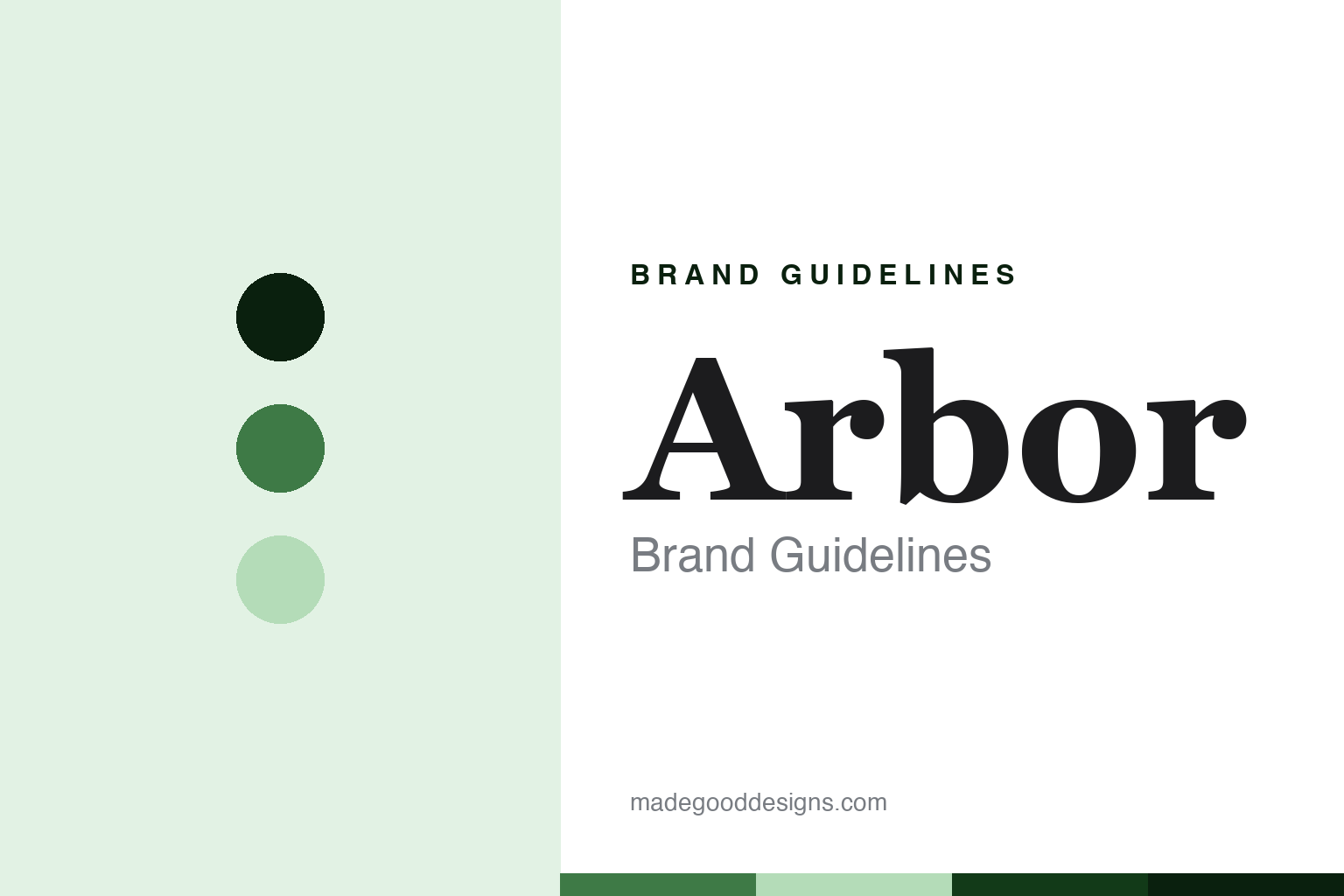
Arbor Brand Guidelines
The board grown from wood.
Aa
Two constants: a grove-green palette and a grain-serif register. Abstract homage — not an Arbor product or mark; no board, veneer or logo is reproduced.
The board grown from wood
Arbor is the independent Venice, California snowboard and skate brand built on sustainability, the first to skin a board with a real wood-veneer topsheet.
Arbor closes the snow round as its sustainability node — the independent Venice, California brand that built its whole identity around natural materials and the environment, and that was first to replace a snowboard’s plastic topsheet with real wood veneer. Its answer to a round about who owns the mountain’s gear and where it is made is a green one, told carefully: an independent, founder-led brand, its boards built in a solar-powered factory in the desert.
Its identity is the board grown from wood. The eco founding, the wood-veneer innovation and the solar-powered manufacturing are the story here. Grain, not plastic. The board grown from wood.
(Honest notes, so the founders, the making and the eco claims are framed accurately. Arbor sells snowboards, skateboards and apparel as its heroes — its wood-veneer boards among them; we report its language as the brand’s own. On origin: Arbor, the Arbor Collective, was founded in 1995 in Venice, California, by Bob Carlson and Chris Jensen, and it remains independent and privately held, with no parent company. On the innovation: Arbor is credited as the first traditional action-sports brand founded specifically around sustainability, and the first to replace a snowboard’s plastic topsheet with a responsibly sourced wood veneer, originally Hawaiian Koa. On where it is made: Arbor’s snowboards are built in Dubai, in the United Arab Emirates, at the SWS, or Sideways Sports, factory, which runs on solar energy — production moved there in 2013, having previously been in Austria; its skateboards and apparel are made elsewhere, which is not clearly documented, so we leave it undisclosed. On the eco claims, fairly: we frame Arbor’s environmental commitments as the brand’s own stated positions, crediting its documented Returning Roots programme and its work with a Hawaiian reforestation initiative, and we do not assert specific programme names or figures we cannot confirm. Its designs and the Arbor name are IP we describe but do not reproduce; there is no official brand hex; these tones are an unofficial interpretation.)
Colour
Arbor lives in a grove green. Click a swatch to copy the hex.
Arbor’s identity is independent, natural and sustainable — a grove green, an ink, a pale grove, a deep grove, and a paper. The palette leans grove green and pale grove: a natural, grounded register that nods to wood grain and living forests rather than a loud logo colour. It signals the board grown from wood — independent, natural and sustainable. The honest caveat: Arbor’s identity leans on real wood-grain aesthetics rather than a fixed colour, and with no official brand hex these green values are a natural, unofficial interpretation, not first-party colours.
The lesson is a grove green signals a natural, sustainable identity. Arbor’s world is a board made from wood, not plastic. For designers, it is a reminder that a grove green and a soft pale can carry a natural, eco-led brand — a grounded tone held as an accent, not a product shot. Because a mid hue can fail as small text, keep type dark and let the colour live in the accents, palette and band. The takeaways: credit Arbor for the wood-veneer topsheet; attribute the Venice founding and independent ownership; state the Dubai solar-powered making; and frame the eco claims as the brand’s own, without asserting unverified programme names.
Typography
The register is a grain serif — independent, natural, sustainable.
Arbor’s identity carries an independent, natural, sustainable spirit — a founder-led brand built on materials and the environment, not a conglomerate line. A grain serif captures the mood: warm, natural and considered, the register of a wood-made object. Set in a grove-green palette, the grain serif feels natural and grounded — exactly the personality Arbor carries. It behaves like a made, organic thing rather than a loud logo, mirroring a powder-gradient and a camber-curve. (Arbor’s real products and the name are things we describe but do not reproduce, and the exact typeface is not ours to use.) Because it is not ours to use, the honest description is “a grain-serif brand,” shown here in a stand-in. The type behaves like the brand: independent, natural and sustainable.
Aa
A grain-serif brand — natural and grounded. (Specimen set in Playfair Display, a grain-serif STAND-IN; NOT the Arbor logo or products.)
The snow node
Arbor stands for the board grown from wood.
Arbor closes the snow round as its sustainability node. A grove-green palette, a grain serif and an eco founding make one thing — the board grown from wood — the whole identity: independent, natural and sustainable. The wood-veneer innovation is the pitch, the environmental mission is the character, and the solar-powered making is the proof. The point is a founder-led brand built on sustainability, in a round about who owns the mountain’s gear and where it is made.
Put to work, the identity is the brand told straight, the making stated and the eco claims fairly framed. A brand in this spirit would credit Arbor for the wood-veneer topsheet, attribute the Venice founding and independent ownership, state the Dubai solar-powered making, and frame the eco claims as the brand’s own. A reader in this spirit would keep the facts right: Arbor sells wood-veneer snowboards, skateboards and apparel as its heroes; it is the Arbor Collective, founded in 1995 in Venice, California, by Bob Carlson and Chris Jensen, independent and privately held; it is credited as the first action-sports brand built on sustainability and the first to use a wood-veneer topsheet, originally Hawaiian Koa; its snowboards are built in Dubai at the solar-powered SWS factory, having moved there in 2013 from Austria; and its environmental commitments, including a documented Returning Roots programme and Hawaiian reforestation work, are its own stated positions. Arbor closes the round, after DPS. The honest editorial moves are to credit the innovation, to attribute the ownership, to state the making, and to frame the eco claims fairly.
For designers and brand-builders, Arbor closes the snow node: frame eco claims as the brand’s own — and verify a program before naming it. The lessons: a brand can build its whole identity on sustainability and materials, here wood in place of plastic; an independent founder ownership is credited plainly; a manufacturing story is stated where documented, a solar-powered factory in Dubai; and environmental claims are framed as the company’s own stated commitments, with a documented programme credited and unverified programme names left out rather than repeated. It is also a reminder to stay precise: Arbor is the independent, sustainability-built brand behind the wood-veneer board — with the palette here an unofficial interpretation. The hook is that material: while rivals topped boards with printed plastic, Arbor skinned its snowboards in real wood veneer and made the environment its founding purpose, pressing its boards in a solar-powered desert factory. Read that way, Arbor is less a single board than the board grown from wood: independent, natural, sustainable. The lesson for a brand is that framing the eco claims as the brand’s own and verifying a programme before naming it reinforce each other, and stating the making keeps the story earned. Arbor made the-board-grown-from-wood the identity — proof that an honest sustainability story can close a round.
Explore & save
Keep Arbor’s identity on hand — save it to a board in the Made Good inspiration library.
Arbor identity set
Pin the grove-green palette and the grain-serif register to your own board.


