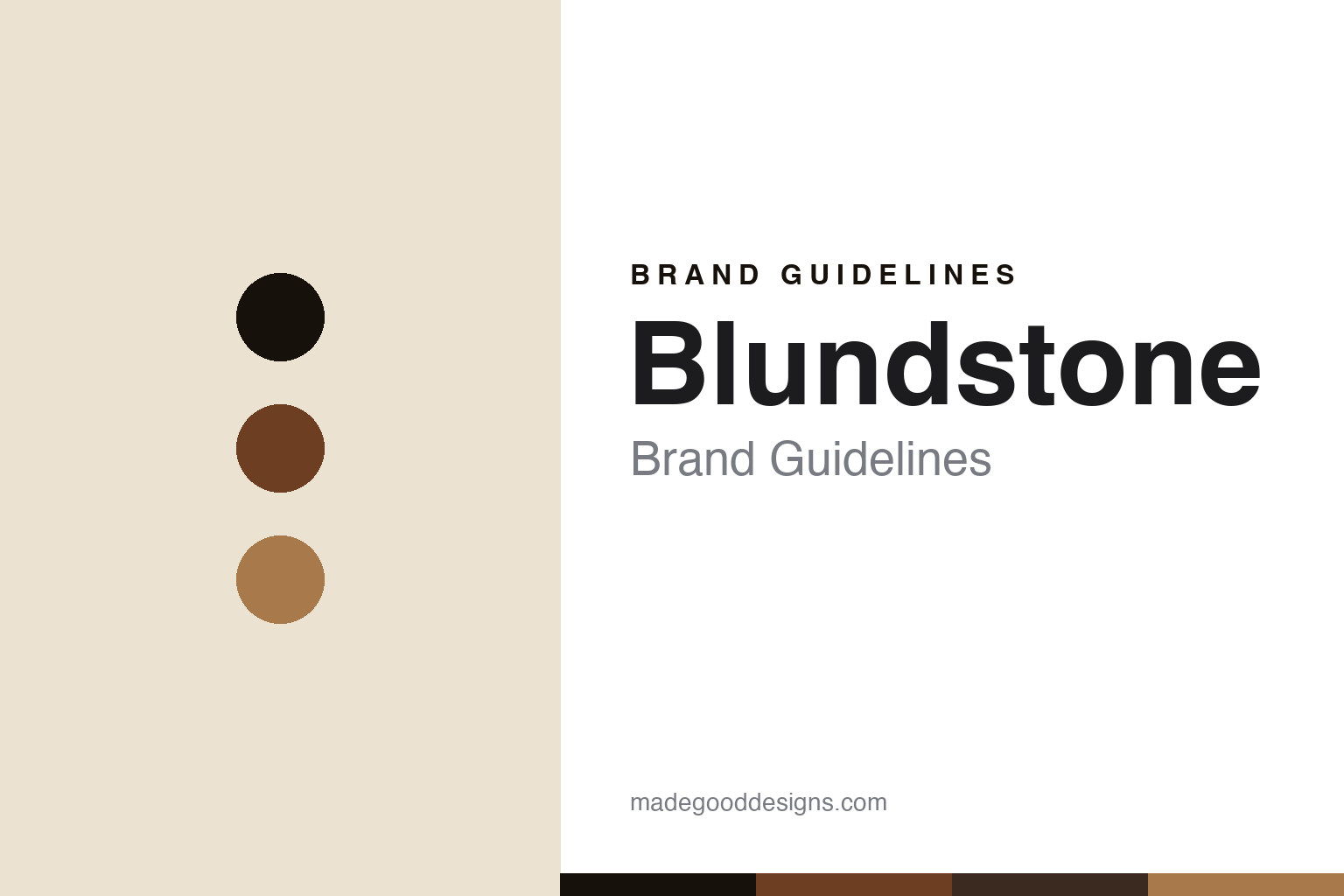
Blundstone Brand Guidelines
The 500.
Aa
Two constants: a rustic-brown-and-tan palette and a rugged grotesque register. Abstract homage — not the Blundstone footwear.
The 500
Blundstone made one elastic-sided boot into an icon.
Blundstone is a lesson in a silhouette as identity. Founded in 1870 in Hobart, Tasmania, by John Blundstone, it has been owned by the Cuthbertson family since 1932. It remains privately held — unusual in its category for staying independent.
Its identity is the elastic-sided, pull-on Chelsea boot — laceless, with twin elastic side gussets and front and back pull tabs. The archetype is the #500 Original, a rugged Australian workwear boot that crossed into fashion and gorpcore. The naming is a numeric system: 500 (the icon), 550 (the wider-fit Classics), 585 (a best-seller) — the leading digit signals the series, the rest the variant. Design is kept in-house in Hobart.
(Honest notes: the current owners are the Cuthbertson family, since 1932 — John Blundstone founded the brand in 1870 but isn’t the owning family, so don’t conflate them. And Blundstone moved manufacturing offshore (mainly Thailand and India) in 2007, closing the Hobart factory — so it’s an Australian brand, designed in Tasmania but made overseas, not “Australian-made.” There’s no official brand hex, so these tones are an unofficial interpretation.)
Colour
Blundstone lives in a rustic-brown-and-tan palette. Click a swatch to copy the hex.
Blundstone’s identity is rugged, honest and utilitarian — an ink, a rustic brown, a stout, a tan, and a sand. The palette pairs a rustic brown with a worn tan — the register of a workwear boot. It signals wear and utility rather than fashion. The honest caveat: with no published brand hex, these tones are an original, unofficial interpretation, not first-party values.
The lesson is a rustic brown with a worn tan signals a workwear boot. Blundstone’s world is a scuffed elastic-sided boot. For designers, it is a reminder that an earthy, worn palette reads as honest and rugged — right for a workwear icon. The takeaways: source the palette from the leather (brown, tan); keep it worn and utilitarian; let the silhouette lead (the Chelsea boot); and treat any single hex as unofficial.
Typography
The register is a rugged grotesque — sturdy, honest, utilitarian.
Blundstone’s identity carries a sturdy, honest, utilitarian spirit — a workwear boot and a numbered system. A rugged grotesque captures the mood: it is plain and hard-wearing, the register of a work tool. Set in a rustic-brown-and-tan palette, the rugged grotesque feels sturdy and honest — exactly the personality Blundstone carries. It is utilitarian rather than decorative, mirroring a pull-on boot. (Blundstone’s real footwear is work we describe but do not reproduce, and the exact typeface is not ours to use.) Because it is not ours to use, the honest description is “a rugged grotesque spirit,” shown here in a stand-in. The type behaves like the brand: sturdy, honest and utilitarian.
Aa
A rugged grotesque spirit — sturdy and honest. (Specimen set in Bricolage Grotesque, a rugged grotesque STAND-IN; NOT the Blundstone footwear.)
A silhouette as identity
Blundstone stands for one boot everyone knows.
Blundstone is a lesson in making a silhouette the identity. A rustic-brown-and-tan palette, a rugged grotesque and an elastic-sided boot make one shape the whole brand — sturdy, honest, iconic. The silhouette is the differentiator. The differentiator is a #500-Chelsea-boot identity.
For designers and brand-builders, Blundstone offers a clear takeaway: make one shape unmistakable. The lessons: perfect one silhouette (the elastic Chelsea boot); number it clearly (500, 550, 585); let it wear in (the worn-leather look); and be honest about the make. It is also a reminder to stay accurate: the Cuthbertsons have owned it since 1932, manufacturing moved offshore in 2007, and the palette here is an unofficial interpretation. Blundstone made a silhouette the brand — proof that one shape can be the difference.
Explore & save
Keep Blundstone’s identity on hand — save it to a board in the Made Good inspiration library.
Blundstone identity set
Pin the rustic-brown-and-tan palette and the rugged-grotesque register to your own board.