C&C Drums Brand Guidelines
The vintage-drum restorer who started making his own.
Aa
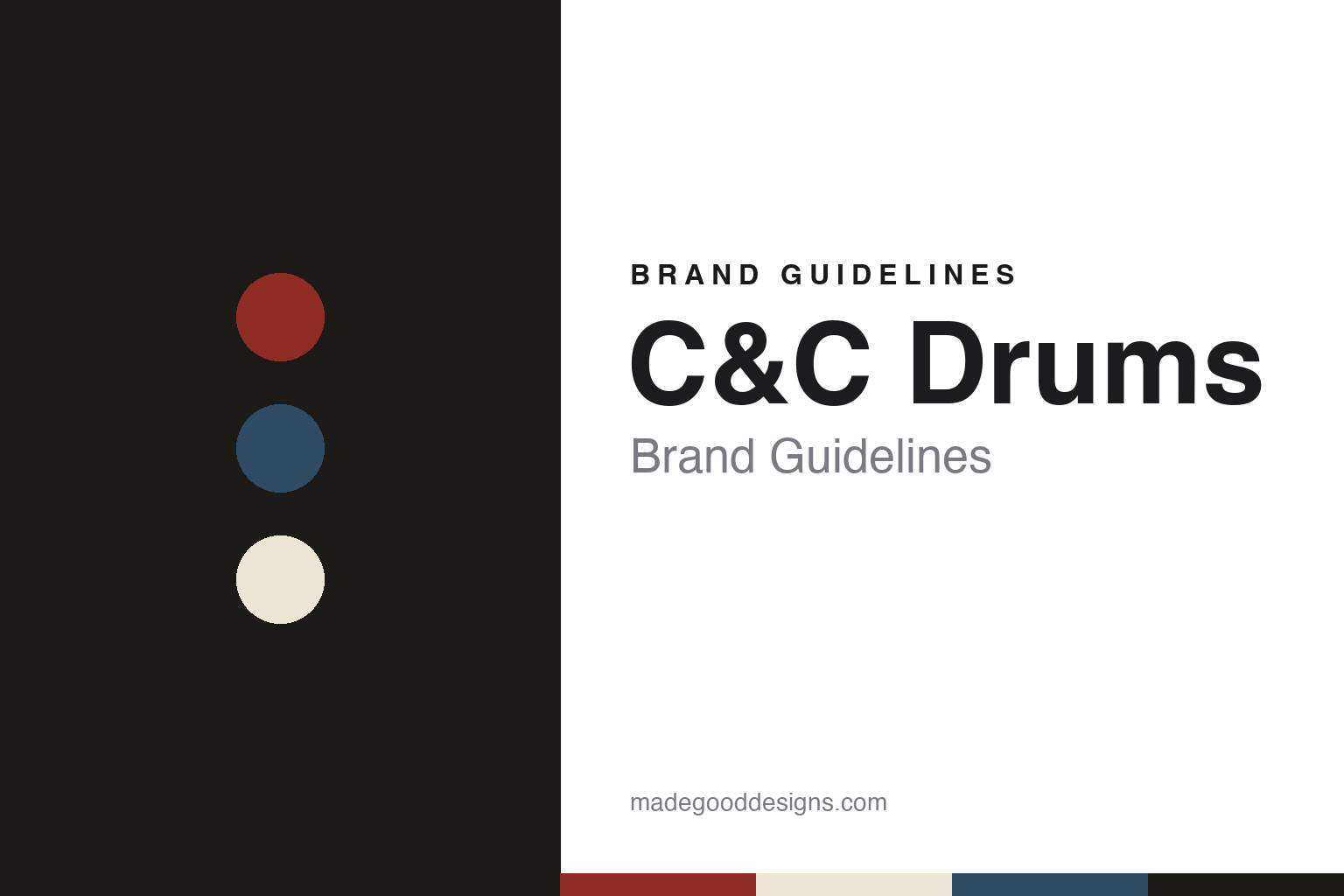
Two constants: a C&C ox red, marine pearl and bison blue palette and a Deco geometric sans register. Abstract homage — not a C&C product or mark; no drum, lug, badge or logo is reproduced.
The New Vintage
A vintage-drum restorer near Kansas City.
C&C Drums is a custom drum maker in Gladstone, Missouri, a city on the north side of the Kansas City area. It was started by Bill Cardwell, a collector and restorer of vintage drums, and the company dates its move into drum building to 1989. Its own account, published on its website in 2005, begins in Arkansas, where a young Cardwell spent a summer picking cotton to buy a Ludwig Acrolite snare drum after seeing the Beatles on The Ed Sullivan Show. From there, the site said, came a passion for the classic drums of Ludwig, Slingerland, Camco, Rogers and Gretsch.
Restoring those drums stayed a hobby, the company says, until Carl Palmer, the drummer of Emerson, Lake & Palmer, asked Cardwell in 1989 to build him a kit with gold-plated hardware. Cardwell recalled on that 2005 page that he simply said yes, and that the job let him put his hands-on knowledge of old drums into a new maple kit with a classic look and sound. Other drummers soon asked for kits of their own; one of the first was Ryan Pope of the Get Up Kids.
By 2010 the website said that manufacturing had “started in the back of C&C Drum Shop, a retail boutique specializing in used and vintage drums,” and that Cardwell had built the company with his son Jacob. After Palmer’s kit, it said, came kits for touring drummers in the Kansas City and Lawrence area, and early players included Scott Minor of Sparklehorse, Kliph Scurlock of the Flaming Lips, Jeremiah Green of Modest Mouse and Derek Grant of Alkaline Trio. Its slogan then was “The New Vintage.”
Colour
Gladstone shells and a Deco lug.
The move from customising to manufacturing came in steps. In July 2008 the company wrote on its website that it was “gearing up for the start of drum shell manufacturing in Gladstone, MO”; its FAQ now says it has made its own shells in its factory since the summer of 2010. It calls them Gladstone Shells. Its European distributor sums up the idea as “less glue, more wood”: thicker plies that, it says, give a lower fundamental note and a warmer sound.
The hardware followed. The C&C Deco lug, made in single- and double-ended versions, is die-cast steel plated in chrome, and the company says its design was “inspired by the architecture of Kansas City.” Bearing edges are cut and sanded by hand, and the company names its edge profiles after places and eras: an Oaklawn edge, described as “Bill’s rendition of the edge cut in Oaklawn, Illinois in the 1960s”; a Los Angeles edge modelled on the 1970s; a Full Contact edge it traces to Brooklyn in the 1960s; and its own Bread & Butter edge.
The first series built on its own shells was the Player Date, developed with the session drummer Joey Waronker. Modern Drummer reported in 2012 that its shells were made of seven plies of luan mahogany, a wood more often found in cheap drums. “We’re in the midst of changing the connotation that luan is just meant for cheap drums,” Jake Cardwell told the magazine, which listed a Big Beat set in lacquer at $1,745 with a matching snare. Today the company lists Player Date I as a 7-ply mahogany drum and Player Date II as maple, mahogany and maple. Its other lines are the Gladstone, in 7-ply North American rock maple; 12th & Vine, with 5-ply shells around a poplar core; Maple Gum; and the Super Flyer, a light travel kit whose drums nest inside one another, painted in satin colours such as Ox Red, Bison Blue and Sea Foam Green.
Typography
Heritage and the American drum.
These seven brands fall into two camps: old American names that have passed through several owners, and small workshops that build drums by hand. Rogers began in 1849 as a drumhead maker in New York state; DRUM! Magazine reported in 2018 that the name is owned by Reliance Musical, a Taiwanese manufacturer, with drums finished in California. Slingerland, founded by H. H. Slingerland in 1912, according to English Wikipedia, was bought from Gibson by Drum Workshop in 2019, and its website says DW is now part of Roland.
Leedy, started in Indianapolis in 1897 by Ulysses G. Leedy, passed to C. G. Conn and then Slingerland; English Wikipedia says Gretsch has held the trademark since 1986 and the brand has lain largely dormant. Noble & Cooley is the exception among the old names: founded in Granville, Massachusetts, in 1854, its team page now lists Nick Jones, a seventh-generation Cooley descendant, and John Keane as owners, its site says it is part of York Creative Collective, and it says its drums are handcrafted in the USA.
The boutique makers are younger. Craviotto, founded by the drummer Johnny Craviotto, says it has made one-ply solid-shell drums since 2004 and now handcrafts them in Nashville. C&C, founded by Bill Cardwell, builds drums at its shop in Gladstone, Missouri, and says it has made its own shells since 2010.
Sakae is the outlier: an Osaka maker established in 1925 that, DRUM! reported, built Yamaha’s top-tier drums for 40 years. It suspended business in 2018, Kyodo reported; DRUM! later reported that Korg had bought the trademark, and the name now appears on drums sold as Sakae Osaka Heritage.
This guide sets out what can be checked about each brand — who founded it, who owns it, and what it says about where its products are made — and marks clearly what rests only on the company’s own word.
Aa
A geometric sans with a Deco accent — after lugs drawn from Kansas City architecture. (Specimen set in Josefin Sans, a sans STAND-IN; NOT the C&C logo.)
C&C Drums
U.S. made, sold through specialists.
Outside reviewers have been warm. In April 2008 MusicRadar tested a custom kit belonging to Owen Hopkins of the Crimea — eight-ply rock-maple toms, a ten-ply 22-inch bass drum and a brass snare — and concluded that while C&C “might be a new name to the UK,” it was already familiar to “players-in-the-know in the US,” naming Johnny Craviotto, “for whom Bill Cardwell has finished drums,” and Ringo Starr. Its only complaint was the price. C&C’s European distributor lists later reviews of the Player Date in Rhythm and the German magazine Drums & Percussion, among others, and Modern Drummer covered the Maple Gum kit in 2017 and 2021.
C&C makes a point of where its drums are made. Its website calls them “U.S. Made, Handcrafted” and says they are built by musicians at its shop in Gladstone, contrasting them with drums “manufactured overseas and only assembled in the U.S.”; we give that as the company’s claim. The site names Bill Cardwell as founder and owner. C&C sells through a small group of drum shops in the United States, Canada, Australia and Japan and through C&C Drums Europe in Cologne, and it now also takes orders directly. Its artist pages list drummers including Jon Wurster, Ian Chang and Jason Tait.
For a design guide, C&C shows how a small maker can build an identity out of borrowed history — vintage edges, Deco hardware and the names of its own town and city. Compare Ludwig, whose Acrolite snare was Cardwell’s first drum, the company says, and DW Drums, another American maker built around custom orders. For this guide we use ox red, marine-pearl cream, bison blue and chrome grey with a geometric sans, an unofficial interpretation; no product or logo is reproduced.
Explore & save
Keep C&C Drums’s identity on hand — save it to a board in the Made Good inspiration library.
C&C Drums identity set
Pin the C&C ox red, marine pearl and bison blue palette and the Deco geometric sans register to your own board.