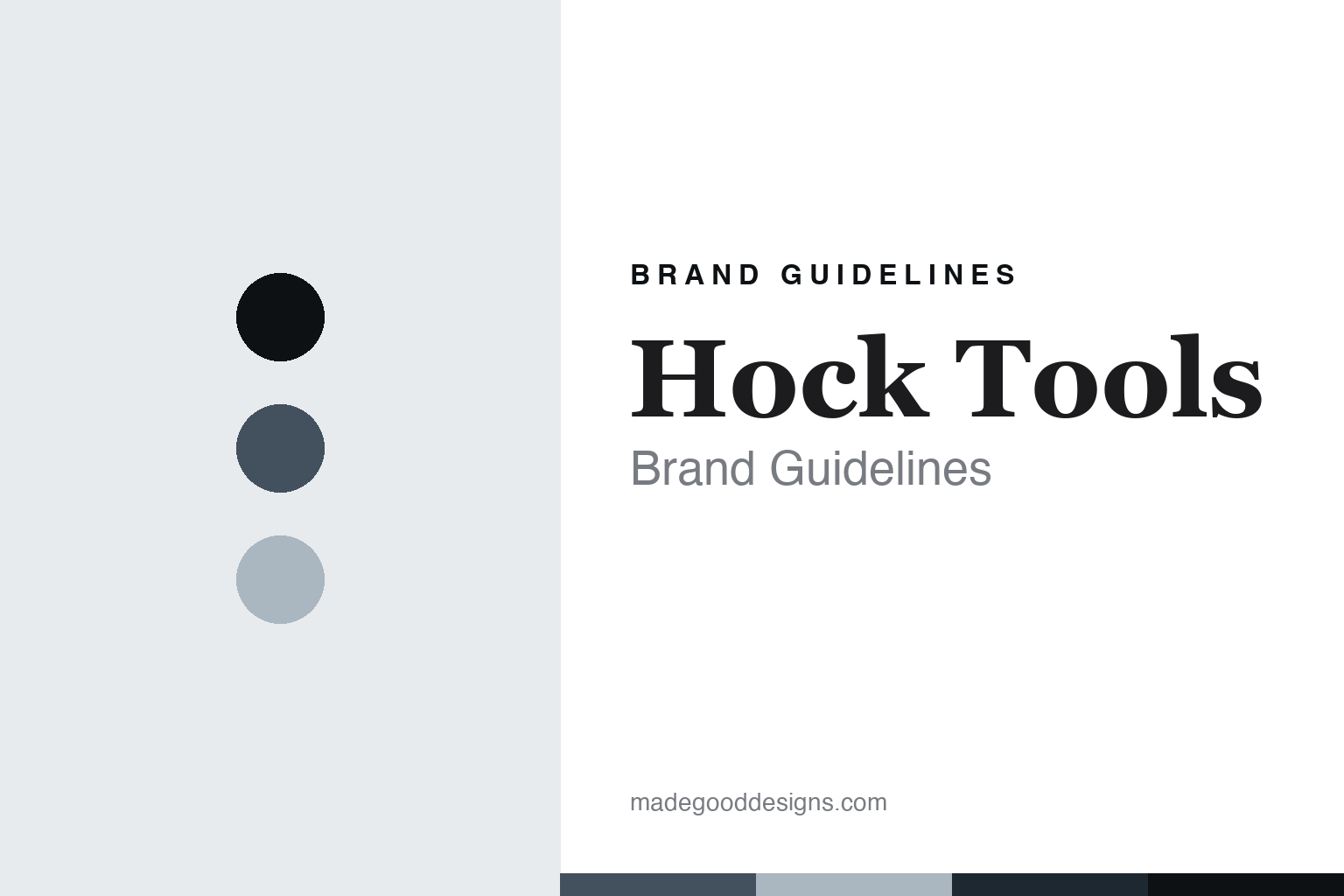
Hock Tools Brand Guidelines
The blade inside the plane.
Aa
Two constants: a blued-steel palette and a blade-serif register. Abstract homage — not a Hock blade or mark.
The blade inside the plane
Hock Tools is the American maker of premium plane irons and blade steel, founded by Ron Hock in Fort Bragg in 1981 and now owned by Lee Valley.
Hock Tools opens the round — the component makers — with the part that does the cutting. It makes premium plane irons and blade steel: bench and block plane blades, chip breakers, spokeshave and scraper blades, knife blanks and plane kits — the edge that goes inside other people’s planes. Its answer to how a maker becomes a name is the blade itself: make a better, thicker iron that upgrades the plane it drops into. An American blade, made to a standard.
Its identity is the blade inside the plane. Hock’s plane irons, its O1 and A2 blade steel and its upgrade-any-plane role are the work it is known for. A blade, not a whole tool. The edge behind many other makers’ planes.
(Honest notes, so the story stays precise, and the ownership needs care. Hock Tools was founded, by Ron Hock’s own account, in 1981 in Fort Bragg, California, when staff and students at James Krenov’s woodworking program convinced him to re-tool from knives to plane irons. On what it makes, plane and block blades, chip breakers, spokeshave and scraper blades, knives, knife blanks and plane kits — not chisels, which it never made. On its steel, it offers O1, a simple high-carbon oil-quenched tool steel taken to about Rockwell 62 for the sharpest edge, and A2, an air-quenched steel with chromium for better edge retention, which it describes as cryogenically treated at very low temperature for added toughness. On where it is made — a theme of this round — the honest answer is a split: some blades are made in the Fort Bragg shop with a black-oxide finish, while a large share are made at a family-owned precision factory in France; so we say made in Fort Bragg and France, not blanket made in the USA. On ownership — the honest heart of this entry — Hock Tools is no longer Ron Hock’s independent business: it was acquired by Lee Valley Tools, the Canadian company behind Veritas, and its site now redirects to Lee Valley; Ron Hock’s current role we could not confirm, so we do not assert it. Post-acquisition manufacturing location we also could not confirm. Its book, The Perfect Edge, is about sharpening. Its name and marks are IP, described but never reproduced, and there is no official brand hex; these tones are an unofficial interpretation. This is design commentary and does not promote any product.)
Colour
Hock Tools lives in a blued-steel palette. Click a swatch to copy the hex.
Hock’s identity is edged, American and made — a blued steel, an ink, a frost, a deep steel, and a paper. The palette leans blued steel and frost: the register of a tool-steel blade and a honed edge. It signals the cutting part. The honest caveat: with no published brand hex, these values are an original, unofficial interpretation, not first-party colours.
The lesson is a blued-steel palette signals a blade-maker identity. Hock’s world is an edged, steel object. For designers, it is a reminder that a cool blued steel and a soft frost can carry a maker of blades — the blue-black of tool steel and the neutral of a honed bevel. Because these tones can fail as small text, keep type dark and let the colour live in the accents, palette and band. The takeaways: make the cutting part; make it well; be honest about where; and treat any single hex as unofficial.
Typography
The register is a blade serif — fine, classical, made.
Hock’s identity carries a fine, classical, made spirit — a craft blade-maker, not a mass brand. A blade serif captures the mood: refined, considered and traditional, the register of a Krenov-school edge. Set in a blued-steel palette, the blade serif feels fine and made — exactly the personality Hock carries. It is the cutting part rather than a logo, mirroring a plane iron. (Hock’s real wordmark and debossed blade stamp are things we describe but do not reproduce, and the exact typeface is not ours to use.) Because it is not ours to use, the honest description is “a blade-serif spirit,” shown here in a stand-in. The type behaves like the blade: fine, classical and made.
Aa
A blade-serif spirit — fine and made. (Specimen set in Cormorant Garamond, a serif STAND-IN; NOT the Hock Tools logo or blade stamp.)
The component makers
Hock Tools stands for the blade that upgrades the plane it enters.
Hock Tools opens the round with the component that matters most: the cutting edge. A blued-steel palette, a blade serif and a plane iron make one thing — the blade inside the plane — the whole identity: edged, American and made. The plane irons are the differentiator, and the upgrade-any-plane role is the meaning. The point is a maker of the blade itself, thick and well-treated enough that it improves whatever plane it drops into.
Put to work, the identity is a component, honestly told, as design. A maker in this spirit would make the cutting part, choose its steel with care, and be honest about where — O1 and cryo-A2 irons, made in Fort Bragg and France. A brand learning from it would see that owning the essential part is a durable identity — that the blade a woodworker fits to upgrade a plane carries an importance the plane body takes for granted — and that being precise, founded 1981 by Ron Hock, now owned by Lee Valley, keeps the story honest. Hock opens the component makers on the round’s two hardest threads at once. The first is ownership: like several makers in this round, Hock is no longer independent — it was bought by Lee Valley, the very Canadian company whose Veritas tools opened this whole vein, so the edge-maker now sits inside a tool giant. The second is where-made: Hock is the honest extreme, a US-founded maker whose blades are split between Fort Bragg and a factory in France, so a blanket made-in-USA would be false. The discipline is in the caveats: not asserting Ron Hock’s current role, not claiming a single country of make, and correcting the book to a sharpening title. The lesson Hock teaches is that a component can hold an identity: the blade gives it substance, and the honesty about owner and origin keeps it credible. The edge is the personality, and the well-made iron is the proof.
For designers and brand-builders, Hock opens the component makers, from the United States: own the essential part, and be honest about owner and origin. The lessons: make the cutting part; treat the steel right; state a split origin plainly; don’t assert a role you cannot confirm; and never reproduce a logo. It is also a reminder to stay precise: Hock Tools is the American maker of premium plane irons and blade steel, founded by Ron Hock in Fort Bragg in 1981 and now owned by Lee Valley — with the palette here an unofficial interpretation. Hock made the blade the identity — proof that the edge inside the plane, honestly told, can be the difference.
Explore & save
Keep Hock Tools’s identity on hand — save it to a board in the Made Good inspiration library.
Hock Tools identity set
Pin the blued-steel palette and the blade-serif register to your own board.