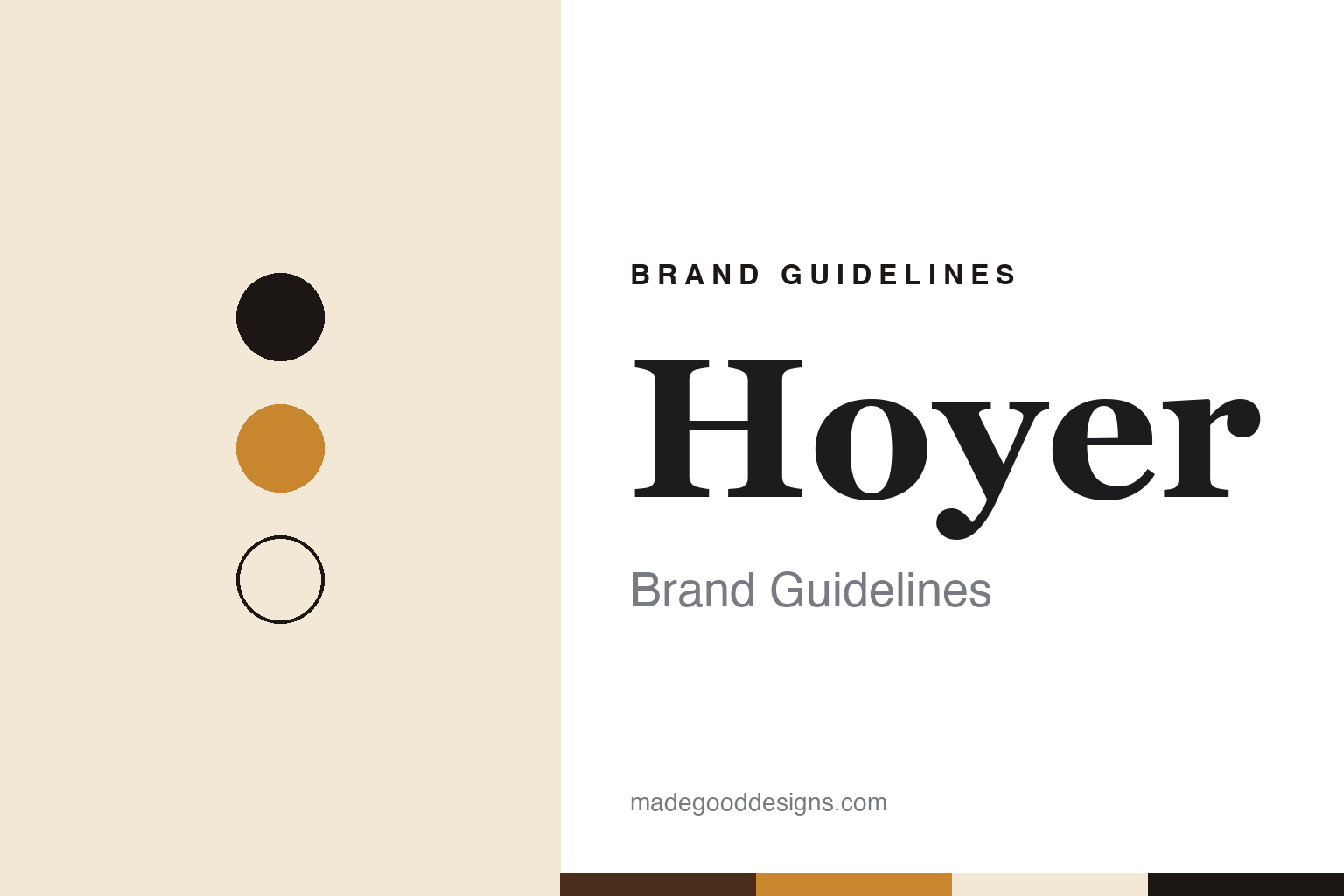
Hoyer Brand Guidelines
The Schönbach archtop name, rebuilt in Franconia, closed in 1987 and revived.
Aa
Two constants: a Hoyer tobacco, amber and cream palette and an archtop serif register. Abstract homage — not a Hoyer product or mark; no instrument, logo or nameplate is reproduced.
From Schönbach to Tennenlohe
A Bohemian instrument family, a war and two US Army trucks.
Hoyer gives 1874 as its founding year, and both English and German Wikipedia repeat it: in that year, they say, Franz Hoyer was making instruments in Schönbach, a music town in the Egerland that is now Luby in the Czech Republic. The company’s own history, written by the family historian Dr. Christian Hoyer and published on its website in 2026, is more careful. It traces the business to the violin maker Johann Josef Hoyer (1815–1876), who founded an instrument and string trade in Schönbach in 1838, and it calls 1874 the year his son Franz (1842–1878) added guitars to the range. The date was first put forward in 1949, the history says, when Arnold Hoyer marked “75 years” of the firm.
The guitar line passed to Franz’s son Josef Hoyer (1870–1956), who opened his own workshop for zithers and guitars in 1894 and won medals at regional shows in 1896, 1897 and 1913, according to the company. His son Arnold Hoyer (1905–1967) trained with him, ran a workshop in Cologne in the late 1930s and returned to Schönbach during the Second World War. In June 1945, the history says, Arnold had his whole workshop, from tonewood to finished guitars, loaded onto two US Army trucks and moved to Tennenlohe near Erlangen in Bavaria, where he was making instruments again by August in the dance hall of an inn. Other expelled Schönbach makers settled in the same district: Framus was founded in Erlangen in 1946, and from 1949 an instrument-makers’ settlement grew at Bubenreuth. Arnold Hoyer stayed in Tennenlohe, the company says.
Colour
Archtops, a folding guitar and a long revival.
Arnold Hoyer built his name on archtop guitars. His 1948 catalogue, which the company calls one of the first in the trade after the war, offered the “Solist” and the “Herr im Frack” (“gentleman in tails”), and a 1949 advertisement called Hoyer “Die führende Gitarre Deutschlands,” Germany’s leading guitar. Later models included the Spezial, the Bianka and the Fantastik, and the company dates its first solid-body electrics to 1961. Hoyers also reached young players: in his 2008 book Guitar Gods, Bob Gulla wrote that Eric Clapton was given an inexpensive steel-string Hoyer for his thirteenth birthday and found it hard to play at first.
After Arnold Hoyer’s death in 1967, his son Walter Hoyer took over and moved the firm toward western and electric guitars. The oddest result was the Foldaxe, an electric guitar with a folding neck, invented by the British industrial designer Roger C. Field, who first had one built for Chet Atkins, German Wikipedia says; Hoyer’s timeline dates its own version to 1977. The company’s two published histories differ on what happened next. The 2009 version said Walter Hoyer left the firm in 1977 and that new owners carried on, with the luthier Walter Krahl, making through-neck models such as the Black Lady and the Eagle; the 2026 version says the firm filed for bankruptcy in 1976 and kept producing at the Thalermühle in Erlangen. Gitarre & Bass wrote in 2015 that reliable information on old Hoyers is thin and often contradictory, and that the late models adapted Gibson and Fender designs without being mere copies. On one point all sources agree: production stopped in 1987.
The name outlived the factory. A German wholesaler revived it in the 1990s, the 2009 company site said, and in 2005 Michael Compernass, whose Hoyer Guitars e.K. was based in Dorsten, according to German Wikipedia, bought the trademark and sold German-made models. In 2009 the British firm Creative Bags and Cases Ltd, run by Martin Ritter, the founder of an instrument-bag brand, agreed to buy the name. The website advertised a “Made in Europe” acoustic range of ukuleles and classical guitars in 2017. Today it says HOYER is a registered trademark of Ritter Pte Ltd, Singapore, and that the brand will launch globally in 2027.
Typography
Heritage as an asset.
Two names came west after the Second World War from Schönbach in Bohemia, now Luby in the Czech Republic. Höfner was founded there by Karl Höfner in 1887 and now works in Baiersdorf in Franconia, where GEWA music took over its business on 1 April 2026 after an insolvency, with the brands held by a Thomann and GEWA holding company. Hoyer, founded in Schönbach by Franz Hoyer in 1874, was re-established at Tennenlohe near Erlangen in 1945 and stopped making guitars in 1987, German Wikipedia says; its website now announces a relaunch in 2027.
Hanika is a Baiersdorf neighbour. Helmut Hanika started his own firm in 1953, making archtop guitars, and later moved to classical guitars, from 1965 by the company’s account and in the 1970s by German Wikipedia’s; the business now belongs to his son Armin, and the company says its instruments are made mostly by hand.
Three are workshops founded by their makers. Lakewood, started in 1986 by Martin Seeliger, builds steel-string guitars at Buseck near Gießen; it says they are built in Germany. Teuffel is Ulrich Teuffel’s company in Neu-Ulm, founded in 1988, he says, and he builds the guitars himself. Marleaux is Gerald Marleaux’s bass workshop at Clausthal-Zellerfeld in the Harz, working since 1990, whose Consat Custom bass won a German musical instrument prize in 2017.
GEWA music is the odd one out, an instrument and accessory company rather than a single workshop: founded at Adorf in the Vogtland by Georg Walther in 1925, it spent five decades in Mittenwald before returning to Adorf, and says it makes products at German, European and Asian sites.
This guide sets out what can be checked about each brand — who founded it, who owns it, and what it says about where its products are made — and marks clearly what rests only on the company’s own word.
Aa
An archtop-era serif — a name built on 1950s catalogues. (Specimen set in Fraunces, a serif STAND-IN; NOT the Hoyer logo.)
Hoyer
A brand that is now mostly its own history.
Hoyer is unusual among guitar brands because, for most of the time since 1987, its main asset has been its past. The current website is built as a museum: a timeline running from the first violin maker recorded in the region in 1631 to the relaunch, with price lists, labels, letterheads and catalogue covers from the family’s collection. Those documents show how the identity was carried. Josef Hoyer printed his own catalogues in the 1890s and ran a four-language advertisement in 1897, the history says. Arnold Hoyer printed his name in script on his labels and set the 1949 slogan in a flowing hand under bold capitals. The 1953 price list carried a laurel badge for “75 Jahre 1874–1949.”
The company has not published brand colours or a typeface for any period, so we read them from the instruments instead. The archtops that made the name were finished in brown-to-amber sunbursts with cream binding over spruce tops, and our palette follows that: tobacco, amber, spruce, cream and ebony. The later electrics, in clear polyester and natural wood, belong to a different chapter of the story, and the revival has yet to show its own look.
For a design guide, Hoyer shows how a family workshop can turn its paperwork into a brand once the factory has gone. Compare Framus, another postwar maker from Schönbach that was later revived, and Schaller, the Bavarian hardware maker that supplied Hoyer and other German guitar firms. For this guide we use tobacco, amber and cream with a serif, an unofficial interpretation; no product or logo is reproduced.
Explore & save
Keep Hoyer’s identity on hand — save it to a board in the Made Good inspiration library.
Hoyer identity set
Pin the Hoyer tobacco, amber and cream palette and the archtop serif register to your own board.