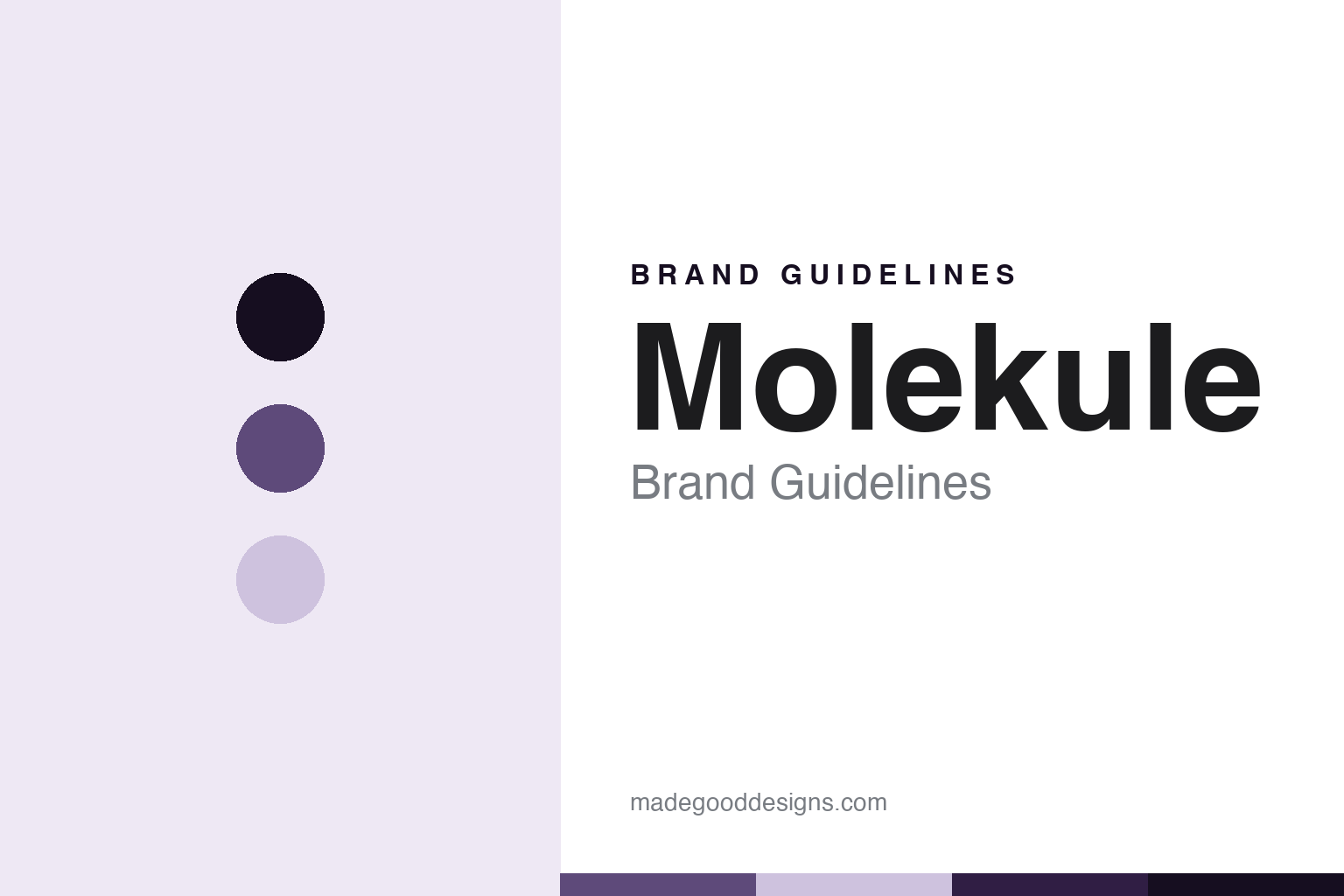
Molekule Brand Guidelines
Form that outran its proof.
Aa
Two constants: a contested-violet palette and a design-sans register. Abstract homage — not a Molekule product or mark; no purifier, cylinder, leather strap or logo is reproduced.
Form that outran its proof
Molekule is the design-award-winning purifier whose “destroy pollutants” claims were called unsupported, and which went through bankruptcy into creditor ownership.
Molekule brings the clean-air round its cautionary node — a beautiful object with a bold promise that regulators and independent testers found unproven, a startup that won the object and lost the argument. It was founded in 2014, originally as Transformair, by Dilip Goswami and Jaya Rao, around technology their father, a university professor, had developed. Molekule sold the purifiers, and its answer to a round about where clean-air machines are made and who owns them now includes a bankruptcy: a design-led disruptor, reorganised under its creditors, whose central claims did not hold up.
Its identity is form that outran its proof. The award-winning design, the contested efficacy claims and the bankruptcy-to-creditor-ownership are the story here. A purifier, over-promised. Form that outran its proof.
(Honest notes, because this is a troubled brand and the disputes are the story, not a thing to bury. Molekule sold purifiers as its heroes — its Air and Air Mini and later models, built on a technology it called PECO, which it claimed destroys pollutants rather than merely trapping them, in a cylindrical aluminium body with a leather strap that earned genuine design and innovation recognition — and we report that history factually. On efficacy, the point that carries the node, reported without softening: a self-regulatory advertising body recommended Molekule discontinue about two dozen advertising claims as unsupported after a competitor complaint; independent testers, including Consumer Reports and Wirecutter, rated it very poorly; a false-advertising class action led to a multi-million-dollar settlement; and it settled an ozone-emissions matter with a California regulator. We frame this as advertising-claims scrutiny from a self-regulatory body, lawsuits and a state regulator — not as a federal-trade-commission action, which we did not find. On ownership: a pre-existing merger formed a public company, which filed for Chapter 11 bankruptcy in 2023 and emerged in 2024 as a private, creditor-owned company that still sells; we do not imply it is the same thriving startup, nor that its claims were vindicated. On where it is made: it once touted US assembly at a Florida plant, but the current footprint is not clearly documented, so we do not blanket-claim made in the USA. Its designs, the Molekule and PECO names and the cylinder-and-strap form are IP we describe but do not reproduce; there is no official brand hex; these tones are an unofficial interpretation.)
Colour
Molekule lives in a contested violet. Click a swatch to copy the hex.
Molekule’s identity is design-led, bold and contested — a contested violet, an ink, a pale lilac, a deep aubergine, and a paper. The palette leans contested violet and pale lilac: a stylish, slightly uneasy register that suits a beautiful object with a disputed promise rather than a loud logo colour. It signals form that outran its proof — designed, ambitious and unproven. The honest caveat: with no published brand hex, these values are an original, unofficial interpretation, not first-party colours.
The lesson is a contested violet signals a design-led, cautionary identity. Molekule’s world was a gorgeous cylinder with a claim that did not hold. For designers, it is a reminder that a stylish contested violet and a soft pale lilac can carry the memory of a brand — a cautionary tone held as colour, not a product shot. Because these tones can fail as small text, keep type dark and let the colour live in the accents, palette and band. The takeaways: date it to 2014; name the bankruptcy and creditor ownership; report the efficacy disputes factually; keep it distinct from an FTC action; and treat any single hex as unofficial.
Typography
The register is a design sans — stylish, bold, cautionary.
Molekule’s identity carries a stylish, bold, cautionary spirit — a design disruptor whose story turned. A design sans captures the mood: clean, modern and confident, the register of a beautiful object whose promise outran its proof. Set in a contested-violet palette, the design sans feels stylish and cautionary — exactly the personality Molekule carries in memory. It behaves like a designed object rather than a loud logo, mirroring anodised aluminium and a leather handle. (Molekule’s real purifiers, the PECO name and the cylinder-and-strap form are things we describe but do not reproduce, and the exact typeface is not ours to use.) Because it is not ours to use, the honest description is “a design-sans brand,” shown here in a stand-in. The type behaves like the brand: stylish, bold and cautionary.
Aa
A design-sans brand — stylish and cautionary. (Specimen set in Manrope, a design-sans STAND-IN; NOT the Molekule logo or any purifier.)
The clean air
Molekule stands for form that outran its proof.
Molekule brings the round its cautionary node. A contested-violet palette, a design sans and a 2014 founding make one thing — form that outran its proof — the whole identity: design-led, bold and contested. The award-winning design is the pitch, and the contested claims are the reckoning. The point is a beautiful object whose promise regulators and testers found unproven, in a round about who owns what and how honestly a claim is made.
Put to work, the identity is the brand told straight, disputes reported factually and ownership named. A maker in this spirit would date it to 2014, name the bankruptcy and creditor ownership, and report the efficacy disputes factually. A reader in this spirit would keep the facts right: Molekule sold purifiers as its heroes, led by the Air and Air Mini on its PECO technology; it was founded in 2014 by Dilip Goswami and Jaya Rao; its marquee claims were found unsupported by a self-regulatory body, independent testers and a class action; and it filed for Chapter 11 in 2023 and emerged in 2024 as a private, creditor-owned company that still sells. Molekule sits fifth in the round, after Austin Air. The honest editorial moves are to date it to 2014, to report the disputes without softening, to keep them distinct from an FTC action, and to name the bankruptcy and creditor ownership.
For designers and brand-builders, Molekule continues the clean air: report a troubled brand honestly — beautiful design cannot stand in for proof. The lessons: never let form substitute for evidence; report contested claims factually and to the right regulator; distinguish a reorganised company from the original startup; keep a design legacy separate from a claim that failed; and never reproduce a logo. It is also a reminder to stay precise: Molekule is the design-award-winning purifier whose “destroy pollutants” claims were called unsupported, and which went through bankruptcy into creditor ownership — with the palette here an unofficial interpretation. The hook is that lesson: Molekule is the design world’s cautionary tale of form outrunning proof — a leather-handled aluminium cylinder gorgeous enough for a best-inventions list, built on a promise to destroy pollutants rather than trap them that regulators and independent testers called unproven — a startup that won the object and lost the argument. Read that way, Molekule is less a purifier than a warning: stylish, bold, cautionary. The lesson for a brand is that design and honesty must travel together, and reporting the disputes straight keeps the story earned. Molekule made form-that-outran-its-proof the identity — proof that even a cautionary tale carries a round.
Explore & save
Keep Molekule’s identity on hand — save it to a board in the Made Good inspiration library.
Molekule identity set
Pin the contested-violet palette and the design-sans register to your own board.