ASUS ROG Ally Brand Guidelines
The PC giant’s Windows handheld.
Aa
Two constants: a gunmetal-steel palette and a gamer-sans register. Abstract homage — not an ASUS or ROG product or mark; no console, screen or logo is reproduced, and the ROG red-and-black is deliberately not used.
The PC giant’s Windows handheld
The ASUS ROG Ally is the Taiwanese PC giant’s Windows handheld, the open-platform challenger to the Steam Deck.
The ASUS ROG Ally brings the handheld round its PC-giant node — the response of a huge, established computer company to Valve’s Steam Deck. It is made by ASUS, the publicly listed Taiwanese electronics giant, under its Republic of Gamers, or ROG, gaming sub-brand, and it launched in 2023. ASUS makes and sells the hardware, and its answer to a round about where handhelds are made and who owns them is direct: a listed Taiwanese company, made in China.
Its identity is the PC giant’s Windows handheld. The ASUS engineering heritage, the ROG gaming sub-brand and the open Windows platform are the story here. A device, challenging. The PC giant’s Windows handheld.
(Honest notes, so the ownership, the software and the newer models are framed accurately. ASUS sells the hardware as its hero — the ROG Ally, and the 2024 ROG Ally X refresh — and we report its language as the brand’s own. On ownership: ASUS was founded in 1989 in Taipei, Taiwan, by former Acer engineers, and is listed on the Taiwan Stock Exchange; ROG is its gaming sub-brand, launched in 2006, spanning motherboards, graphics cards, laptops, monitors, phones and more, so the Ally is one product within a large family. On the software: the ROG Ally runs Windows 11, not SteamOS, which is its key difference from the Steam Deck — it can run Steam, Epic, Xbox Game Pass and more. On the newest model: there is a genuine ROG Xbox Ally, co-developed by ASUS and Microsoft and launched in 2025, dual-branded ROG and Xbox, and we keep it distinct from the 2023 Ally and 2024 Ally X. On where it is made: China, framed softly since origin can vary by production run. Its designs, the ASUS and ROG names, the ROG “Fearless Eye” logo, the red-and-black livery and the Xbox mark are IP we describe but do not reproduce; there is no official brand hex; these tones are an unofficial interpretation.)
Colour
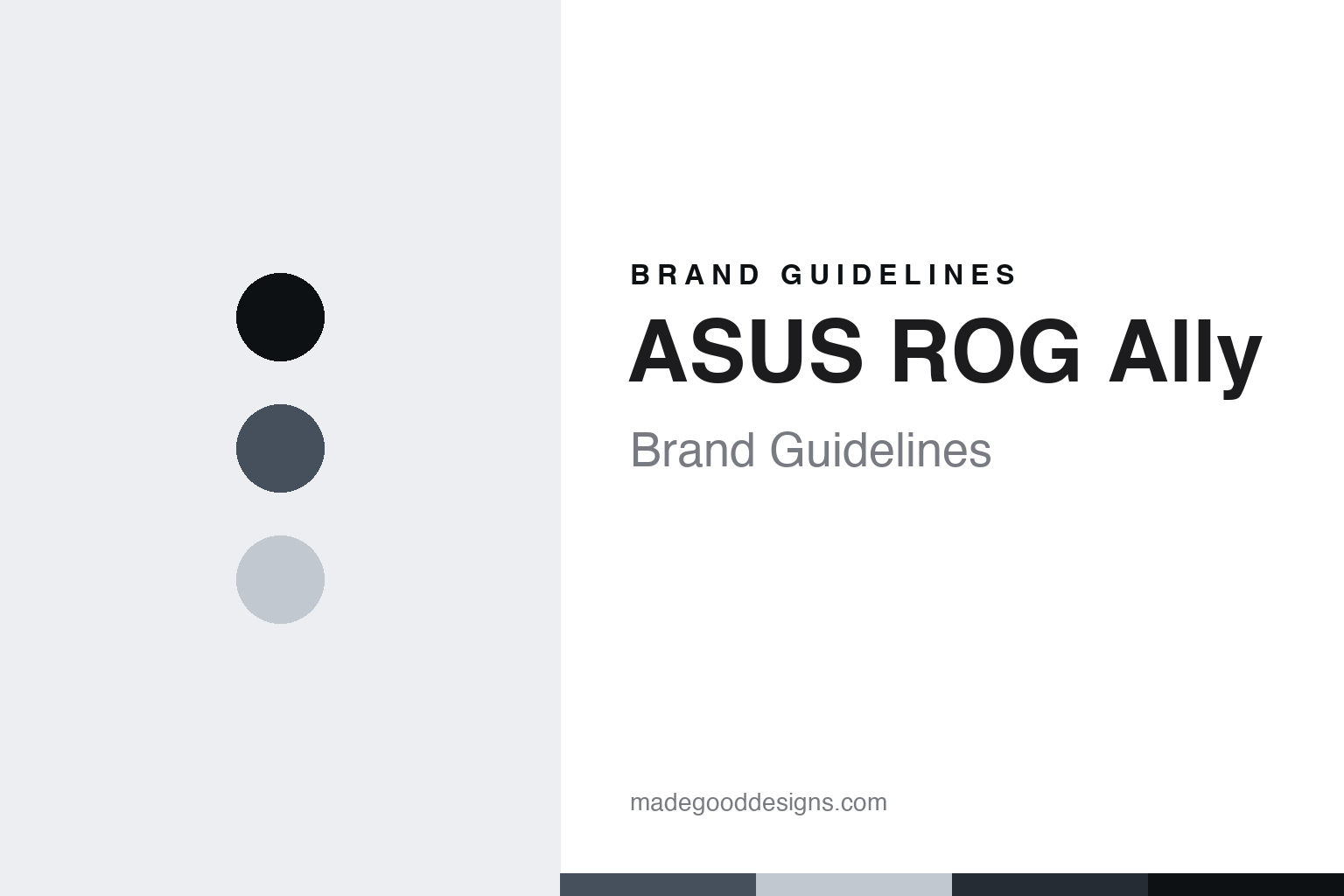
The ASUS ROG Ally lives in a gunmetal steel. Click a swatch to copy the hex.
The ROG Ally’s identity is engineered, open and challenging — a gunmetal steel, an ink, a pale steel, a deep slate, and a paper. The palette leans gunmetal steel and pale steel: a cool, engineered register that nods to PC hardware rather than a loud logo colour, and deliberately not to ROG’s own red-and-black. It signals the PC giant’s Windows handheld — engineered, open and built by a computer company. The honest caveat: with no published brand hex, and with the ROG red-and-black treated as trade dress, these values are an original, unofficial interpretation, not first-party colours.
The lesson is a gunmetal steel signals an engineered, challenging identity. The ROG Ally’s world is a Windows PC engineered into the hands. For designers, it is a reminder that a cool gunmetal steel and a soft pale steel can carry a hardware brand — an engineered tone held as colour, never the signature red-and-black. Because these tones can fail as small text, keep type dark and let the colour live in the accents, palette and band. The takeaways: name ASUS as the listed Taiwanese parent; date the Ally to 2023; lead with Windows as the difference; keep the 2025 Xbox Ally distinct; and treat the red-and-black as trade dress.
Typography
The register is a gamer sans — engineered, open, challenging.
The ROG Ally’s identity carries an engineered, open, challenging spirit — a PC company’s handheld, not a boutique. A gamer sans captures the mood: clean, sharp and confident, the register of a big computer maker moving into a new form. Set in a gunmetal-steel palette, the gamer sans feels engineered and open — exactly the personality the ROG Ally carries. It behaves like a made, engineered thing rather than a loud logo, mirroring a circuit board and a heat sink. (The real ROG Ally hardware, the ROG name and the red-and-black are things we describe but do not reproduce, and the exact typeface is not ours to use.) Because it is not ours to use, the honest description is “a gamer-sans brand,” shown here in a stand-in. The type behaves like the brand: engineered, open and challenging.
Aa
A gamer-sans brand — engineered and open. (Specimen set in Archivo, a gamer-sans STAND-IN; NOT the ROG logo or its red-and-black livery.)
The handheld
The ASUS ROG Ally stands for the PC giant’s Windows handheld.
The ASUS ROG Ally brings the round its PC-giant node. A gunmetal-steel palette, a gamer sans and a 2023 launch make one thing — the PC giant’s Windows handheld — the whole identity: engineered, open and challenging. The ASUS engineering heritage is the pitch, and the open Windows platform is the proof. The point is a huge computer company answering the Steam Deck on its own terms, in a round about where these machines are made and who owns them.
Put to work, the identity is the brand told straight, ownership named and models kept distinct. A maker in this spirit would name ASUS as the listed Taiwanese parent, date the Ally to 2023, and lead with Windows as the difference. A reader in this spirit would keep the facts right: ASUS sells the ROG Ally and Ally X as its heroes; ASUS is a Taiwanese company founded in 1989 and listed on the Taiwan Stock Exchange; ROG is its gaming sub-brand from 2006; the Ally runs Windows 11; it is made in China; and there is a separate 2025 ROG Xbox Ally co-developed with Microsoft. The ROG Ally sits second in the round, after the Steam Deck. The honest editorial moves are to name ASUS, to date the Ally to 2023, to lead with Windows, to keep the Xbox Ally distinct, and to treat the red-and-black as a mark.
For designers and brand-builders, the ROG Ally continues the handheld: let a PC giant’s engineering be the identity — and name the parent, lead with the platform, and keep the models straight. The lessons: answer a category-igniter with your own engineering scale; make an open platform the differentiator against a closed one; name a listed parent and its sub-brand; keep a co-branded partner device distinct from the base line; and never reproduce a logo or a signature colour. It is also a reminder to stay precise: the ASUS ROG Ally is the Taiwanese PC giant’s Windows handheld, the open-platform challenger to the Steam Deck — with the palette here an unofficial interpretation. The hook is that answer: when Valve’s Linux handheld caught fire, ASUS — a company that already builds the motherboards, laptops and graphics cards PC gaming runs on — put full Windows in a handheld so it could run every store at once, and turned its ROG engineering loose on the form. Read that way, the ROG Ally is less a new idea than a giant’s reply: engineered, open, challenging. The lesson for a brand is that engineering scale and an open platform reinforce each other, and naming the parent keeps the story earned. The ROG Ally made the-PC-giant’s-Windows-handheld the identity — proof that a giant’s reply carries a round.
Explore & save
Keep ASUS ROG Ally’s identity on hand — save it to a board in the Made Good inspiration library.
ASUS ROG Ally identity set
Pin the gunmetal-steel palette and the gamer-sans register to your own board.