Steam Deck Brand Guidelines
The handheld that reignited PC gaming.
Aa
Two constants: a steel-navy palette and a SteamOS-sans register. Abstract homage — not a Steam Deck product or mark; no console, screen or logo is reproduced.
The handheld that reignited PC gaming
The Steam Deck is Valve’s SteamOS handheld that reignited the PC-handheld category and tied it to the dominant PC game store.
The Steam Deck opens the handheld round as its category-igniter node — the device that took the idea of a handheld gaming PC and made it mainstream. It is made by Valve, the privately held American company behind the Steam store, and it launched in 2022. Valve makes and sells the hardware, and its answer to a round about where handhelds are made and who owns them is direct: designed by a private US company, with its chip fabbed in Taiwan and final assembly in China.
Its identity is the handheld that reignited PC gaming. The SteamOS software, the tie to the Steam store and the category revival are the story here. A device, igniting. The handheld that reignited PC gaming.
(Honest notes, so the “first” claim, the ownership and the software are framed accurately. Valve sells the hardware as its hero — the Steam Deck, in its original LCD form and the 2023 OLED refresh, which is a mid-cycle update, not a “Steam Deck 2” — and we report its language as the brand’s own. On the category claim, an important hedge: the Steam Deck did not invent the handheld gaming PC, since earlier Windows handhelds existed, so it is credited with reigniting and mainstreaming the category, not creating it. On the software: it runs SteamOS, a Linux-based system, not Windows, which is a genuine point of difference from its rivals. On ownership: Valve was founded in 1996 by Gabe Newell and Mike Harrington and is privately held, headquartered in Bellevue, Washington. On the store tie: the Deck exists to run games from Steam, Valve’s own storefront, which holds the large majority of PC game sales. On where it is made: it is designed in the US, its custom chip is fabricated in Taiwan, and final assembly is in China. On traps: Valve’s games and its Index VR headset are separate from the Deck hardware. Its designs, the Steam and Valve names and their logos are IP we describe but do not reproduce; there is no official brand hex; these tones are an unofficial interpretation.)
Colour
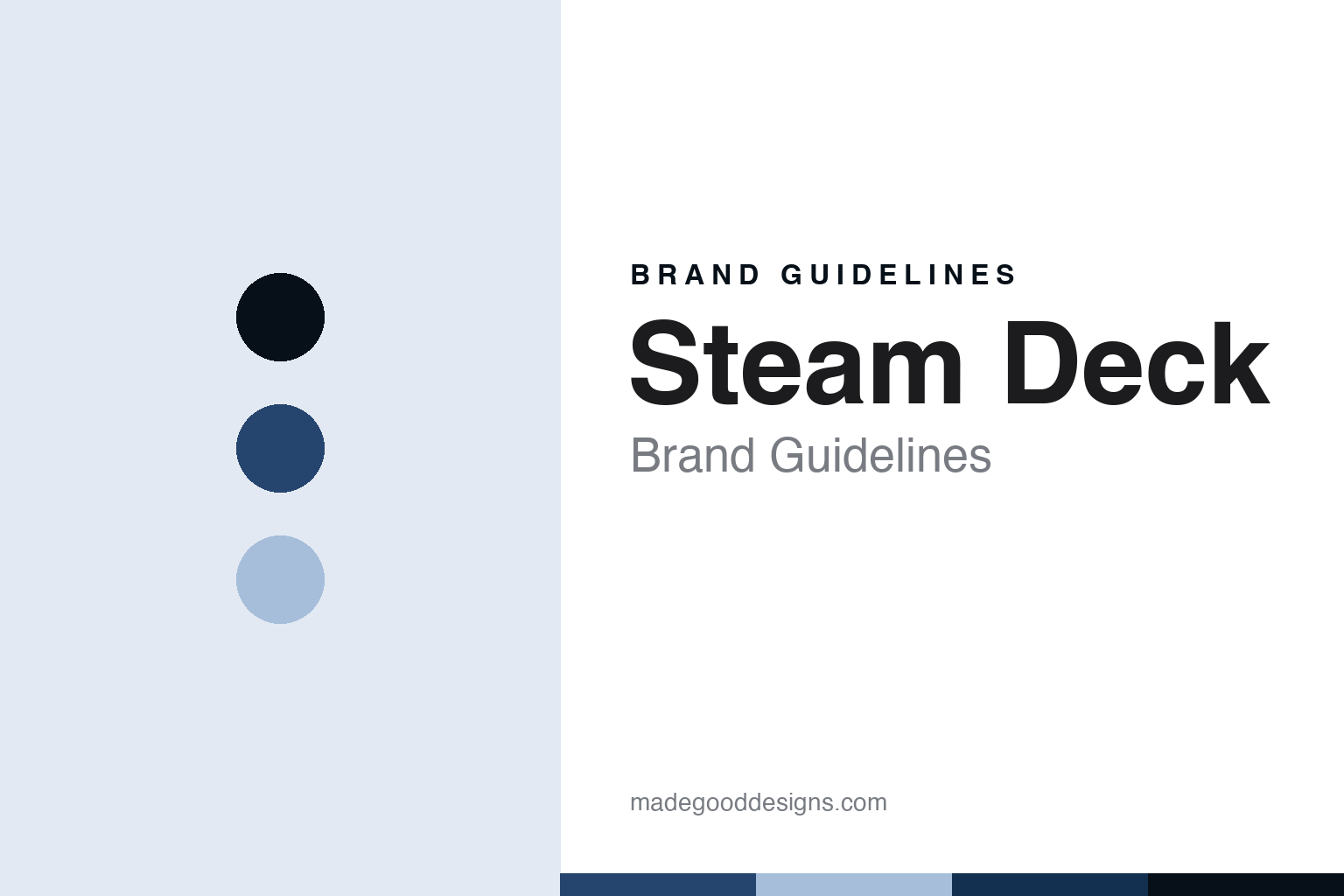
The Steam Deck lives in a steel navy. Click a swatch to copy the hex.
The Steam Deck’s identity is igniting, software-led and open — a steel navy, an ink, a pale sky, a deep marine, and a paper. The palette leans steel navy and pale sky: a cool, technical register that nods to a Linux system and a games library rather than a loud logo colour. It signals the handheld that reignited PC gaming — technical, open and category-defining. The honest caveat: with no published brand hex, these values are an original, unofficial interpretation, not first-party colours.
The lesson is a steel navy signals an igniting, software-led identity. The Steam Deck’s world is a PC library in the hands, running on Linux. For designers, it is a reminder that a cool steel navy and a soft pale sky can carry a hardware brand — a technical tone held as colour, not a product shot. Because these tones can fail as small text, keep type dark and let the colour live in the accents, palette and band. The takeaways: date it to 2022; hedge “reignited” not “invented”; name SteamOS as Linux; place assembly in China with the chip from Taiwan; and treat any single hex as unofficial.
Typography
The register is a SteamOS sans — technical, open, category-defining.
The Steam Deck’s identity carries a technical, open, category-defining spirit — a software company’s hardware, not a toy. A SteamOS sans captures the mood: clean, exact and confident, the register of a Linux system running a huge games library. Set in a steel-navy palette, the SteamOS sans feels technical and open — exactly the personality the Steam Deck carries. It behaves like a made, engineered thing rather than a loud logo, mirroring a circuit board and a pixel grid. (The real Deck hardware, the Steam name and the logos are things we describe but do not reproduce, and the exact typeface is not ours to use.) Because it is not ours to use, the honest description is “a SteamOS-sans brand,” shown here in a stand-in. The type behaves like the brand: technical, open and category-defining.
Aa
A SteamOS-sans brand — technical and open. (Specimen set in Space Grotesk, a SteamOS-sans STAND-IN; NOT the Steam Deck logo or any product.)
The handheld
The Steam Deck stands for the handheld that reignited PC gaming.
The Steam Deck opens the handheld round as its category-igniter node. A steel-navy palette, a SteamOS sans and a 2022 launch make one thing — the handheld that reignited PC gaming — the whole identity: igniting, software-led and open. The SteamOS software is the pitch, and the Steam store tie is the proof. The point is the device that made the handheld gaming PC mainstream, in a round about where these machines are made and who owns them.
Put to work, the identity is the brand told straight, the claim hedged and the software named. A maker in this spirit would date it to 2022, hedge “reignited” rather than “invented,” and name SteamOS as Linux. A reader in this spirit would keep the facts right: Valve sells the Steam Deck as its hero, in LCD and OLED forms; it is a private US company founded in 1996; the Deck runs SteamOS, a Linux system; it is designed in the US, its chip is fabbed in Taiwan and it is assembled in China; and it exists to run the Steam store. The Steam Deck opens the round, before the ROG Ally. The honest editorial moves are to date it to 2022, to hedge the category claim, to name SteamOS, to place manufacturing across the US, Taiwan and China, and to keep Valve’s games and VR separate.
For designers and brand-builders, the Steam Deck opens the handheld: reignite a category and own the software — and be honest you revived it rather than invented it. The lessons: mainstream a category others merely started; tie hardware to a platform you already own; hedge a “first” that is really a revival; describe a software difference precisely; and never reproduce a logo. It is also a reminder to stay precise: the Steam Deck is Valve’s SteamOS handheld that reignited the PC-handheld category and tied it to the dominant PC game store — with the palette here an unofficial interpretation. The hook is that revival: earlier Windows handhelds existed and went nowhere, and then Valve — the company that owns where PC gamers already buy their games — built a Linux handheld that put that whole library in your hands, and the category finally caught fire. Read that way, the Steam Deck is less a console than a store made portable: technical, open, category-defining. The lesson for a brand is that owning the platform and honest framing reinforce each other, and hedging the claim keeps the story earned. The Steam Deck made the-handheld-that-reignited-PC-gaming the identity — proof that a revival can open a round.
Explore & save
Keep Steam Deck’s identity on hand — save it to a board in the Made Good inspiration library.
Steam Deck identity set
Pin the steel-navy palette and the SteamOS-sans register to your own board.