Freeman Brand Guidelines
Buck Freeman’s 1927 Des Moines decorating firm, now in Dallas.
Aa
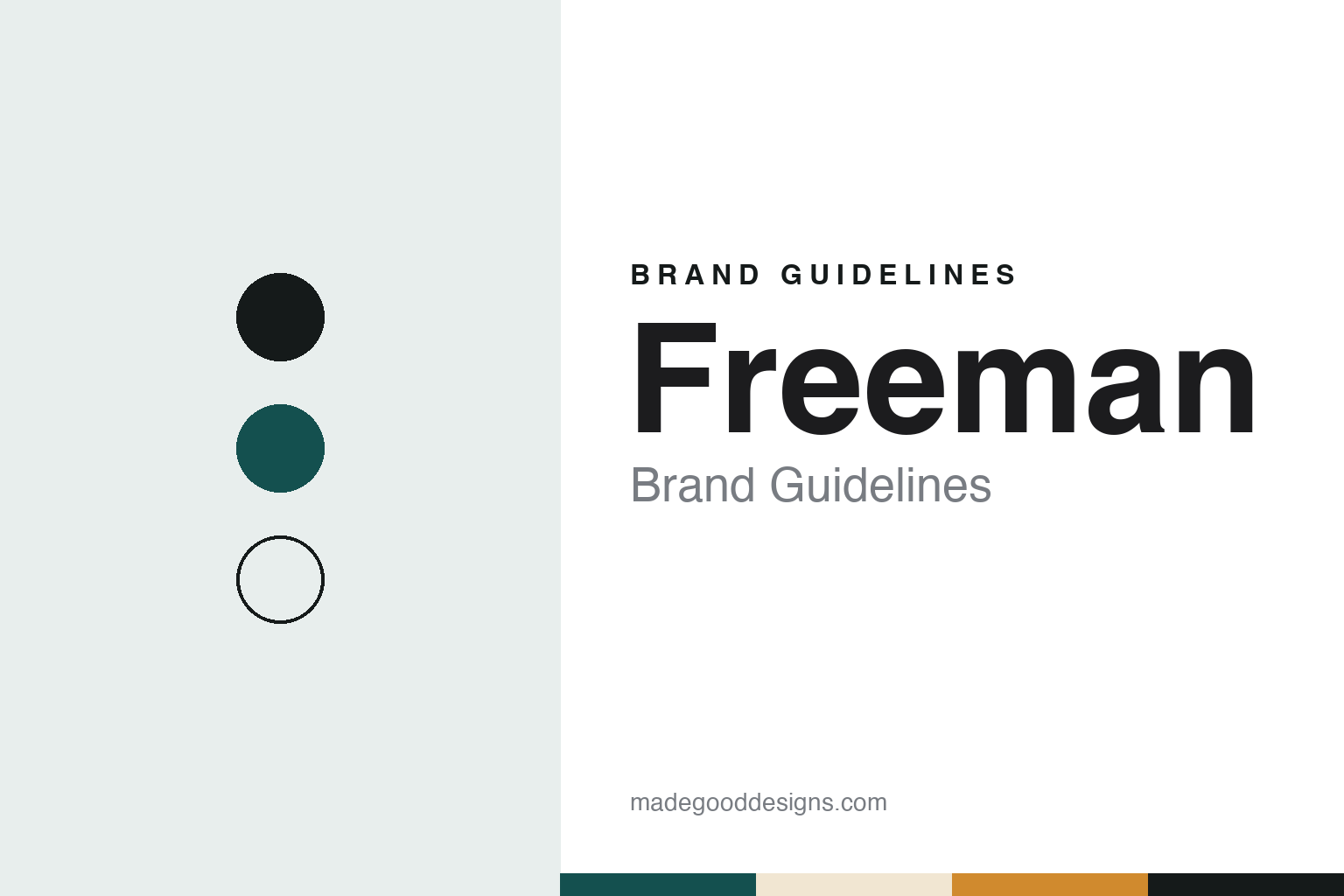
Two constants: a teal, amber and canvas palette and a grotesque sans register. Abstract homage — not a Freeman asset; no logo, booth or event photograph is reproduced.
Freeman Decorating
Fraternity parties, then a decorating office in Des Moines.
Freeman traces itself to a student’s sideline. The company says Donald S. “Buck” Freeman found his interest in party decorating and parades while pledging a national fraternity at the University of Iowa. A profile in Family Business Magazine, dated 2 June 2014, says he first opened a business called the New Idea Service Company in 1923, and in 1927 established the first Freeman Decorating Company office in Des Moines, Iowa.
The company counts its history from 1927. Its chief executive, Janet Dell, told the trade magazine Trade Show Executive in an interview published on 3 February 2025 that Buck Freeman turned his interest into Freeman Decorating Company that year, and that the firm grew from a small, family-run decorating company into a large business in live events. In a 2023 statement quoted by the Dallas news site Dallas Innovates, the company spoke of its 96-year history.
Freeman’s own timeline shows the business adding services around that decorating work one by one. It says freight and rigging became core services in 1961, a division for exhibit construction and management followed in 1966, and in 1975 the company moved into sound and visual production.
The move to Texas is dated in two ways. Freeman’s website says it opened a Dallas office in 1950 to serve the State Fair of Texas and that the office quickly became its headquarters. The 2014 Family Business Magazine profile instead says the headquarters was relocated to Dallas in 1974, so the two dates are given here side by side.
Colour
From hall dressing to full-service events.
Freeman works mostly behind the names of other people’s shows. Dallas Innovates described it in 2023 as a design and production company for corporate events, exhibit programs, expositions and conventions, and its website offers separate services for conferences and trade shows, for exhibitors and for AV production, with a page where exhibitors find their show and place orders. Trade Show Executive described its present range in 2025 as including AV production, strategy and show planning, and on-site services at shows.
The company’s timeline marks the steps. It says its reach was nationwide across the United States by 1981, its first Canadian division opened in 1988, and in 1995 it began offering exhibitors an online ordering system. A rigging division for complex, theatre-style staging followed in 2000, full electrical services in 2002, and creative and strategy services for brands at events in 2007. Freeman says it opened offices in the United Kingdom in 2013 and expanded into China and Singapore in 2015, along with acquisitions in data and digital services that year.
The largest recent step was a purchase. On 1 August 2023 Dallas Innovates reported that Freeman had acquired Sparks, a Philadelphia brand-experience agency founded in 1919 that designs exhibits and events for corporate clients. The deal’s terms were not disclosed. Sparks was to be combined with Freeman’s agency business, which works for corporate clients, while Freeman kept its long relationships with show organisers. Bob Priest-Heck was then chief executive.
Freeman also publishes research on the industry. Janet Dell told Trade Show Executive that its Freeman Trends Report gathers findings from attendees, exhibitors and organisers through the year. The company says that in 2020 it launched a coalition called Go LIVE Together, which led to the formation of the Exhibitions and Conference Alliance, and that in 2021 it signed the Net Zero Carbon Events pledge.
Typography
Design and documentation.
Exhibition and trade-fair organisers sell two things at once: the shows themselves and the places that hold them. Their corporate websites reflect that split. GL events, for example, divides its group page into Live, Venues and Exhibitions, while Easyfairs gives its owned halls in Belgium, the Netherlands and Sweden their own section and logo files alongside the group mark.
Most of the visible branding belongs to the shows rather than the parent company. A group may run more than a hundred show brands, each with its own name, logo and audience, so the corporate identity often works as an endorsement in the background. Many show names simply state a sector, a material or a place, as Global Industrie, UK Metals Expo and Packaging Première do, while others, such as Sirha or Première Vision, work as names in their own right.
Photography does much of the work. Organisers publish wide shots of busy aisles, stands and halls, and some credit the photographer by name beside the show and city, as GL events does on its exhibitions page. Venue pages lean on floor areas, hall counts and plain descriptions of what the space can be shaped into, from a small trade show to a large conference.
Behind the shows sit practical tools for exhibitors and visitors, described plainly: online portals, exhibitor packages, floor plans and visitor registration. Corporate pages then cover the owners, the board and the venues held under ownership or concession, often with a dated history timeline. This guide sets out what can be checked about each organiser — who founded it, who owns it and which shows and venues it runs — and marks what rests on the company’s own word.
Aa
A grotesque sans for a show contractor. (Specimen set in Archivo, a sans STAND-IN; NOT the Freeman logo.)
Freeman
Three generations and a single surname.
Freeman has stayed with its founding family. Family Business Magazine described it in 2014 as family- and employee-owned. The founder’s son, Don Freeman, joined the business in 1964, according to that profile, became executive vice president in 1968 and president in 1972, and was named chairman and chief executive in 1977.
The third generation followed. In the 2023 Dallas Innovates report, Carrie Freeman Parsons spoke as Freeman’s chair and described it as “a family-owned company,” and she named the investment firm KKR as a strategic partner; the report said KKR had provided financing for the Sparks deal. The company says Janet Dell became chief executive in 2024, and Trade Show Executive introduced her in 2025 as chief executive and a board member.
The name has narrowed over time, from Freeman Decorating Company to the single word Freeman, and the company now presents itself around the line “making moments that matter,” which appears on its website and in its chief executive’s interview. Its website lists five values — integrity, empathy, innovation, enthusiasm and a learning mindset — and quotes the founder saying he was never focused on being the biggest. The company also publishes a code of conduct and a sustainability policy on its website.
For a design guide, Freeman shows how a contractor whose craft is to make other brands look good can keep one family name across almost a century of change in what it sells. Compare it with the American show organiser Emerald and the global organiser RX. For this guide we use show-floor teal, bunting amber and canvas with a grotesque sans, an unofficial interpretation; no product or logo is reproduced.
Explore & save
Keep Freeman’s identity on hand — save it to a board in the Made Good inspiration library.
Freeman identity set
Pin the teal, amber and canvas palette and the grotesque sans register to your own board.