Moonstar Brand Guidelines
Made in Kurume.
Aa
Two constants: an indigo-and-gold palette and a Japanese sans register. Abstract homage — not the Moonstar footwear.
Made in Kurume
Moonstar fires its soles in a kiln, the old Kurume way.
Moonstar is a lesson in process heritage as identity. Founded in 1873 in Kurume, Fukuoka, as a tabi (split-toe footwear) maker, the private Japanese company is one of Kurume’s historic “rubber three” alongside Asahi Shoes and Bridgestone. The moon-and-star trademark — the name literally means “moon star” (月星) — was adopted in 1928.
Its identity is traditional vulcanized construction, made in Kurume. Rubber is moulded over a last onto a canvas upper and fired in a kiln, where sulfur chemically fuses the rubber to the upper — a bond more durable than modern cemented (glued) construction. The premium heritage line is Fine Vulcanized (MFV), joined by the 810s lifestyle line, all built on that Kurume craft.
(Honest notes: Moonstar is private and unlisted, and much of its business is mass-market Japanese school shoes (the SUPERSTAR brand) and licensed OEM production — so we focus on the small premium heritage lines. The 1873 founding was a tabi maker, not a sneaker company. The vulcanized, kiln-fired, sulfur-fused process is real (we skip unverified cure-time specifics), and there’s no official brand hex, so these tones are an unofficial interpretation.)
Colour
Moonstar lives in an indigo-and-gold palette. Click a swatch to copy the hex.
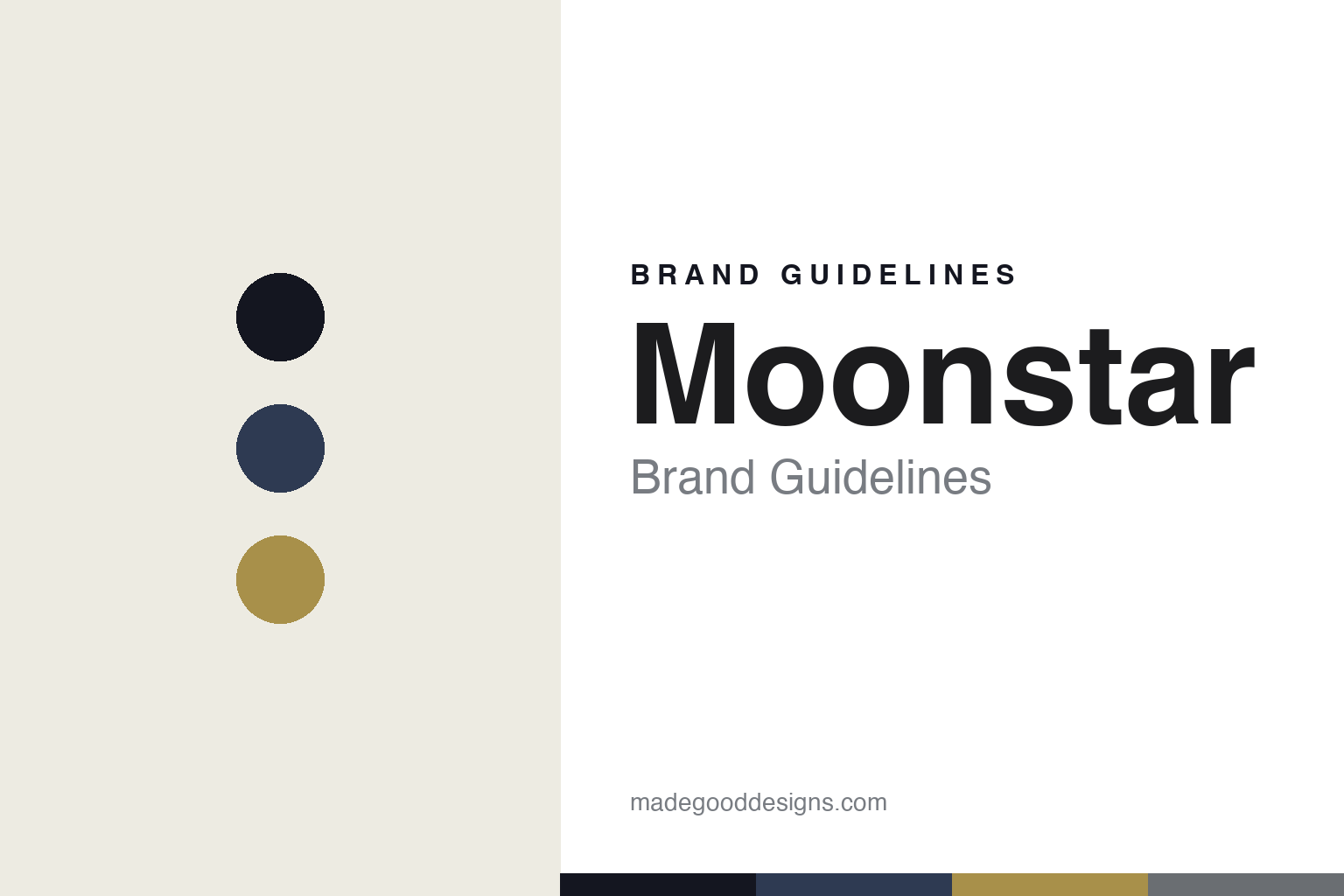
Moonstar’s identity is heritage, crafted and quiet — an ink, an indigo, a star gold, a rubber grey, and a rice. The palette pairs a deep indigo with a star gold — the register of the moon-and-star mark and a Japanese craft house. It signals the night sky and craft rather than gloss. The honest caveat: with no published brand hex, these tones are an original, unofficial interpretation, not first-party values.
The lesson is a deep indigo with a star gold signals a Japanese craft house. Moonstar’s world is a kiln-fired vulcanized shoe. For designers, it is a reminder that a deep, quiet palette drawn from a mark (the moon and star) reads as heritage and considered — right for a 150-year maker. The takeaways: source the palette from the mark (indigo, gold); keep it quiet and deep; let the craft lead (vulcanization); and treat any single hex as unofficial.
Typography
The register is a Japanese sans — clean, quiet, considered.
Moonstar’s identity carries a clean, quiet, considered spirit — vulcanized craft and a moon-and-star mark. A Japanese sans captures the mood: it is calm and precise, the register of Japanese minimalism. Set in an indigo-and-gold palette, the Japanese sans feels clean and quiet — exactly the personality Moonstar carries. It is considered rather than loud, mirroring a hand-lasted shoe. (Moonstar’s real footwear and mark are works we describe but do not reproduce, and the exact typeface is not ours to use.) Because it is not ours to use, the honest description is “a Japanese sans spirit,” shown here in a stand-in. The type behaves like the brand: clean, quiet and considered.
Aa
A Japanese sans spirit — clean and quiet. (Specimen set in Zen Kaku Gothic New, a Japanese sans STAND-IN; NOT the Moonstar footwear.)
Process heritage as identity
Moonstar stands for a sole fired the old way.
Moonstar is a lesson in making process heritage the identity. An indigo-and-gold palette, a Japanese sans and a kiln-fired sole make Kurume craft the whole brand — clean, quiet, enduring. The process is the differentiator. The differentiator is a vulcanized, made-in-Kurume identity.
For designers and brand-builders, Moonstar offers a clear takeaway: let an old process be the premium. The lessons: keep the craft alive (kiln vulcanization); anchor the identity in a mark (the moon and star, 1928); separate the premium from the volume (Fine Vulcanized vs school shoes); and be honest about the business. It is also a reminder to stay accurate: it began as a tabi maker in 1873, most of the business is mass-market, and the palette here is an unofficial interpretation. Moonstar made process heritage the brand — proof that how it’s cured can be the difference.
Explore & save
Keep Moonstar’s identity on hand — save it to a board in the Made Good inspiration library.
Moonstar identity set
Pin the indigo-and-gold palette and the Japanese-sans register to your own board.