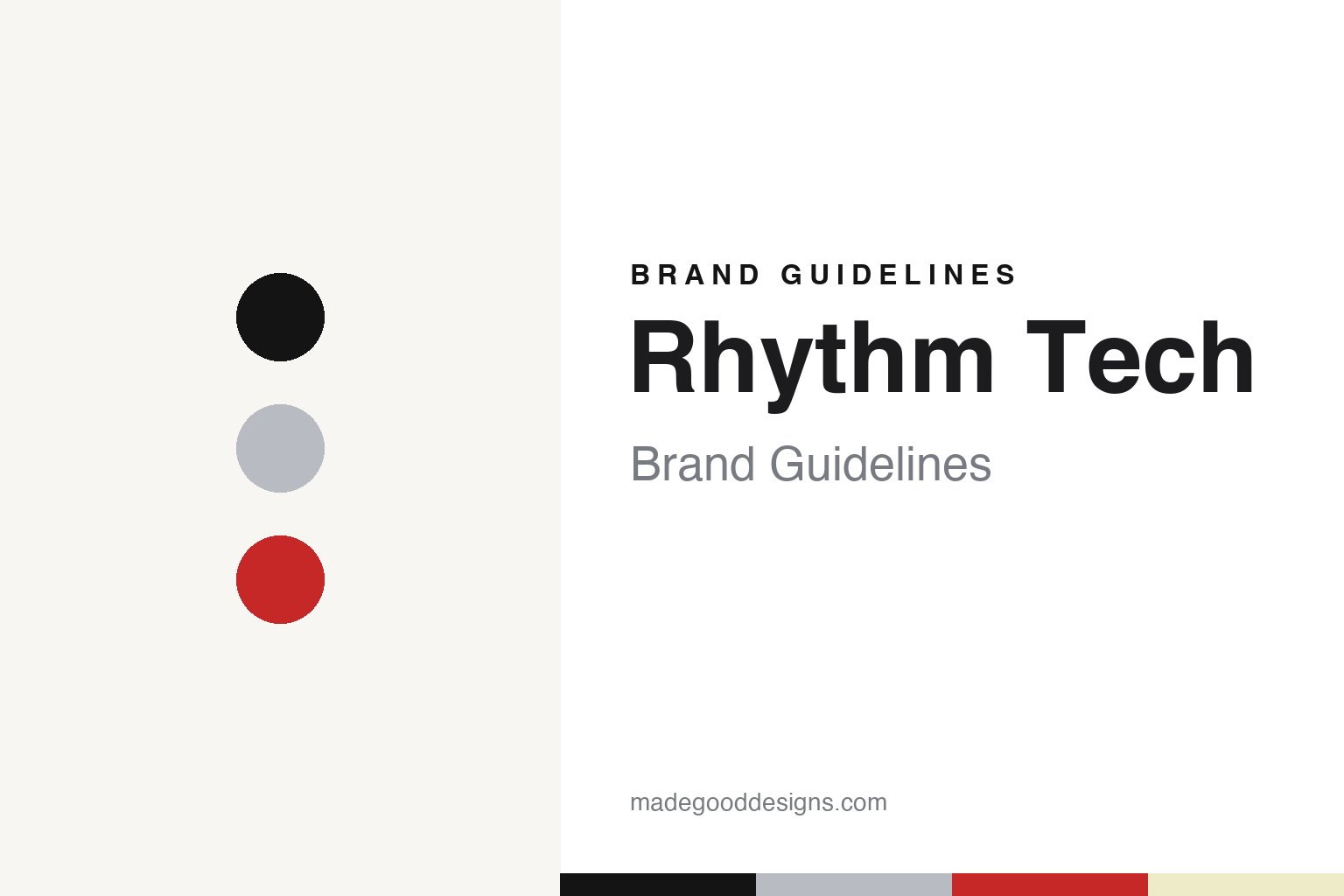
Rhythm Tech Brand Guidelines
The session drummer who cut a circle and moved the handle to the middle.
Aa
Two constants: a Rhythm Tech black, steel and red palette and an industrial sans register. Abstract homage — not a Rhythm Tech product or mark; no instrument, logo or nameplate is reproduced.
The crescent
A tired arm at a fifteen-minute session.
Rhythm Tech began with a tambourine and a tired arm. Its founder, Richard Taninbaum, was a New York session drummer and percussionist. Modern Drummer, profiling the company in December 2000, reported that he grew up around the music trade — his father had marketed clarinet and saxophone reeds and mouthpieces for almost fifty years and took him to trade shows in the early 1960s — and that after six months at Berklee College of Music he toured for a summer with a young vocal group, The Manhattan Transfer, worked in California studios, and moved back to New York in 1974 to play on jingles, records and demos.
In the late 1970s he played on many disco records and was often called to overdub hand percussion across a whole fifteen-minute tape, so that a producer could cut a single, a dance mix and an album track from one performance. The standard tool, he told the magazine, was Ludwig’s headless tambourine, with a wooden shell and heavy nickel-plated brass jingles, which “weighed about six pounds.” After about four minutes his arm gave out, and the track had to be finished in pieces. The company’s own account sets the moment at The Power Station, the New York studio, on a session with the producer and engineer Bob Clearmountain.
His answer was geometric. “I drew a circle,” he told Modern Drummer, “and then cut out a piece of that circle to give me access to the middle”; turned round and reattached, the piece became a handle at the centre of the instrument. That is the crescent-shaped tambourine, held at its balance point rather than by the rim; the company adds that it gave the handle a cushioned grip. The first prototype was cut from a broken wooden tambourine, and a friend helped him make plastic versions, which percussionists such as Ralph MacDonald and Sammy Figueroa asked about.
The design is on record. The Official Gazette of the US Patent and Trademark Office lists a design patent for a tambourine in Taninbaum’s name, filed on 31 August 1978 and granted on 28 April 1981; a second tambourine design patent in his name followed in March 1983.
Colour
From one mould to a catalogue.
When the record business slowed at the end of the 1970s, Taninbaum offered the tambourine to Ludwig. Talks dragged on for nearly a year, Modern Drummer reported, so “at the age of twenty-six he launched Rhythm Tech” himself. He spent all his money on a mould for the tambourine body and sat six days a week at a kick-press built in the early 1900s to put rivets into clothing, and his father’s trade contacts found him distributors at home and abroad. No source we checked gives an exact founding date; the company’s current “45 years” banner points to about 1981, and in 2016 KMC Music said it had been going for “more than thirty-five years.”
The catalogue grew from drummers’ problems. The Studio Shaker copied a Coke-can shaker made by Taninbaum’s mentor, Rubens Basini. When Steve Jordan, then in David Letterman’s television band, clamped a Rhythm Tech tambourine to a cymbal stand, the company designed a proper mount: the Drum Set Tambourine, or DST, which it was advertising in Modern Drummer by 1986. “We were the first company to make such an item,” Taninbaum said in 2000. “But it really was Steve’s idea, not mine.” Ned Steinberger, the bass designer, worked on its “index Tension” tuning rods; the sculptor Pete Engelhart’s metal instruments gave it the Ribbon Crasher; and the Hat Trick updated the old Ching Ring jingle for the hi-hat. Later came the ProTorq drum key, the Active Snare system, Eggz shakers and a glow-in-the-dark colour called Midnight Sun.
In 2000 the company was based in New Rochelle, New York; its 1986 advertisements and a 1993 letter give neighbouring Mamaroneck. It told Modern Drummer then that “virtually all” of its products were made in the United States: assembly, shipping and some manufacturing were done at the New Rochelle headquarters, and “over 95%” of what it produced came from metal stampers, plastic moulders and extruders in the Bronx, Brooklyn and lower Connecticut. Its tambourines, the company says today, are moulded from “a special blend” of plastic rather than clear plastic, which it calls too rigid and fragile.
Typography
Hand percussion in context.
The seven brands in this group make the instruments that sit around the drum kit: hand drums, cajóns, frame drums, tambourines, concert percussion and drumheads.
Two are hand-drum makers. LP, or Latin Percussion, was founded in New York in 1964 by Martin Cohen; Drum Workshop bought it from Fender’s Kaman Music business in 2014–15, and Roland bought Drum Workshop in 2022. Tycoon Percussion says it was founded in Bangkok in 1983 by Stephen Yu, a musician from Hong Kong, and that it is family-owned and makes its instruments in its own Thai factory.
Two work mainly in wood. Schlagwerk says it began in 1982, when two carpentry apprentices, Gerhard Priel and Bengt Schumacher, copied a Brazilian slit drum, and that it makes its cajóns at Gingen an der Fils, Germany, though its cajón cymbals are hammered in Turkey. Cooperman says Patrick Cooperman began making drumsticks and fifes in Mount Vernon, New York, in the 1950s, and that it has worked from a former sawmill in Bellows Falls, Vermont, since 2006.
Three make tambourines, concert percussion and drumheads. Rhythm Tech grew from the crescent tambourine of the session drummer Richard Taninbaum, which it says it introduced in 1980; its website calls it a division of JAM USA. Black Swamp Percussion was founded by Eric Sooy in Bowling Green, Ohio, dates itself to 1995 and now works from Zeeland, Michigan, calling its instruments “USA made.” Aquarian, founded in 1980 by Roy Burns and Ron Marquez, has made drumheads since 1987 and is based in Anaheim, California.
This guide sets out what can be checked about each brand — who founded it, who owns it, and what it says about where its products are made — and marks clearly what rests only on the company’s own word.
Aa
An industrial sans for a product-led brand. (Specimen set in Archivo, a sans STAND-IN; NOT the Rhythm Tech logo.)
Rhythm Tech
From New Rochelle to a Montreal group.
The company stayed independent for about three and a half decades. In February 2016 Modern Drummer reported that JAM Industries — a Montreal music group, as Wikipedia describes it — had acquired Rhythm Tech, and that its subsidiary KMC Music had become the brand’s exclusive US distributor, alongside lines such as Paiste, Gibraltar, Latin Percussion, Remo, Toca, Vater and Vic Firth. KMC’s president, Mark Terry, named Carmine Appice, Carter Beauford, Gregg Bissonette and Dennis Chambers among its players, and said Taninbaum, “the visionary founder,” would keep consulting on product development and design.
Today the website calls Rhythm Tech “a division of JAM USA LLC” and gives a contact address in Buffalo Grove, Illinois. It still sells tambourines, bells and blocks, shakers, triangles, cajons, drumstick attachments and youth percussion, only through dealers. We could not find a current statement of where those products are made, so the 2000 “made in the US” account should be read as history rather than as a description of today’s range.
Design was part of the business from the start. Taninbaum told Modern Drummer he had become “very involved in the industrial-design aspect” of bringing products to market, and the Graphis Design 91 annual credits him and Robert Linett as art directors of Rhythm Tech percussion bags. The visual signature, though, is the product itself: the crescent with its hand-hold at the centre, a silhouette that explains its purpose at a glance.
For a design guide, Rhythm Tech shows how one ergonomic idea can become a brand’s whole shape. Compare Ludwig, whose heavy headless tambourine was the problem it set out to solve, and Remo, another American maker that rethought a traditional instrument with synthetic materials. For this guide we use studio black, jingle steel and a signal red with a sans, an unofficial interpretation; no product or logo is reproduced.
Explore & save
Keep Rhythm Tech’s identity on hand — save it to a board in the Made Good inspiration library.
Rhythm Tech identity set
Pin the Rhythm Tech black, steel and red palette and the industrial sans register to your own board.