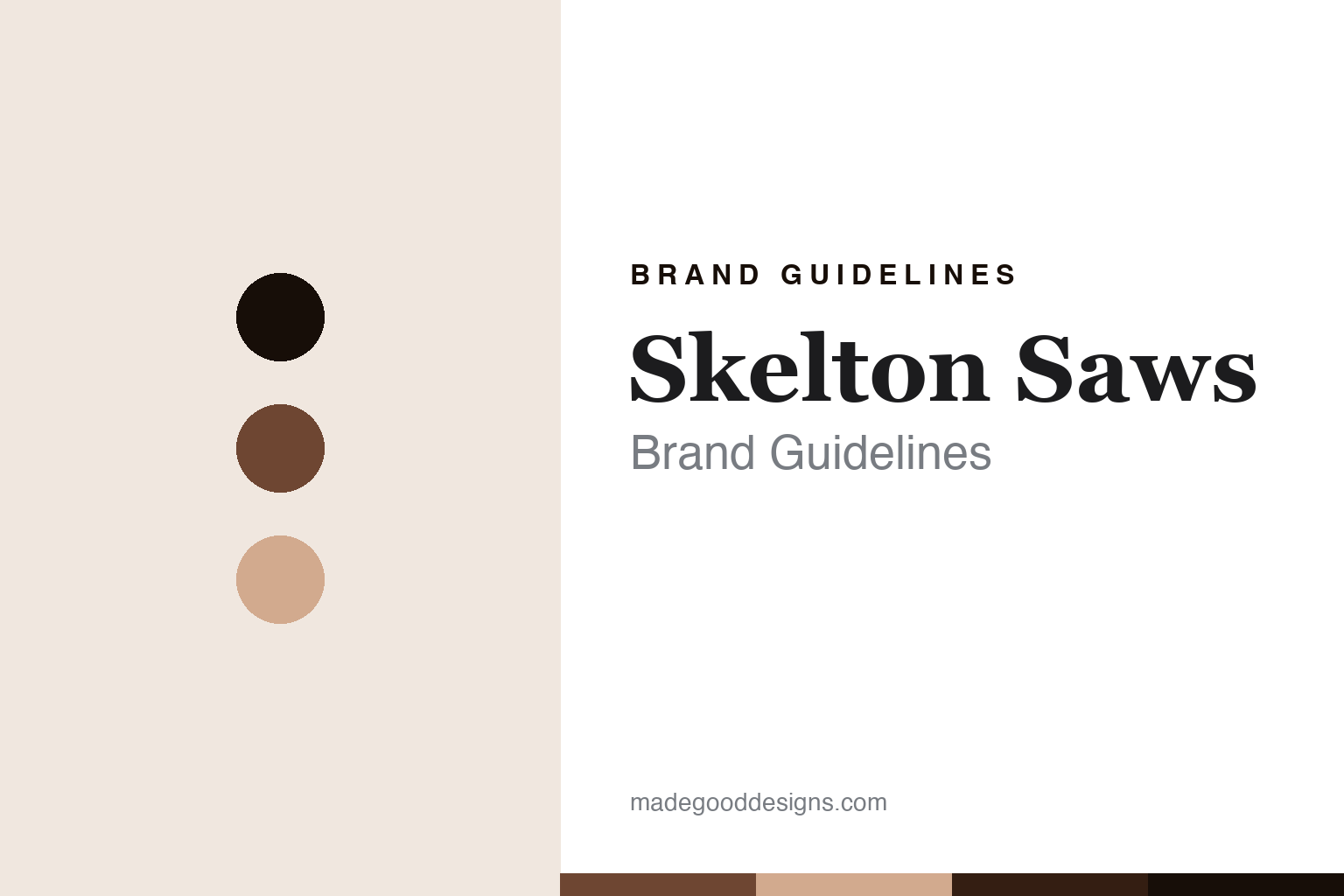
Skelton Saws Brand Guidelines
The English saw revived.
Aa
Two constants: a walnut palette and a revival-serif register. Abstract homage — not a Skelton saw or mark.
The English saw revived
Skelton Saws is the modern English backsaw workshop of Shane and Jacqueline Skelton in Scarborough, reviving handmade British sawmaking since around 2014.
Skelton Saws is the round’s saw revival, a two-person workshop bringing back handmade English backsaws. From Scarborough, in North Yorkshire, Shane Skelton makes bespoke dovetail, carcase and tenon backsaws by hand, while Jacqueline Skelton runs the business. Its answer to how a maker becomes a name is craft and story: revive a craft that had all but died in Britain, one hand-cut saw at a time. An English saw, made by hand.
Its identity is the English saw revived. Skelton’s handmade backsaws, its English making and its husband-and-wife workshop are the work it is known for. A saw, made in Yorkshire. A craft brought back.
(Honest notes, so the story stays precise, and one location correction matters. Skelton Saws is run by Shane Skelton, who makes the saws, and Jacqueline Skelton, who runs the business — a two-person, family-run micro-workshop. On where it is made — the theme of this round — it is made in England, by hand, in Scarborough, North Yorkshire; importantly, it is not in Cumbria, and we found no evidence tying it to Sheffield, so we anchor it in Yorkshire and drop the Sheffield framing. On founding, we say around 2014, attributing the date to a single profile, since the site gives no founding year. On what it makes, bespoke handmade backsaws — dovetail, carcase and tenon — plus longer saws, with figured-wood handles and detailed brass and steel work. On ownership, it is an independent, family-run workshop, with the founder still making. Its founder’s colourful multi-trade background, and the claim that it revived British sawmaking after more than a century, we attribute as reported rather than assert; the tools did win a 2016 Heritage Crafts “Made in Britain” award, which we can state. The long waiting list we describe as a year or more, without a single figure. Its name, wordmark and family crest are IP, described but never reproduced, and there is no official brand hex; these tones are an unofficial interpretation. This is design commentary and does not promote any product.)
Colour
Skelton Saws lives in a walnut palette. Click a swatch to copy the hex.
Skelton’s identity is handmade, English and revived — a walnut, an ink, a pale walnut, a deep walnut, and a paper. The palette leans walnut and steel: the register of a figured saw handle and a polished plate. It signals a revived hand craft. The honest caveat: with no published brand hex, these values are an original, unofficial interpretation, not first-party colours.
The lesson is a walnut palette signals a handmade, made-in-England identity. Skelton’s world is a handmade, steel-and-walnut, English object. For designers, it is a reminder that a warm walnut and a cool steel can carry a revived craft — the brown of a figured handle and the neutral of a saw plate. Because these tones can fail as small text, keep type dark and let the colour live in the accents, palette and band. The takeaways: revive the craft; make it at home; do it by hand; and treat any single hex as unofficial.
Typography
The register is a revival serif — refined, English, made.
Skelton’s identity carries a refined, English, made spirit — a saw revival, not a factory. A revival serif captures the mood: traditional, elegant and hand-crafted, the register of a bespoke bench. Set in a walnut palette, the revival serif feels refined and made — exactly the personality Skelton carries. It is a revived craft rather than a logo, mirroring a hand-cut backsaw. (Skelton’s real wordmark and its family crest are things we describe but do not reproduce, and the exact typeface is not ours to use.) Because it is not ours to use, the honest description is “a revival-serif spirit,” shown here in a stand-in. The type behaves like the workshop: refined, English and made.
Aa
A revival-serif spirit — refined and made. (Specimen set in Playfair Display, a revival-serif STAND-IN; NOT the Skelton wordmark or crest.)
The new toolmakers
Skelton stands for the handmade English saw, brought back.
Skelton Saws is a lesson in how reviving a craft can be an identity. A walnut palette, a revival serif and a handmade backsaw make one thing — the English saw revived — the whole identity: handmade, English and revived. The handmade backsaws are the differentiator, and the revival of a near-dead craft is the meaning. The point is a two-person Yorkshire workshop that brought handmade English sawmaking back, one hand-cut saw at a time.
Put to work, the identity is a revival, honestly told, as design. A maker in this spirit would revive the craft, make it at home, and do it by hand — dovetail and tenon backsaws, figured handles, made in Scarborough. A brand learning from it would see that reviving a lost craft is a durable identity — that a saw hand-cut in a country that had stopped making them carries a story a factory saw cannot — and that being precise, Shane and Jacqueline Skelton, around 2014, made in North Yorkshire, keeps the story honest. Skelton pairs across the vein with the American saw maker of an earlier round: two modern workshops, one English and one American, both reviving the handmade joinery saw. The honest editorial moves are the corrections — Scarborough, not Cumbria; Yorkshire, not Sheffield — and the attributions: the founder’s multi-trade backstory and the “revived British sawmaking” line as reported, the 2016 award as fact, the waiting list as a year or more. The lesson Skelton teaches is that a revival can hold an identity: the English hand-making gives it substance, and the honesty about place and claims keeps it credible. The revival is the personality, and the Yorkshire-made saw is the proof.
For designers and brand-builders, Skelton holds an England pole in the new toolmakers: revive the craft, and make it by hand at home. The lessons: bring back the craft; make in-country; correct the where-made assumptions; attribute the bigger claims; and never reproduce a logo or crest. It is also a reminder to stay precise: Skelton Saws is the modern English backsaw workshop of Shane and Jacqueline Skelton in Scarborough, reviving handmade British sawmaking since around 2014 — with the palette here an unofficial interpretation. Skelton made a revival the identity — proof that a handmade English saw, honestly told, can be the difference.
Explore & save
Keep Skelton Saws’s identity on hand — save it to a board in the Made Good inspiration library.
Skelton Saws identity set
Pin the walnut palette and the revival-serif register to your own board.