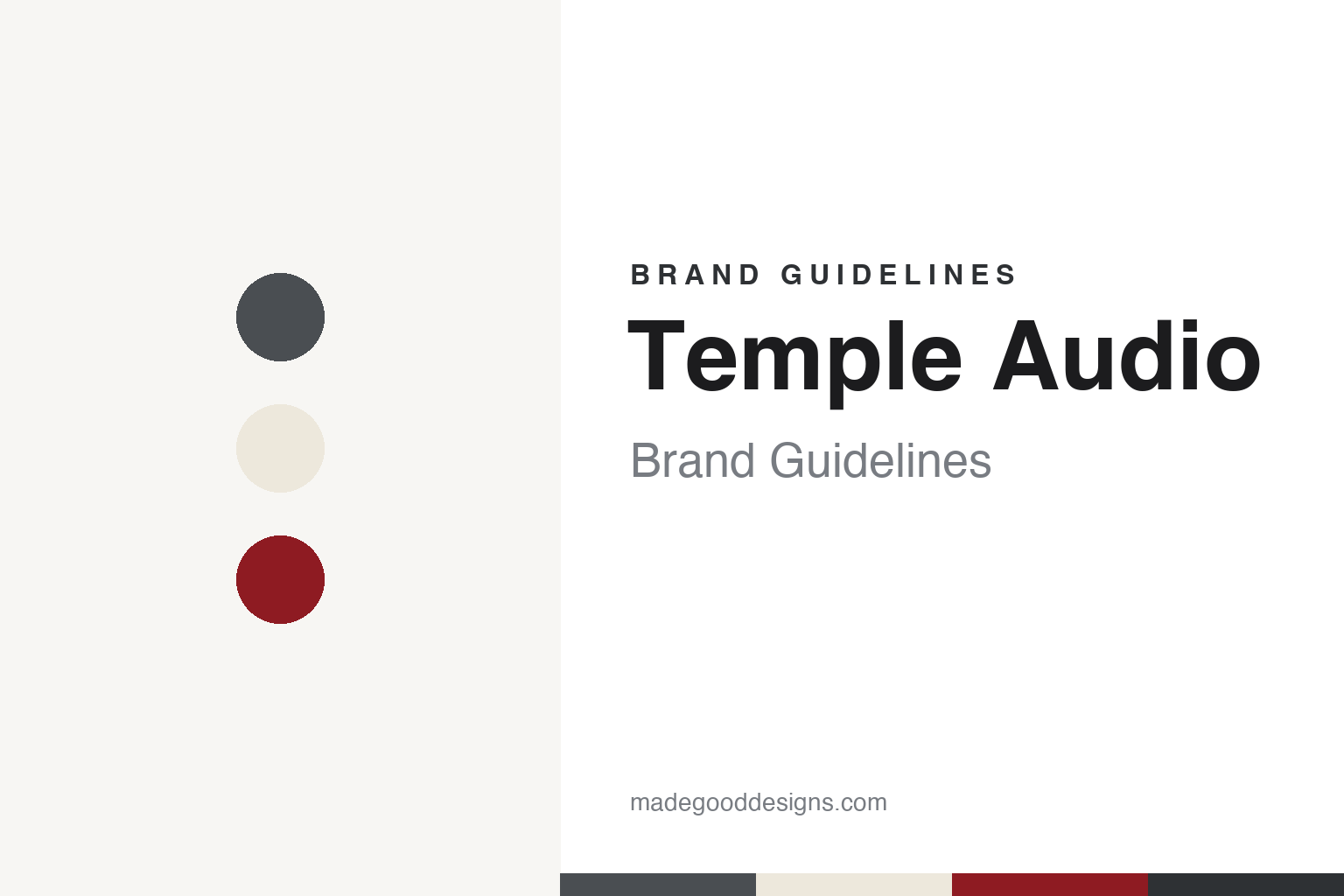
Temple Audio Brand Guidelines
The Saskatchewan board built like a modular rack.
Aa
Two constants: a gunmetal, vintage white and red palette and a condensed sans register. Abstract homage — not a Temple Audio product or mark; no board, logo or nameplate is reproduced.
From artist to artist
A request, a first board and a workshop on the prairies.
Temple Audio is a pedalboard maker from the Canadian prairies. Its company, Temple Audio Design Inc., is based in Warman, Saskatchewan, a small city just north of Saskatoon; the address appears on its website in 2019 and again in 2026. By its own account it is a Canadian company, and its products are made in Canada.
The company tells its origin story on its website. “In 2009, Ryan Dyck was asked to build a guitar effects pedalboard with some features that could not be found in the current market,” an “Our Story” page said in 2018. “While abroad with limited resources, the first Templeboard was created.” Dyck, the page went on, then turned to developing the products full-time, and the business came to employ “several people from the community.” The page was signed “Ryan Dyck, CEO/Founder.” We give the account as the company’s own.
The earliest copy of templeaudio.com in the Internet Archive, from January 2013, shows a very different product from today’s. Under the line “From Artists, to Artists,” Temple sold two electronic pedalboards: the Rhythm, an eight-channel board at $1,799.99, and the Lead, a thirteen-channel board at $2,349.99, each designed to fit a Pelican road case. The site spoke of a “Trademarked True Bypass switching system” that combined digital control with “a fully analog signal path,” and of power supplies from The GigRig built into the board.
Later in 2013 the company’s blog followed the building of a new workshop. In June it reported “firing up the CNC,” finalising two simpler boards, the T21 and T34, for production, and buying a MakerBot 3D printer for prototyping, noting that “our design department uses CAD to design all our boards.” In July it opened pre-orders for the T21 at $479: a board of “high grade aluminium” weighing 3.5 pounds, with its own hard case.
Colour
Holes, plates and modules.
The Templeboard’s look comes from its deck. Where many pedalboards use open rails, Temple uses a flat aluminum top punched with a grid of small holes, plus larger openings for cables. The company says the “unique perforated mounting surface with cable management holes” lets players “Tetris” in more gear than they would expect, and describes the boards as “CNC machined aluminum construction with powder coating.”
The holes are what make Temple’s other idea work. In July 2013 it introduced a Quick Release pedal-mounting system, then described as patent pending: plates attached to each pedal that fasten to the perforated deck, so a pedal can be moved or swapped without peeling fastener. The current plates come in three sizes — 33, 57 and 79 millimetres square — and the company describes them as tool-free, with a thumbscrew lock and “repeatable positioning.”
The company’s 2018 site set out the board’s evolution in versions: a first build with true-bypass switching and an expression dial; the T21 Pro and T34 Pro, with a built-in looper and the first perforated and Quick Release tops; standard T17, T21 and T34 boards; and finally “the Modular TEMPLEBOARD.” That last step defined the present range. Boards come in three depths — SOLO, DUO and TRIO, for one, two or three rows of pedals — in lengths of 17, 24 and 34 inches, and their end caps take swappable modules the company calls MODs.
The MODs turn the end of the board into a small patch panel. The current list includes modules named for DI, XLR, line, amp, USB, IEC and powerCON connections, as well as blank punched plates. Some come from partnerships: the Hi5 MOD, which powers up to five pedals, was developed in partnership with the power-supply maker CIOKS, and a separate bracket holds a Voodoo Lab power supply under the board. The boards come in three finishes, Gunmetal Gray, Vintage White and Temple Red — the same three colours offered on the T21 in 2013.
Typography
The pedalboard trade.
A pedalboard gives effects pedals a fixed home and needs clean power and routing. The makers here are known for different parts of it: frames, isolated power and switching.
Some are best known for the frame. Pedaltrain calls itself an independent accessory maker based in Nashville, founded in 1999 as a one-man start-up, with a European joint venture in Belgium. RockBoard belongs to Warwick GmbH & Co. Music Equipment KG of Markneukirchen, Germany, the company named in its website’s imprint. Temple Audio Design, of Warman, Saskatchewan, in Canada, sells the Templeboard and its quick-release pedal mounting system.
Others are best known for power. Truetone started as Visual Sound, which its founder, Bob Weil, launched at the NAMM show in 1995; it introduced the 1 SPOT adapter, took the Truetone name in 2015, is based in Spring Hill, Tennessee, and says it is still family owned. CIOKS was founded in Copenhagen in 1991 by Poul Ciok, who, the company says, still runs it; it is based today in Køge, Denmark, and says its power supplies are made in-house by a sister company in Poland.
Two Californian firms make both power and switching. Voodoo Lab, of Santa Rosa, says it has designed electronics for musicians since 1986. Decibel Eleven, of Valencia, launched its Hot Stone power supplies in 2012; it is a division of the electronics maker MYE, which it says has production facilities in the USA and abroad.
This guide sets out what can be checked about each brand — who founded it, who owns it, and what it says about where its products are made — and marks clearly what rests only on the company’s own word.
Aa
A condensed sans for a board built like a rack. (Specimen set in Barlow Condensed, a sans STAND-IN; NOT the Temple Audio logo.)
Temple Audio
Made in Saskatchewan, the company says.
Temple’s strongest claim is about where it makes things. In 2018 its website said its products were “proudly manufactured in Saskatchewan, Canada,” and in 2019 its “About us” page spoke of “our Made in Canada products.” The 2026 website lists “Canada” as the place of manufacture for its SOLO, DUO and TRIO boards and for its modules and accessories. These are the company’s own statements; we have not seen an independent account of its production, though its 2013 blog posts about installing a CNC machine in its own workshop fit them.
Its website names no parent company, and its legal pages in 2018 gave the name Temple Audio Design Inc. with the Warman address. The boards are sold direct and through dealers around the world, with items bought from a dealer covered by that dealer’s own terms, the company says; it lists its refund rules under the name Templeboards.com.
Temple markets itself through musicians. Its artists page says it supports “thousands of artists globally” and lists players from bands including Turnstile, Big Thief, Knocked Loose and Tycho, as well as the Australian guitarist Plini; its home page links to Deep Sea Diver, the band led by Jessica Dobson, under the heading “Designed by artists for artists.” The slogan from its first website — “From Artist to Artist” — still sums up how it presents itself.
For a design guide, Temple Audio shows how a perforated surface and a set of standard plates can turn a pedalboard into a system rather than a single object. Compare Pedaltrain, the Nashville maker whose slotted rails are a different answer to the same problem, and Strymon, whose pedals often sit on boards like these. For this guide we use gunmetal, vintage white and a deep red with a condensed sans, an unofficial interpretation; no product or logo is reproduced.
Explore & save
Keep Temple Audio’s identity on hand — save it to a board in the Made Good inspiration library.
Temple Audio identity set
Pin the Temple Audio gunmetal, vintage white and red palette and the condensed sans register to your own board.