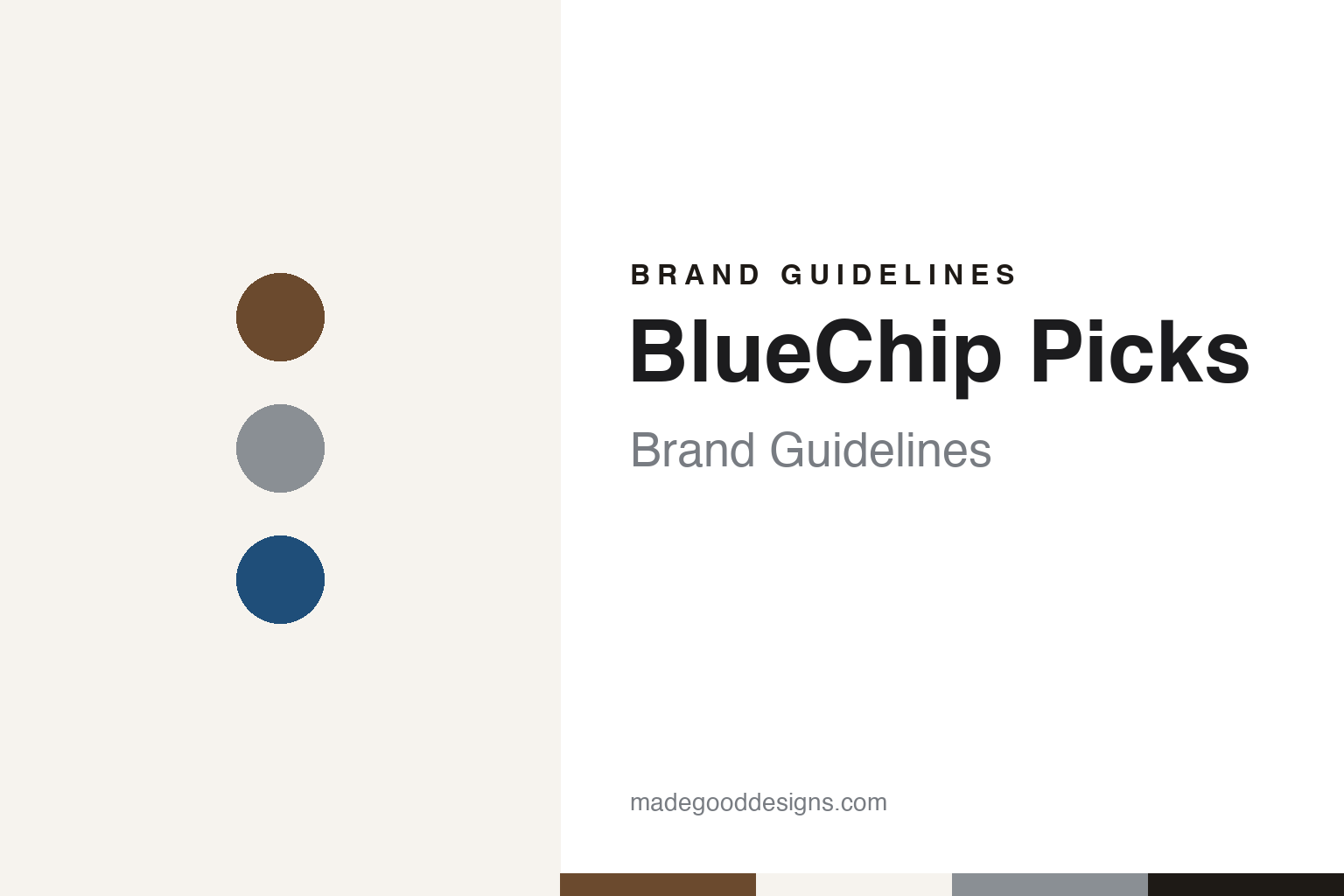
BlueChip Picks Brand Guidelines
The Tennessee machine shop that turned an expensive composite into a pick.
Aa
Two constants: a composite brown and machinist steel palette and a machinist sans register. Abstract homage — not a BlueChip product or mark; no pick, logo or etching is reproduced.
Blue Chip Machining
A pick that started on the shop floor.
BlueChip Picks did not start as a music company. Its own account is that the picks are named after a machine shop, Blue Chip Machining, in East Tennessee, and the man behind both is Matthew Goins. In a review reproduced on the company’s website, DownBeat quoted Goins, described as Blue Chip’s president, on how it began: “I had been machining this composite material for 10 years that costs $4,800 for a 10”x10” square. One day I noticed an employee shaping a tortoise pick in the shop and a discussion led to the idea of forming a pick from the composite.”
The same review says Goins took his prototype to several music festivals and spent two years refining the design. By June 2008 a website was up — the earliest copy in the Internet Archive names Goins as the contact and announces “the Blue Chip Pick, Patent Pending,” made from “a very high grade self lubricating special formulated composite material,” with “better tone and response than tortoise shell.” In the July 2008 issue of Vintage Guitar, the reviewer Steven Stone wrote that he had heard about the picks on the Mandolin Café message board, contacted “Blue Chip owner Matthew Goins” and was sent samples; at that point the range was six picks, in teardrop, pointed three-sided and rounded three-sided shapes, each in 1mm and 1.25mm.
The company’s “About Us” page today describes BlueChip as a small company based in Knoxville, Tennessee, and names a five-man crew: Matthew Goins with Allen Goins, Brian Phillips, Tyler Morris and Shain Hansard. Its mailing address and its online shop give Clinton, a town in Anderson County north of Knoxville, and the site’s footer names the business BlueChip Picks Inc.
Colour
Milled, beveled, polished and etched.
The product is unusual for its colour as much as its price. The company says its picks are cut on industrial-grade CNC machines in its own machine shop, then “beveled and polished by hand before being laser etched.” It describes the material only as “a specially formulated composite material that will withstand very high temperatures and is extremely wear resistant,” containing “special lubricants” that make it fast off the strings, and calls it “extremely expensive” and “highly proprietary.” It does not name the material, and neither do we.
The colour follows from that material. “Why are they brown and not blue?” is a question the company says it always hears; its answer is that the brown comes from the material’s chemical make-up and cannot be changed, so BlueChip picks “only come in brown.” Its FAQ adds that the picks will not deform in heat, need no polishing, survive a washing machine, and are not instrument-specific: the same shapes are sold for guitar and mandolin, with thumb picks recommended for resonator players.
The catalogue is built from coded shapes and thicknesses — the online shop lists families such as TD, TP, TAD, CT and a Jazz model in 2mm and 2.5mm, with a speed or round bevel on most shapes and a rounded bevel only on the Jazz picks. The DownBeat review compared the Jazz model to Dunlop’s Jazz III. Flatpicks were $35 each when DownBeat reviewed them, and the shop lists most at the same price in 2026. The company does not offer custom shapes, saying every pick is milled from a computer design and one-off set-up costs would be too high.
Thumb picks came later. The company describes them as one of its picks attached to a laser-cut stainless-steel band, shaped and polished by hand, and sells a model it calls the BCT-JD, which it says was designed by the banjo player J.D. Crowe to his own specifications, with his initials on the underside.
Typography
Picks as a design object.
These seven pick makers solve one job in very different ways. Two Dutch makers work in thick, bevelled picks. Chicken Picks was started by the guitarist Eppo Franken, who began selling his thermoset picks in 2010; the company says that since 2013 they have been machine-made in Germany and Belgium and hand-finished in the Netherlands. Wegen is the work of Michel Wegen, a professional model maker in Lochem, who says each of his picks is made by hand.
Two American makers work in hard synthetics. V-Picks is the Smith family’s business in Tennessee; Vinni Smith says he first cut acrylic picks in 1980 and revived them in 2003, and the company describes its picks as handmade in the USA. BlueChip, based in Knoxville, Tennessee, says its picks are milled on CNC machines in its own machine shop, Blue Chip Machining.
Two others draw on an older material or a longer history. Red Bear Trading, of Cedar City, Utah, says it has made picks by hand since 2003 from Galalith, a casein plastic made from milk protein. Pickboy is a brand of Nakano Co., Ltd., which says it was founded in Japan in 1967 as a guitar-accessory maker and supplies its celluloid, nylon and polyacetal picks from Japan.
The seventh, Dava, rethinks the pick’s shape rather than its material. Dave Storey says he started the company in 1996; it has been based in Albuquerque, New Mexico, since at least 2004, makes multi-gauge picks with a flexible centre section, and says its picks are made in the USA.
This guide sets out what can be checked about each brand — who founded it, who owns it, and what it says about where its products are made — and marks clearly what rests only on the company’s own word.
Aa
A condensed machinist sans for a shop-floor brand. (Specimen set in Barlow Semi Condensed, a sans STAND-IN; NOT the BlueChip logo.)
BlueChip Picks
Named for a machine shop, coloured by a material.
BlueChip has built its name in bluegrass and acoustic music more than in rock. Steven Stone’s Vintage Guitar piece framed it as an answer to an old problem: tortoiseshell picks, made from the endangered hawksbill turtle, are restricted, brittle and inconsistent, and players had spent years looking for a legal substitute. He placed BlueChip alongside Red Bear’s man-made tortoise picks in that search. The company’s own testimonials page quotes players including Chris Thile, Bryan Sutton, Julian Lage, Rhonda Vincent and Mike Marshall, and says it is “proud to be endorsed by” Ricky Skaggs; those are the company’s selections, not independent surveys.
The DownBeat reviewer, Keith Baumann, called it “a groundbreaking product and well worth the $35 for the discerning player,” and noted that the picks were slick on the strings yet easy to grip; Stone remarked on a polished surface that stayed slightly tacky whatever the moisture on a player’s fingers. Both reviews are read here as the company reproduces them on its website.
The identity is plain. The name refers to the parent machine shop rather than to the product, which is why the company has to explain the colour, and the brand sells precision — coded shapes, stated tolerances, a laser-etched mark — rather than a mascot or a story about a founder’s band. The website itself is a simple WordPress site with a separate shop. One domain trap is worth knowing: the shop and site live at bluechippick.net, while bluechippick.com is a parked domain offered for sale and is not the company.
For a design guide, BlueChip shows how a by-product name and an unchangeable material colour can become the brand: brown picks, a blue name and a machinist’s precision. Compare Wegen Picks, a one-man Dutch maker of thick handmade picks, and Gravity Picks, the Californian acrylic pick maker. For this guide we use composite brown, machinist steel and a chip blue with a condensed sans, an unofficial interpretation; no product or logo is reproduced.
Explore & save
Keep BlueChip Picks’s identity on hand — save it to a board in the Made Good inspiration library.
BlueChip Picks identity set
Pin the BlueChip composite brown and machinist steel palette and the machinist sans register to your own board.