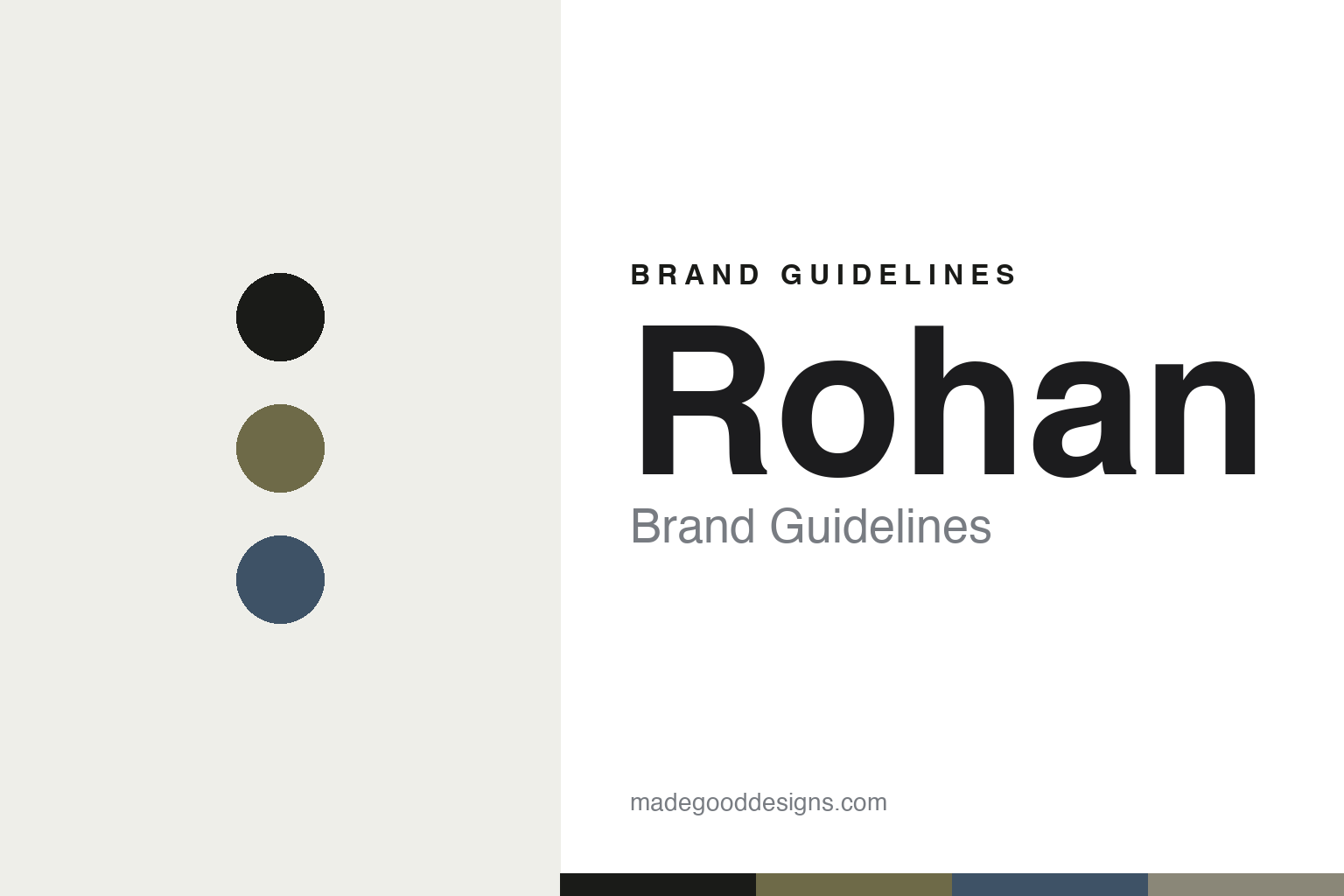
Rohan Brand Guidelines
Travel clothing since 1972.
Aa
Two constants: a travel-olive palette and a practical sans register. Abstract homage — not the Rohan wordmark or logo.
Travel clothing since 1972
Rohan pioneered lightweight technical travel clothing.
Rohan is a lesson in a use-case as the whole brand. Founded in 1972 by Paul and Sarah Howcroft in Skipton, Yorkshire — close to the Yorkshire textile mills — the brand became a pioneer of lightweight, technical travel clothing.
Its brand identity is understated, practical and travel-first — quick-dry, packable, multi-pocket kit for travellers and walkers rather than fashion. Its first product (around 1975) was a pair of quick-drying mountaineering salopettes; a Rohan jacket (the Windlord) was worn during the 1978 first oxygen-free ascent of Everest by Messner and Habeler. The lightweight travel range that followed — the signature Rohan Bags travel trousers — is still made today.
(Honest notes: Rohan isn’t independent — it has been a subsidiary of the British group H. Young Holdings since 2016, after passing through Clarks and private-equity owners. Co-founder Paul Howcroft died in 1993. And there’s no official brand hex, so the tones here are an unofficial interpretation.)
Colour
Rohan lives in a travel-olive palette. Click a swatch to copy the hex.
Rohan’s identity is understated, practical and earthy — an ink, a travel olive, a slate blue, a stone, and a bone. The palette pairs a muted travel olive with a slate blue — the register of practical travel kit and quiet function. It signals utility, journeys and understatement rather than fashion or colour. The honest caveat: with no published brand hex, these tones are an original, unofficial interpretation, not first-party values.
The lesson is muted, practical tones signal a function-first travel brand. Rohan’s world is an airport, a trail, a long journey light. For designers, it is a reminder that an olive with a slate blue reads as practical and understated — right for a travel-clothing brand. The takeaways: use muted, practical tones; keep it understated; and treat any single hex as unofficial — using ink for small text so the palette stays quiet.
Typography
The register is a practical sans — understated and functional.
Rohan’s identity carries a practical, understated, functional spirit — travel utility and quiet competence. A plain practical sans captures the mood: it is clear and unfussy, the register of a function-first brand. Set in a travel-olive palette, the practical sans feels understated and functional — exactly the personality Rohan carries. It is useful rather than decorative, mirroring packable travel kit. (Rohan’s real wordmark is a trademark we describe but do not reproduce, and the exact brand typeface is not ours to use.) Because the mark is not ours to use, the honest description is “a practical sans spirit,” shown here in a stand-in. The type behaves like the brand: practical, understated and functional.
Aa
A practical sans spirit — understated and functional. (Specimen set in Instrument Sans, a practical sans STAND-IN; NOT the Rohan wordmark, which is a trademark.)
A use-case as identity
Rohan stands for practical travel clothing.
Rohan is a lesson in making a use-case the identity. A travel-olive palette, a lightweight-technical heritage and the signature Rohan Bags make travel the whole brand — practical, understated, function-first. The use-case is the differentiator. The differentiator is a technical, travel, practical identity.
For designers and brand-builders, Rohan offers a clear takeaway: a job can be a brand. The lessons: solve a real need (lightweight kit for travel); prove it (mountaineering heritage, the 1978 Everest jacket); and design for the long haul (Insect Shield, UV protection, the Barricade waterproof, a Care & Repair service). It is also a reminder to stay accurate: it’s a subsidiary of H. Young Holdings (not independent), it was founded in Skipton (HQ now Milton Keynes), and the palette here is an unofficial interpretation. Rohan made travel the brand — proof that a use-case can be the difference.
Explore & save
Keep Rohan’s identity on hand — save it to a board in the Made Good inspiration library.
Rohan identity set
Pin the travel-olive palette and the practical-sans register to your own board.