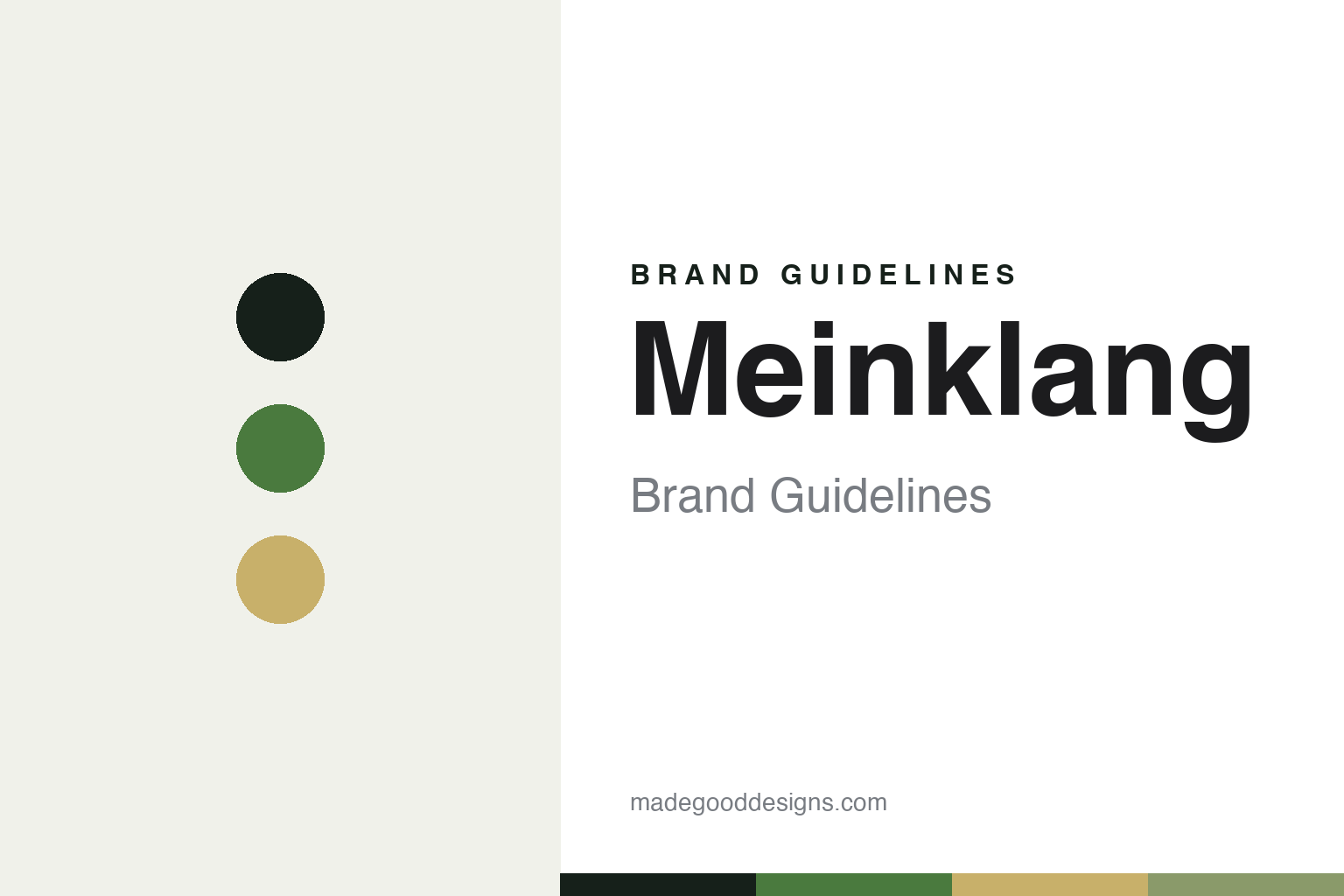
Meinklang Brand Guidelines
Farm-to-glass minimalism.
Aa
Two constants: a farm-green palette and a clean sans register. Abstract homage — not the Meinklang labels or icons.
Farm-to-glass minimalism
Meinklang is a biodynamic mixed farm, not just a winery.
Meinklang is a lesson in a farm as a brand. Run by the Michlits family in Pamhagen, Burgenland, Austria (on the Pannonian plain by Lake Neusiedl, with vineyards across the border in Hungary at Somló), it is a large, self-sufficient mixed biodynamic farm — cattle, sheep, pigs and ancient grains as well as vines — and Demeter-certified since 2003.
Its brand identity is clean, iconographic and agricultural — a “farm-to-glass” minimalism of white, uncoated paper, restrained type and simple line-drawn icons rather than crests. The labels behave as a system, so the whole range reads as one calm family on the shelf. Signature lines include Graupert (from deliberately un-pruned “wild” vines), the frizzante rosé Prosa, and the Foam pét-nats.
(Honest notes: Meinklang is a whole mixed farm, not only a winery. Its Konkret concrete-egg wine is a concept/limited cuvée, not a current staple. Its label designer isn’t publicly credited. And there’s no official brand hex, so the tones here are an unofficial interpretation.)
Colour
Meinklang lives in a farm-green palette. Click a swatch to copy the hex.
Meinklang’s identity is natural, clean and agricultural — an ink, a farm green, a wheat, a meadow, and a cream. The palette leans on a farm green with a wheat gold — the register of fields, grain and a biodynamic farm. It signals nature, calm and honesty rather than luxury. The honest caveat: with no published brand hex, these tones are an original, unofficial interpretation, not first-party values.
The lesson is green and wheat tones signal a farm-first identity. Meinklang’s world is a mixed farm with grain, animals and vines. For designers, it is a reminder that a farm green with a wheat gold reads as agricultural and calm — right for a biodynamic farm. The takeaways: use farm green and wheat; keep it calm and clean; and treat any single hex as unofficial — using ink for small text so the palette stays natural.
Typography
The register is a clean sans — calm and iconographic.
Meinklang’s identity carries a calm, clean, agricultural spirit — a farm and simple icons. A clean sans captures the mood: it is quiet and orderly, the register of a systematized, honest brand. Set in a farm-green palette, the clean sans feels calm and iconographic — exactly the personality Meinklang carries. It is orderly rather than ornate, mirroring a farm-to-glass label. (Meinklang’s real labels and icons are works we describe but do not reproduce, and the exact typeface is not ours to use.) Because the labels are not ours to use, the honest description is “a clean sans spirit,” shown here in a stand-in. The type behaves like the brand: calm, clean and agricultural.
Aa
A clean sans spirit — calm and iconographic. (Specimen set in Sen, a clean sans STAND-IN; NOT the Meinklang labels, which are their own work.)
A farm as identity
Meinklang stands for a whole biodynamic farm.
Meinklang is a lesson in making the farm the identity. A farm-green palette, clean iconographic labels and a whole mixed-farm story make agriculture the whole brand — calm, honest, systematic. The farm is the differentiator. The differentiator is a biodynamic, farm-to-glass, systematic identity.
For designers and brand-builders, Meinklang offers a clear takeaway: a system and a story can be a brand. The lessons: design a coherent system (one calm template, small icons, colour accents); tell the real story (a self-sufficient biodynamic farm, Demeter since 2003); and name with character (Graupert’s “scruffy” wild vines). It is also a reminder to stay accurate: it’s a whole mixed farm (not only a winery), Konkret is a concept cuvée, and the palette here is an unofficial interpretation. Meinklang made the farm the brand — proof that a system can be the difference.
Explore & save
Keep Meinklang’s identity on hand — save it to a board in the Made Good inspiration library.
Meinklang identity set
Pin the farm-green palette and the clean-sans register to your own board.


