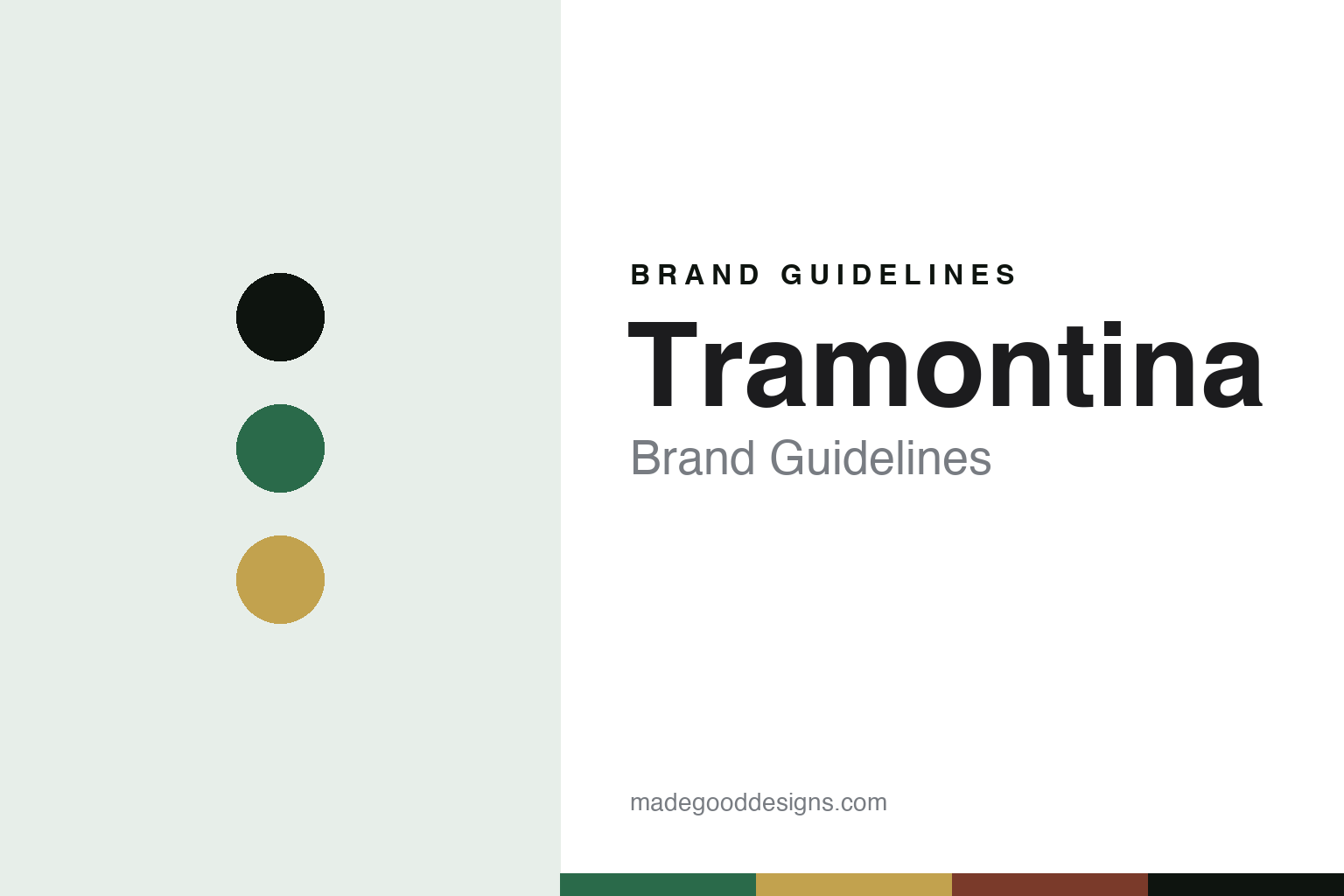
Tramontina Brand Guidelines
The world’s everyday knife.
Aa
Two constants: a Brazil-green palette and a global-sans register. Abstract homage — not a Tramontina knife, handle or wordmark.
The world’s everyday knife
Tramontina is a Brazilian maker whose everyday knives, made in Brazil, equip kitchens worldwide.
Tramontina is a lesson in the everyday knife at global scale as the identity. Founded in 1911 in Carlos Barbosa, in southern Brazil, it grew into one of the world’s great housewares makers, and its knives — bright-handled, stainless, affordable — are found in kitchens in scores of countries. Its answer to how a country makes the everyday blade is a democratic one: make a good knife cheaply, in your own factories, and put it everywhere. A knife made for everyone.
Its identity is the everyday blade, made in Brazil and sold to the world. Tramontina’s scale, its Brazilian knife-making and its value are the work it is known for. A reach, made a signature. A family company that armed the world’s kitchens.
(Honest notes, so the story stays precise. Tramontina was founded in 1911 in Carlos Barbosa, Rio Grande do Sul, by Valentin Tramontina, and remains a family-owned Brazilian company — organised as a group of associated, specialised industrial units rather than a cooperative — with its knives and cutlery made in Brazil, at Tramontina Cutelaria in Carlos Barbosa. One honest scope note: Tramontina is a large group whose other categories are made in several countries, including the United States, India and Mexico, so we make the made-in-Brazil claim for the knives and cutlery specifically, not for the whole catalogue. Its exact line names and per-line handle details are things we describe generally rather than assert. Its designs and wordmark are its IP, described but never reproduced, and there is no official brand hex — these tones are an unofficial interpretation. This is design commentary and does not promote any product.)
Colour
Tramontina lives in a Brazil-green palette. Click a swatch to copy the hex.
Tramontina’s identity is practical, warm and Brazilian — a Brazil green, an ink, an amber, a clay, and a chalk. The palette leans Brazil green and amber: the register of a bright everyday handle and a warm southern light. It signals value and reach over luxury. The honest caveat: with no published brand hex, these values are an original, unofficial interpretation, not first-party colours.
The lesson is a Brazil-green palette signals a practical, global identity. Tramontina’s world is an affordable, made-in-Brazil, everywhere-you-look object. For designers, it is a reminder that a warm green and an amber can carry a brand built on scale and value — the green of a southern hillside and the amber of a kitchen at dinnertime. Because these tones can fail as small text, keep type dark and let the colour live in the accents, palette and band. The takeaways: make it well and cheaply; make it at home; be honest about which categories are Brazilian; and treat any single hex as unofficial.
Typography
The register is a global sans — clean, friendly, universal.
Tramontina’s identity carries a clean, friendly, universal spirit — an everyday object, not a boutique one. A global sans captures the mood: even, warm and legible in any language, the register of a brand sold worldwide. Set in a Brazil-green palette, the global sans feels clean and friendly — exactly the personality Tramontina carries. It is universal rather than exclusive, mirroring a knife made for every kitchen. (Tramontina’s real designs and wordmark are things we describe but do not reproduce, and the exact typeface is not ours to use.) Because it is not ours to use, the honest description is “a global-sans spirit,” shown here in a stand-in. The type behaves like the maker: clean, friendly and universal.
Aa
A global-sans spirit — clean and friendly. (Specimen set in Manrope, a global-sans STAND-IN; NOT the Tramontina wordmark or any knife design.)
The knife around the world
Tramontina stands for the everyday knife at global scale.
Tramontina is a lesson in making scale and value the identity. A Brazil-green palette, a global sans and a bright everyday blade make one thing — a good knife made cheaply and sold everywhere — the whole maker: practical, warm and Brazilian. The reach is the differentiator. The differentiator is democratic scale: a family company that makes its knives at home in Brazil and puts them within reach of kitchens across scores of countries.
Put to work, the identity is value-at-scale as design. A maker building in this spirit would make a genuinely good everyday object affordable, keep the core making at home even as the group grows, and be honest about which parts of a big catalogue are made where. It would treat availability and price as a feature, not a compromise. It would say plainly that its knives are Brazilian-made without implying its whole range is. A brand learning from it would treat affordability as a discipline that must be re-earned at scale, keeping quality steady even as volume climbs, and would let ubiquity build trust — a knife people already know from their own kitchen — rather than chase an exclusivity it does not need. It would keep its factories close to the people who run them, so growth in scale never loosens the family’s grip on how the knives are actually made. And it would remember that being in every kitchen is a responsibility as much as a triumph: the everyday knife has to be good precisely because so many people rely on it. The lesson Tramontina teaches is that scale and value can build a brand: the reach gives it ubiquity, and the Brazilian making gives it substance. The value is the personality, and the everyday knife is the proof.
For designers and brand-builders, Tramontina holds the everyday-scale pole in this round about the knife around the world: make a good blade affordable, at home, for everyone. The lessons: make it well and cheaply; keep the core making home; be honest about a big catalogue; and never reproduce a protected design. It is also a reminder to stay precise: Tramontina is a family-owned Brazilian company founded in 1911 in Carlos Barbosa, its knives made in Brazil and sold worldwide, with other categories made elsewhere — with the palette here an unofficial interpretation. Tramontina made scale and value the maker — proof that the everyday knife can be the difference.
Explore & save
Keep Tramontina’s identity on hand — save it to a board in the Made Good inspiration library.
Tramontina identity set
Pin the Brazil-green palette and the global-sans register to your own board.