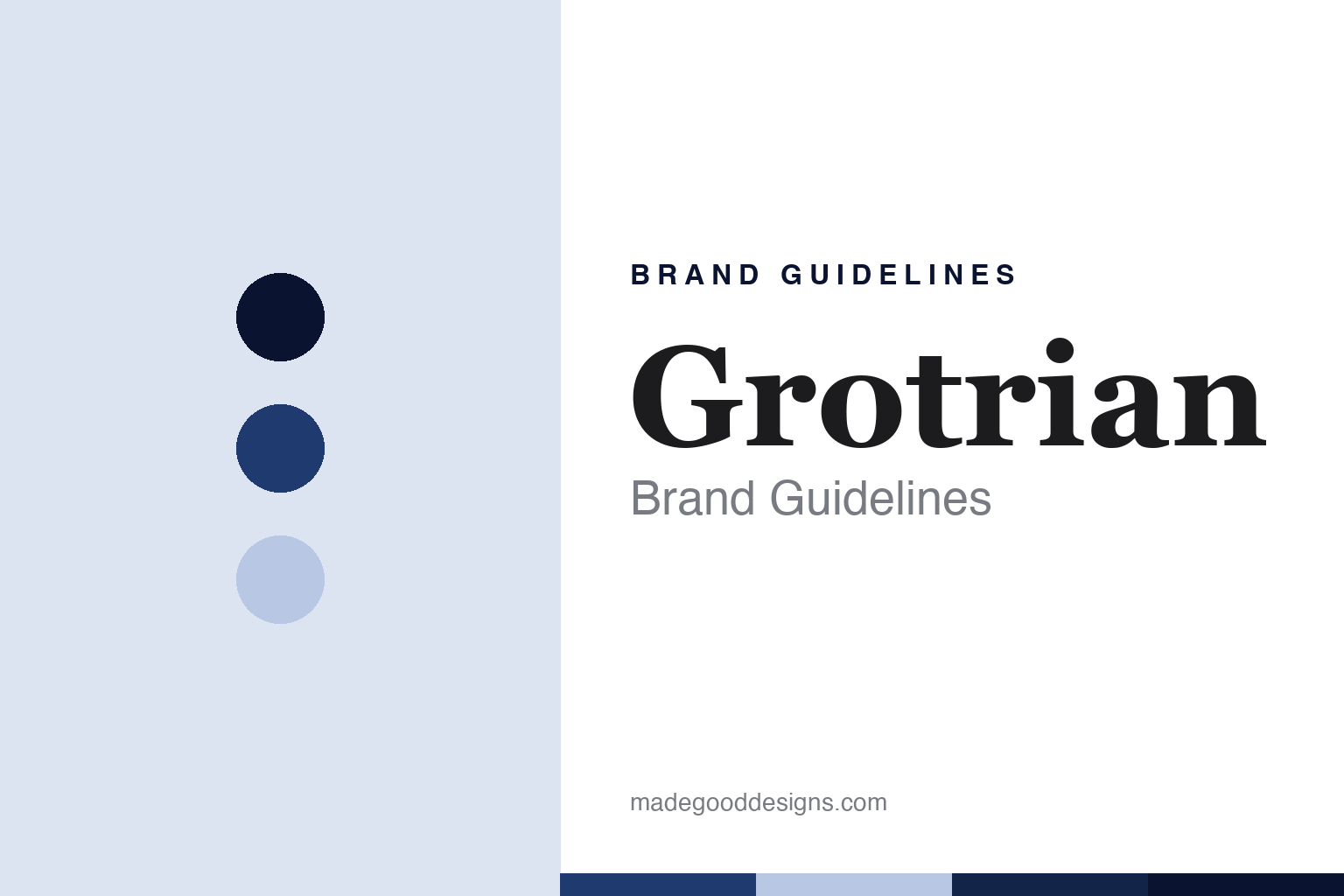
Grotrian Brand Guidelines
The name a court took out of America.
Aa
Two constants: a heraldic-blue palette and a court-hand serif register. Abstract homage — not a Grotrian product or mark; no piano, arms or wordmark is reproduced.
A family that asked to take a name
Grotrian’s story is a story about a surname — who was allowed to carry it, where, and for how long.
The house dates itself to 1835, when Heinrich Engelhard Steinweg began building pianos in Seesen, in the Harz. The United States Court of Appeals told the rest of the founding in a single paragraph in 1975: “In 1835 Heinrich E. Steinweg began making pianos in Germany. He emigrated to New York in 1850 with three sons, changed his name to Steinway and founded appellee Steinway & Sons… Heinrich’s oldest son, C. F. Theodor Steinweg, remained in Germany… Later he sold his business to his three employees, Wilhelm Grotrian, Adolph Helfferich and H. G. W. Schulz.”
Those three names are still in the company’s legal name — Grotrian, Helfferich, Schulz, Th. Steinweg Nachf., the last two words meaning “Theodor Steinweg’s successors.” Friedrich Grotrian had joined Theodor as a partner in the 1850s, and the firm moved to Braunschweig in 1857. Steinway, in other words, is the emigrant branch of the family business; Grotrian is the business that stayed.
Then, in December 1918, the Grotrian family asked the authorities for permission, in the court’s words, “to change its name to ‘Steinweg, or at least Grotrian Steinweg’. One of the principal reasons was to aid in the export of its product.” The family took the surname Grotrian-Steinweg in 1919. A name that had stayed behind in Germany was being reattached to the business that kept its workshop — and, by the family’s own account to the court, partly so that it would sell abroad.
Colour
In 1975 an American court decided that the German half of the family could not use the family name in America.
The case is Grotrian, Helfferich, Schulz, Th. Steinweg Nachf. v. Steinway & Sons, 523 F.2d 1331, decided by the Second Circuit on 9 July 1975. The court was careful about what it was not saying: “The issue here is not the possibility that a purchaser would buy a Grotrian-Steinweg thinking it was actually a Steinway.” The harm was earlier in the sale — “the likelihood that a consumer, hearing the ‘Grotrian-Steinweg’ name and thinking it had some connection with ‘Steinway’, would consider it on that basis… Such initial confusion works an injury to Steinway.”
The trial judge had put it more vividly, and the appeals court quoted him: “Misled into an initial interest, a potential Steinway buyer may satisfy himself that the less expensive Grotrian-Steinweg is at least as good, if not better, than a Steinway.” The relief was an injunction against using in the United States the name “Steinweg” — and Grotrian “was enjoined from making any reference to the historical connection between the firms.” The court affirmed the injunction and vacated the money awards.
Read that last clause again. The court did not dispute the history; it barred the company from telling it in America. The case is widely cited as the root of what American lawyers now call initial-interest confusion, a doctrine since invoked in American disputes over guitars, contact lenses and watches. A piano maker that had asked for the name partly to help exports was told, in America, that the name itself was the problem.
In the series’ Steinway guide the same family appears from the other side of the Atlantic. The American buyer’s guide PianoBuyer lists the brand today simply as Grotrian — an observation, not a claim that the injunction is why.
Typography
In 2015 a Hong Kong group bought control and promised the pianos would stay in Braunschweig. In January 2025 the Braunschweig factory closed.
Grotrian announced a new shareholder “with effect from 01 April 2015”: the Parsons Music Group of Hong Kong, which took about two-thirds of the company. The family kept a third, strategic decisions required three-quarters of the board, and the then managing director, Burkhard Stein, told the trade press: “We have written agreements that our pianos will only be built in Braunschweig.”
By 2018 there was a second line, and the company named it after a family member. Grotrian’s own site says its Wilhelm Grotrian pianos “werden speziell für uns von unserer Muttergesellschaft Parsons Music Limited in Yichang/China … hergestellt” — are made specially for it by its parent company in Yichang, China, a city that China’s People’s Daily says makes one in every seven of the world’s pianos. Grotrian’s German “Made in Germany” certificate, displayed on the same site, covers only the instruments of the Grotrian-Steinweg “Concerto” line. Both statements were true at once; they describe two different pianos under one family name.
Then the company failed. In September 2024 the local court in Braunschweig published the insolvency of the piano maker, which then employed about 35 people; the dpa report noted that “since 2015 the firm has belonged to the Parsons Music Group.” In December, according to German press reports citing public broadcaster NDR, the administrator gave notice to all 31 remaining employees, and Parsons bid for the assets and the brand. The register shows the operating partnership in liquidation from 4 October 2024. PianoBuyer records: “In January 2025, the Braunschweig, Germany facility was closed following the filing of insolvency.”
Where future Grotrian pianos will be built is not documented in anything we read. German reports have speculated; we do not repeat speculation as fact.
Aa
A formal, high-contrast serif — the voice of a court opinion or a family charter. (Specimen set in Fraunces, a serif STAND-IN; NOT the Grotrian wordmark, arms or products.)
Three black cockerels and a website
The arms are six centuries old. The website is a few months out of date.
Grotrian’s tagline is warm and simple — “Weil wir die Musik lieben” / “Because we love music” — and its house motto is a founder’s instruction to his sons Kurt and Willi: “Jungs, baut gute Klaviere, dann kommt alles andere von selbst” — boys, build good pianos, and everything else will follow. In 2018 the company described the family arms on its own site: three black cockerels on a white field on a blue ground, recorded, it said, in 1390.
That same site, fetched on 1 October 2026, still invites visitors to “our factory located in Braunschweig” and still names the old operating company in its imprint. We do not call it false; we set it beside the trade record that says the facility closed in January 2025, and let the two documents speak. A brand site is often the last part of a company to learn what has happened to it.
For this guide we use a heraldic blue and a pale field tone, after the arms the company describes, with a formal serif. They are an unofficial interpretation, not Grotrian’s own colour values, and nothing of the arms or wordmark is reproduced.
Explore & save
Keep Grotrian’s identity on hand — save it to a board in the Made Good inspiration library.
Grotrian identity set
Pin the heraldic-blue palette and the court-hand serif register to your own board.