Parsons Music Brand Guidelines
From the forest to the showroom.
Aa
Two constants: a Yichang-green palette and a retail-sans register. Abstract homage — not a Parsons Music product or mark; no piano or logo is reproduced.
A shop that built a supply chain
Parsons began by selling pianos. It now owns most of what goes into one.
Parsons Music Group says it was founded in Hong Kong in 1986, when it opened its first shop, 柏斯琴行. Its founders are a brother and sister, Terence and Arling Ng. It entered Guangzhou in 1993 and today describes a retail network that its Chinese site counts at about 130 stores plus 500 agents, and its Australian site as more than 100 retail locations and 80 music schools. The figures are its own and they differ by market; we give both.
What makes Parsons unusual in this round is that it started at the shop counter and worked backwards. Its own manufacturing page lists the result: an upright-piano base in the Yichang high-tech zone, covering 880 mu — roughly 59 hectares — with a stated capacity of 80,000 uprights a year; a grand-piano base of 273 mu; a parts plant that it says was the first in China to make carbon-fibre actions; an iron-frame foundry of 93,000 square metres at Dangyang; and a timber yard at Yantai, run as a joint venture with the Canadian company Trans-Pac, into which it says ¥130 million has been invested. A piano begins as a log and a casting; Parsons owns both ends. It also lists digital pianos in Shanghai, guitars in Qingdao and a violin workshop making 5,000 instruments a year.
That is a supply chain from forest to showroom — wood yard, foundry, factory, shop and school — owned by one family company. When Parsons bought into a German piano house in 2015, Grotrian’s announcement described it as having about 5,000 staff, about 100 of its own shops, and a sawmill and iron foundry in China. The same release called it a Familienunternehmen — a family business — so in 2015 one family company in Hong Kong bought control of another in Braunschweig. We found no stock-exchange listing for Parsons in the sources we checked.
Colour
Yichang makes one in seven of the world’s pianos, says People’s Daily. Parsons built its piano base there.
In June 2023 China’s People’s Daily reported that the city of Yichang, in Hubei province, “produces 70,000 pianos each year, which means that one out of every seven pianos in the world is made in the city.” It credited Parsons with building its piano base there between 1999 and 2001, employing more than 2,800 people, with revenue of more than ¥2 billion, and able at full capacity to make “over 500 pianos each day … one piano a minute.” Another Chinese report, from 2024, put Yichang’s output at about 80,000; we give each figure with its date.
Parsons sells under its own names as well as others it has acquired. Its own Chinese line, 长江 — Yangtze River, produced its first nine-foot concert grand in 2009, with the stated aim “在世界舞台,奏响辉煌之声” — to sound a glorious voice on the world stage. It also controls Wilh. Steinberg of Eisenberg in Thuringia, whose own site says plainly: “WILH. STEINBERG is Part of the Parsons Music Group.” Sources differ on when control passed — 2007 by Parsons’ Australian account, 2013 by others — so we say only that it has been majority-owned by Parsons since at least 2013. Steinberg’s Performance series, a buyer’s guide says, is made entirely by Parsons in China to Thuringian designs.
Parsons describes itself as the world’s seventh-largest musical-instrument retailer and a “top 3” piano maker. Both are its own rankings, and we could not test them. What is not in doubt is the scale of the place it builds in.
Typography
In 2015 Parsons said production in Braunschweig would be expanded. In January 2025 the Braunschweig factory closed.
Grotrian announced Parsons as a shareholder “mit wirtschaftlicher Wirkung zum 01. April 2015” — with economic effect from 1 April 2015 — and said in the same release that “die Produktion in Braunschweig soll ausgebaut werden”: production in Braunschweig was to be expanded. A 2016 industry report gave the terms: Parsons held about two-thirds, the family a third, and strategic decisions needed three-quarters of the board — a family blocking vote.
By 2018 Parsons was building a second Grotrian line, Wilhelm Grotrian, in Yichang; Grotrian’s own site says those pianos are made specially for it by its parent company in Yichang. Then, in September 2024, the Braunschweig maker’s insolvency was made public. In December, German press reports citing the broadcaster NDR said the administrator had dismissed all 31 remaining employees, and that Parsons’ offer for the business had been conditional on those dismissals — a report we attribute rather than adopt. A buyer’s guide records that the Braunschweig facility closed in January 2025. Our Grotrian guide tells that story in full.
We searched for any later statement by Parsons about what it acquired or where future Grotrian pianos will be built, in German and Chinese press and on Parsons’ own Hong Kong, Chinese and Australian sites, and found none; the same sources carried the 2015 announcement, so the search worked. Meanwhile, as of 1 October 2026, Parsons’ Chinese site still lists “德国GROTRIAN钢琴生产基地” — a German Grotrian piano production base — among its operations, and Grotrian’s own site still describes its Braunschweig factory. Two websites, one in each language, still describe a building the trade record says has closed.
Aa
A clean retail sans with full Chinese support — friendly, legible, bilingual. (Specimen set in Noto Sans HK, a sans STAND-IN; NOT the Parsons Music logo or products.)
Music is Life
The mission is a teacher’s. The structure is an industrialist’s.
Parsons’ mission is “推广音乐文化,培育音乐人才” — in its own English, “TO PROMOTE MUSICAL CULTURE AND CULTIVATE MUSICAL TALENT” — and its slogan is “音乐就是生活” / “Music is Life,” a line that also appears on Wilh. Steinberg’s site. It is the language of a music school, which Parsons also is — one that happens to own a foundry.
That combination is the identity. A company that teaches children, sells them a piano, and builds the piano from its own timber and its own iron has an unusually complete view of the instrument — and an unusually strong reason to own a European name to sit at the top of the range. Parsons bought one in Thuringia and another in Braunschweig. The Braunschweig factory has since closed.
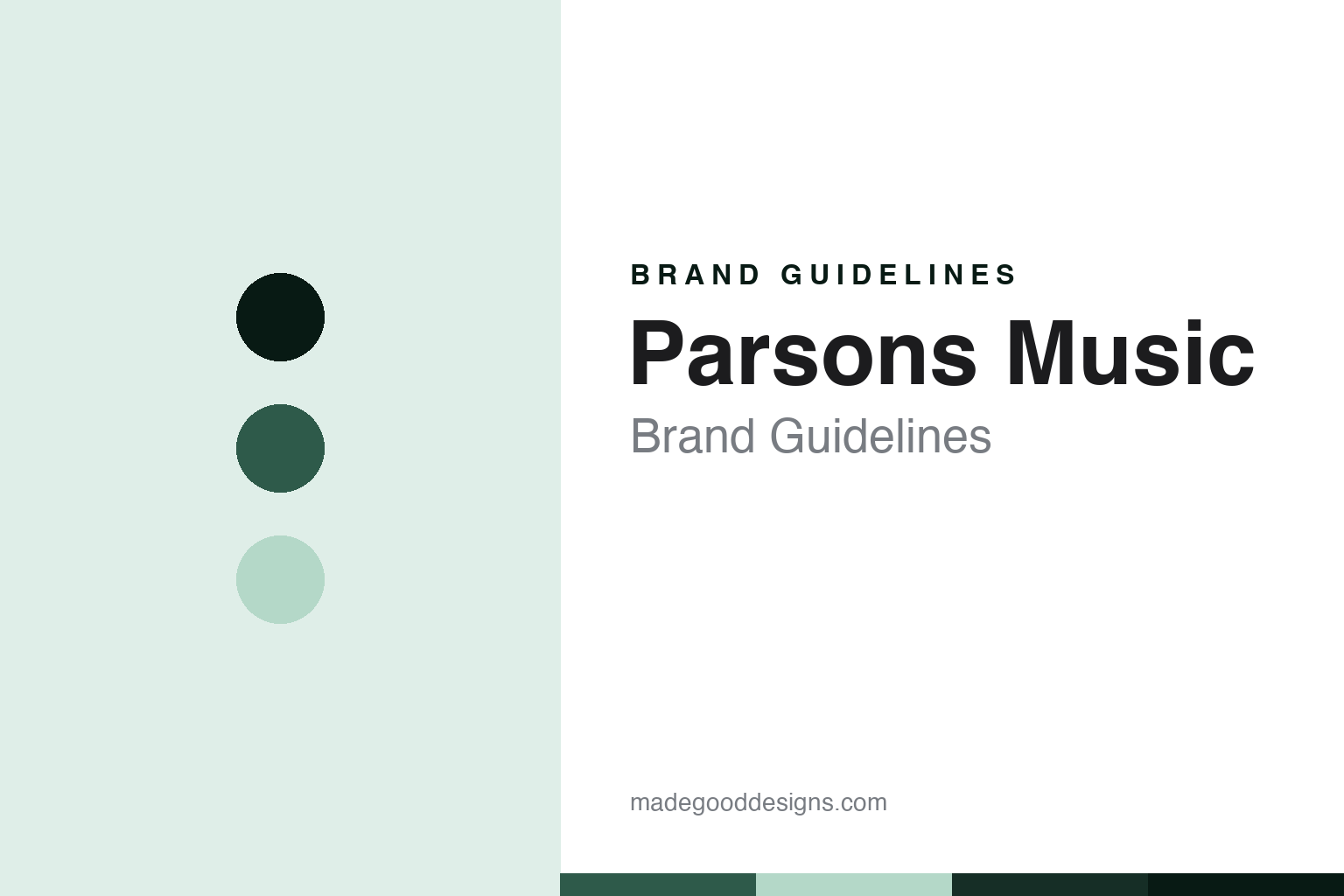
For this guide we use a Yichang green and a pale celadon with a clean bilingual sans. These are an unofficial interpretation, not Parsons’ own colour values — we did not find them published — and nothing of its mark is reproduced.
Explore & save
Keep Parsons Music’s identity on hand — save it to a board in the Made Good inspiration library.
Parsons Music identity set
Pin the Yichang-green palette and the retail-sans register to your own board.