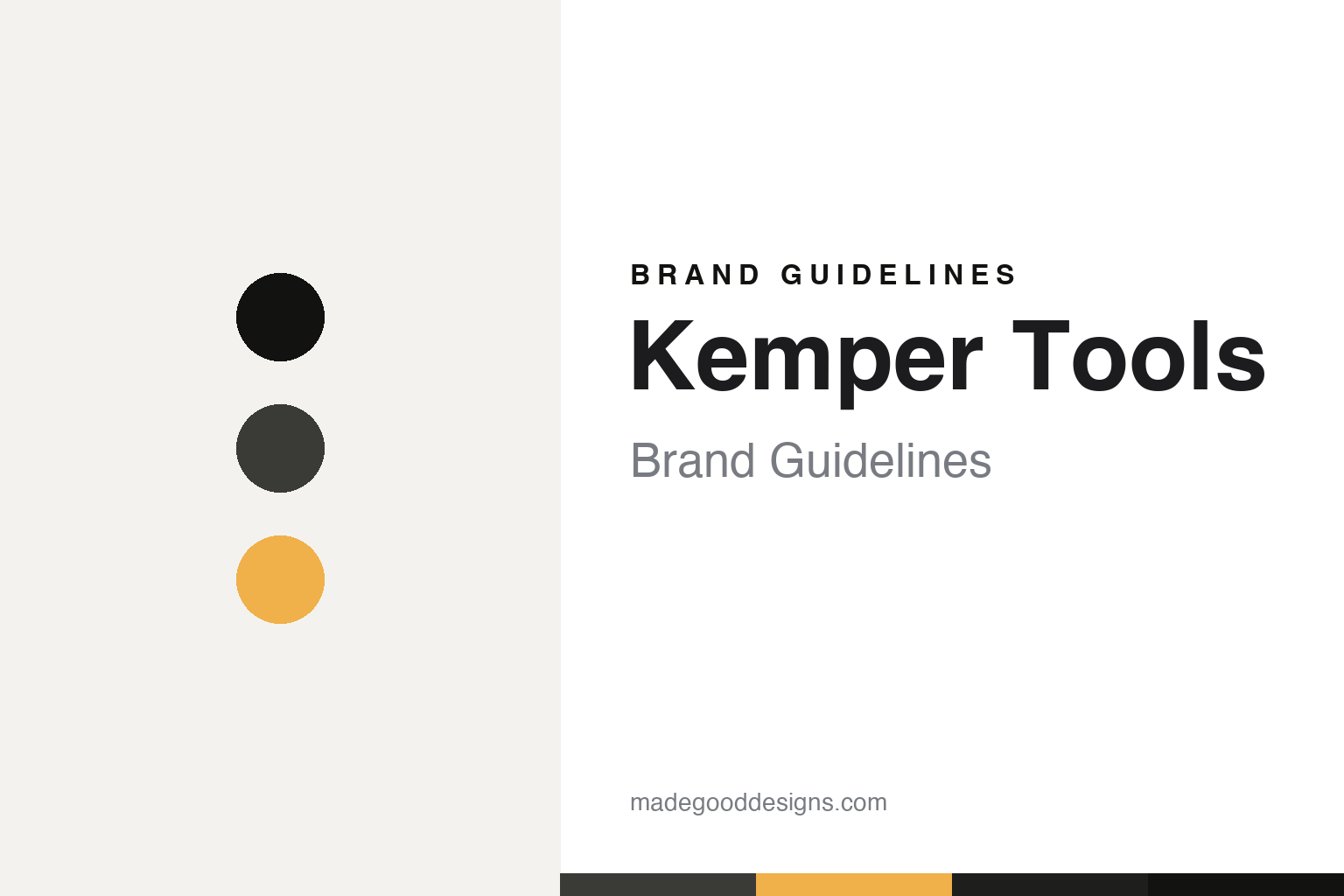
Kemper Tools Brand Guidelines
Closed, reopened, sold — in one summer.
Aa
Two constants: a tool-steel palette and a bold-grotesque register. Abstract homage — not a Kemper product or mark; no tool or logo is reproduced.
One tool, for a friend
Kemper’s story begins with a favour.
The company’s older website told it simply: “It all started in 1947, a friend asked Jack Kemper to make a tool for his class. Jack made his first ceramic tool in his garage in California.” Its current one tells it the same way, more briefly: “Back in 1947, Jack Kemper created a single handcrafted tool in his California garage as a favor to a friend.” From one tool came a company whose ribs, scrapers, loop tools and kits are sold to studios and classrooms across the United States and, by its own account, abroad.
Jack Kemper, the old site said, “studied tools from the early Romans,” and trained under a “96 year old mastercraftsman, Anthony Rigotty,” whose company he later bought. By its own account Kemper grew into “the world’s largest manufacturer of quality ceramic art tools,” selling in “twenty seven foreign countries” — the company’s own claim, which we report as such. “In the early seventies, Kemper MFG. moved to Chino, California.”
In 1981, the same history said, “Jack Kemper retired selling the company to Kempers’ Vice President, Herb Stampfl,” who had joined as an engineer. A line of dollmaking tools followed the next year. For four decades Kemper was Stampfl’s company — a founder’s name carried on by his successor. The website reflected that steadiness: the archived version we read in January 2024 still carried a copyright line from 2004, “Kemper Enterprises,” two decades on.
Colour
June 2024: closing. August 2024: a buyer. September 2024: Laguna.
The summer of 2024 nearly ended the brand. On 6 June 2024, the trade publication Craft Industry Alliance reported in an article on how the news rippled through the ceramics industry, Kemper announced that it would close, after a sale of its building fell through and it could not afford the rent. Herb Stampfl was then 81 and had worked at Kemper since 1968 — fifty-six years at one company, more than forty of them as its owner. He was quoted saying: “We didn’t want to leave anyone in a lurch.” It is a very small-business sentence.
Two months later the closure was reversed. On 6 August 2024, the same report said, Kemper announced that a buyer had been found. The buyer named itself in a letter dated 16 September 2024: “We are very excited and thrilled to announce Laguna’s purchase of Kemper Tools. The Kemper business will remain in California at their current location in Chino.” The letter was published by Laguna Clay’s sister trading name, Axner. Craft Industry Alliance had reported that the business would relocate within the area; we give both statements, attributed, because they differ.
Kemper’s current about page names the new leadership: “Today, under the leadership of Bryan Vansell… Kemper remains proudly rooted in the U.S.A.” Vansell, trade profiles say, is the president and owner of Laguna, which had itself been bought by Terrakotta in 2017. So the pottery-tool brand that began with one man’s favour to a friend now sits beside a clay brand that began with one man’s van on a beach, under one owner. No sale price was published for either deal.
Typography
“Proudly rooted in the U.S.A.” — a careful phrase.
Kemper’s origin wording has changed in a small but telling way. The old site said: “Located in the U.S.A., we have handcrafted tools for the Ceramic Arts for over 50 years.” The new one says the company “remains proudly rooted in the U.S.A.” Neither sentence says “Made in USA,” and we found no such claim on the current about page. “Rooted” describes a company; it is not a statement about where each tool is made. We report it exactly as written.
Its tools are the potter’s most intimate equipment — the rib that smooths a wall, the wire that cuts a pot from the wheel, the loop that trims a foot. Its range includes the PTK pottery tool kit, RB ribs, S-series steel scrapers, 8R ribbon tools and a Pro 400 series. Trimming and scraping are also among the dustiest moments in the studio, when dried clay comes off as fine particles. Britain’s Health and Safety Executive warns that respirable silica dust “is very fine and invisible under normal lighting” and “can get deep into the lungs,” and since 2018 American employers have been held to 50 micrograms of respirable crystalline silica per cubic metre over an eight-hour day. A good tool does not make dust; the way it is used, and the way the bench is cleaned, decide how much ends up in the air.
Kemper is not the only American art-supplies name in this round to be carried by a larger owner: Speedball, the North Carolina maker best known for lettering pens and printmaking, has been buying smaller brands — a pottery-wheel maker among them — for nearly two decades, since 2008. The company that nearly closed in 2024 thus sits squarely within this round’s theme: the brand is a name, a history and a range of tools, and its continuity depended in the end on whether someone would buy it.
Aa
A heavy, confident grotesque — the weight of a steel tool in the hand. (Specimen set in Archivo Black, a sans STAND-IN; NOT the Kemper logo or products.)
Uncle Kemper
The new voice is avuncular. The mark is plain.
Under Laguna, Kemper has found a new tone of voice. Its homepage says: “If your uncle didn’t teach you the basics of ceramics, don’t worry Uncle Kemper has your back!” And it adds a manifesto line in capitals: “WE EXIST TO PROVE THAT ART IS FOR EVERYONE.” The old site’s heading had been grander — “World Leader in Quality.” The shift is from a manufacturer’s boast to a teacher’s welcome, which suits a brand sold to people learning the craft.
The logo is plain: an off-white wordmark reversed out of near-black, with a separate “K” mark in the footer — the kind of mark that can be stamped on a wooden handle as easily as printed on a web page. It does not try to look old, though the company is nearly eighty. The identity rests on the name and on the tools in the drawer.
For this guide we use a tool steel and a warm brass with a heavy grotesque. These are an unofficial interpretation, not Kemper’s own colour values, and nothing of its logo is reproduced.
Explore & save
Keep Kemper Tools’s identity on hand — save it to a board in the Made Good inspiration library.
Kemper Tools identity set
Pin the tool-steel palette and the bold-grotesque register to your own board.