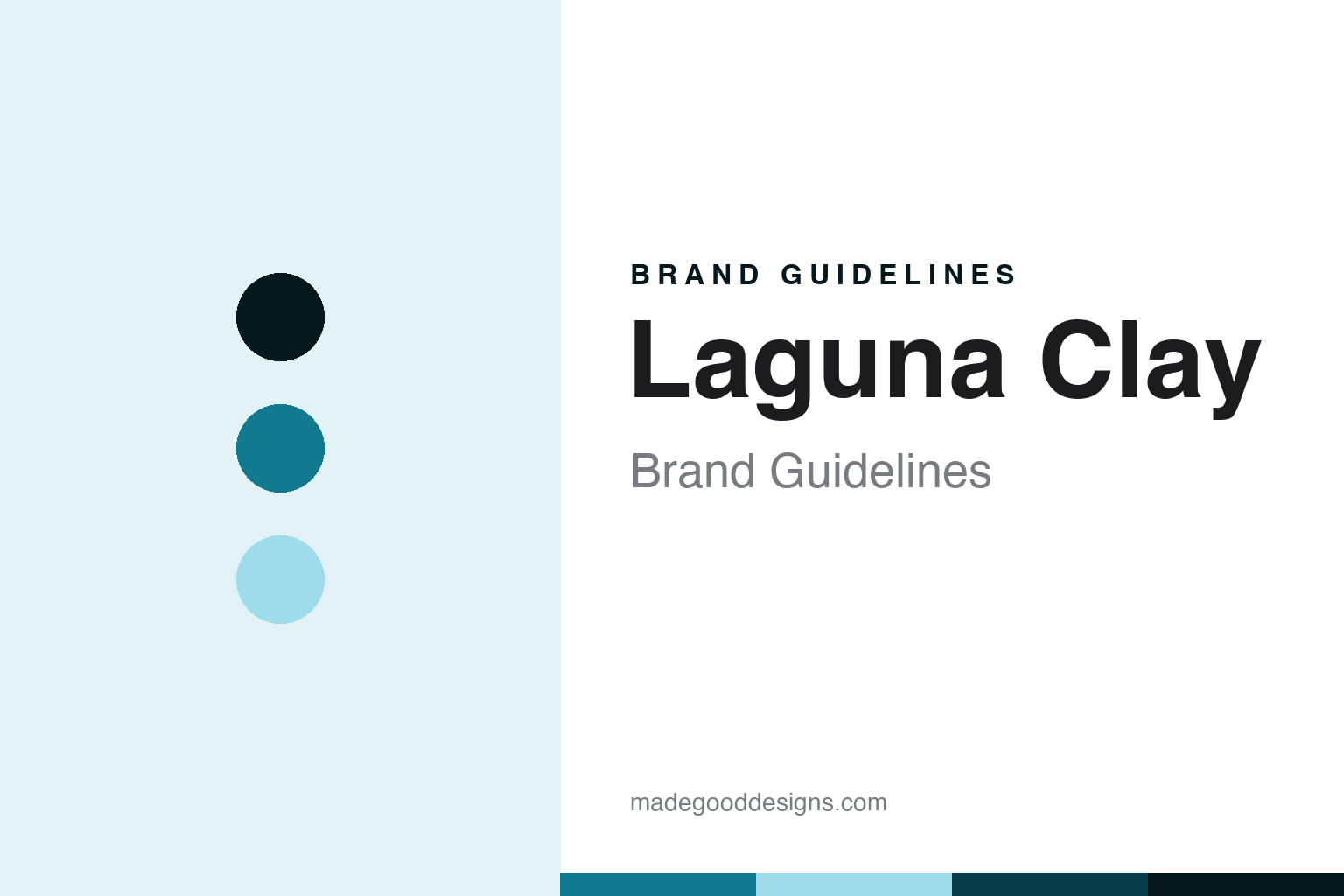
Laguna Clay Brand Guidelines
Beach van to clay company, with a warning.
Aa
Two constants: a Pacific-teal palette and a hand-script register. Abstract homage — not a Laguna product or mark; no clay, script logo or label is reproduced.
Pots from the back of a van
Laguna’s founding story is the most Californian in this series.
Laguna Clay tells its beginning as a scene: “In 1976… Laguna Clay was born. Our founder set up shop right on the beach, selling pots… from the back of his van.” Its own page does not name him. A business profile names Jon Brooks as the company’s longtime president, and says he learned clay chemistry from his geologist father, but we do not state that he was the founder, because the company does not.
From a van it grew into a supplier with sites in three states and a catalogue that runs from moist clays and glazes to equipment. Trade sources list a string of acquisitions along the way, among them Mineral Ceramic Products, S. Paul Ward, Westwood Ceramic Supply, Pacifica potter’s wheels and Miller Ceramic Supply. We give those as the trade record lists them; the company’s own pages do not set out the full history.
Its logo is a hand-lettered script, “Laguna,” in bright cyan with a black outline, over “CLAY COMPANY” in thin black capitals — a beach-town signature on an industrial product. It is the only script logo in this round, and it carries the founding story better than any tagline could.
Colour
In 2017 the founder’s era ended with a sale to Terrakotta.
The ownership change is documented by the buyer. In an announcement dated 20 July 2017, the ceramic supplier Axner said that Jon Brooks had sold Laguna Clay Company to Terrakotta, Inc., with Bryan Vansell as president. Its footer now reads: “Axner and Laguna are trade names of Terrakotta, Inc.” Two well-known names in American ceramic supply are, in law, one company’s trading styles.
Under its new ownership Laguna has kept buying. In a letter dated 16 September 2024 it announced “Laguna’s purchase of Kemper Tools,” the California maker of pottery hand tools founded in 1947, which had announced its own closure that June; “The Kemper business will remain in California at their current location in Chino,” the letter said. Our Kemper guide tells that story from the other side.
Where its products are made is spread across the country. Laguna lists sites at City of Industry, California; Byesville, Ohio; and Oviedo, Florida, the last being the Axner branch. Trade listings describe manufacturing in California and Ohio. One line on its own site is specific: “Made in our sunny-side Florida facility, check out our Colored Porcelains.” We report each statement as given, and do not assign every product to a particular plant.
Clay is heavy and costly to ship, which is one plausible reason a supplier would make it in more than one region; the company itself does not explain its footprint, and we offer that only as a reading.
Typography
“Some of our products can expose you to chemicals including crystalline silica.”
Laguna’s most unusual piece of branding is a warning. Its website footer reads: “Some of our products can expose you to chemicals including crystalline silica, which are known to the State of California to cause cancer, and Lithium Carbonate, which is known to the State of California to cause birth defects or other reproductive harm.” That is California’s Proposition 65 at work: a company selling into the state must warn about listed substances its products can expose people to, and clay contains silica.
Other makers in this series respond to the same law differently. In 2026 the Indianapolis glaze maker AMACO began shipping products with redacted labels, explaining that it was acting “to minimize frivolous lawsuits” under California’s labelling law and that “Nothing has changed in the formulation.” Laguna, by contrast, prints a standing warning on every page. Two answers to one statute — one removes what might invite a claim, the other states the hazard plainly.
The hazard is real and specific to the studio. Dry clay, glaze materials and sanding dust can put respirable crystalline silica into the air, which is why it is regulated as a workplace hazard as well as a labelling one. A clay company that names silica in its own footer is telling its customers something every pottery teacher eventually has to: the material is beautiful, and its dust should not be breathed.
Two legal regimes sit behind that footer. California added crystalline silica — in its words, “airborne particles of respirable size” — to the Proposition 65 list of carcinogens on 1 October 1988. And since 23 June 2018, the federal workplace standard, 29 CFR 1910.1053, has required American employers to ensure that “no employee is exposed to an airborne concentration of respirable crystalline silica in excess of 50 μg/m3,” averaged over eight hours, with action required from 25; employers with objective data showing exposure will stay below 25 “under any foreseeable conditions” are outside it, and medical surveillance for workers above the action level began in June 2020. OSHA lists pottery and ceramics among the products made with silica. The standard has few exemptions, and the only clay it carves out is “sorptive clays” — absorbent clays of the cat-litter kind, not potter’s clay. A clay manufacturer’s own plants fall squarely inside it; a hobbyist working alone at home is a different matter, since the rule binds employers. Laguna’s factories, as employers, fall within that standard; its footer is the consumer-facing edge of the same hazard. OSHA estimates that about 2.3 million people in the United States are exposed to silica at work, and California’s air-quality board has long listed ceramics, brick and clay-pipe manufacturing among the industries that release it.
Aa
A loose, cheerful hand-script — a signature written on the beach. (Specimen set in Pacifico, a script STAND-IN; NOT the Laguna script logo or products.)
A script and a footer
The logo tells the story. The footer tells the truth.
Laguna’s identity has two halves. The script logo, in cyan, sells the origin: a founder, a van, the Pacific. The warning in the footer sells nothing; it states what the law requires and what the material contains. Together they make an honest brand — a warm story on top, a plain statement underneath.
For designers, the lesson is that a safety statement is part of a brand’s voice whether the company wants it to be or not. Laguna chose to keep the warning visible on every page rather than bury it; that choice is as much an identity decision as the script.
For this guide we use a Pacific teal and a pale surf tone with a cheerful hand-script, after the logo’s colour and form. These are an unofficial interpretation, not Laguna’s own colour values, and nothing of its script logo is reproduced.
Explore & save
Keep Laguna Clay’s identity on hand — save it to a board in the Made Good inspiration library.
Laguna Clay identity set
Pin the Pacific-teal palette and the hand-script register to your own board.