Irmler Brand Guidelines
“Designed by,” not “made by.”
Aa
Two constants: a silver-grey palette and a script register. Abstract homage — not an Irmler product or mark; no piano or logo is reproduced.
An old Leipzig name, revived
Irmler is a name from 1818 and a company from 1999.
Irmler’s own history begins in 1818, in Leipzig, with Johann Christian Gottlieb Irmler. It credits the firm with a grand-piano action of 1842 and with medals from the Saxon court, and it records an ending: the factory was destroyed in 1943, and, the history says, “In 1953 the eastern German administration decided not to continue.” For forty-six years there was no Irmler piano.
Then: “1999 The well known Irmler Piano Company was re-established.” The company that holds the name today is Irmler Piano GmbH, registered in Leipzig, with an address at Dechwitzer Straße 12 in Großpösna — the address of the Blüthner factory. Its managing director, its legal notice says, is Dr. Christian Blüthner-Haessler, who has co-managed Blüthner with Knut Blüthner-Haessler since 1995, according to Blüthner’s history, and who also chairs the German piano makers’ association. The revival came in the same years as Blüthner’s own rebuilding: the family built a new factory at Störmthal, near Leipzig, between 1994 and 1997. Piano Buyer called Irmler “a sister company of Blüthner” and said “Blüthner also owns the Irmler brand.” North Data’s summary of the commercial register shows a merger of Irmler Piano GmbH with Blüthner’s company published in September 2024.
One registry detail is worth noting. The registered purpose of Irmler Piano GmbH, as North Data records it, is “Der Handel mit Klavieren und Flügeln” — trade in pianos and grands. That describes a company that sells instruments, not one that builds them — consistent with a brand whose name is held in Leipzig while, by Piano Buyer’s account, much of its making happened elsewhere.
Colour
“Designed by Blüthner.” One word apart from its sister brands.
Blüthner labels its brands with care. On its website, Rönisch and the Haessler line appear as “made by Blüthner.” Irmler appears as “Irmler designed by Blüthner”, and the Irmler logo itself carries the words “DESIGNED BY BLÜTHNER.” Irmler’s site says its Supreme line is “designed by the Blüthner factory in Leipzig, Germany,” and that its Studio line has “supervision of manufacture and final quality inspection by a German master craftsman.”
We searched eight pages of Irmler’s site, and Blüthner’s Irmler page, for any statement of where the pianos are built — “China,” “Asia,” “Made in,” “Germany,” “Deutschland.” The only hit was the sentence about design in Leipzig. Neither site names a country of manufacture.
Piano Buyer did. In identical text archived in 2016 and 2019, it wrote: “The Studio series is largely made in a factory in China owned by Irmler. The pianos are then shipped to the Blüthner factory in Germany, where Abel hammers are installed.” The Professional series, also called Irmler Europe, it said, “is assembled in Germany using strung backs” from Samick in Indonesia and cabinets from Poland — and it added that “suppliers are subject to change.” It noted that Studio models were also sold under the name Schiller. That account is several years old, and we cannot say whether the arrangement is unchanged.
Typography
Not on the seal list — and not claiming to be.
Irmler is not on the German makers’ seal list. The Bundesverband Klavier (BVK) certifies only brands made “zu 100 % in Deutschland,” and its 2026 list includes Blüthner, Blüthner Digital, Haessler and two Rönisch marks — but not Irmler. The list is laid out by maker, so the omission is visible beside its sister brands. Irmler does not claim otherwise: “designed by” is a different promise from “made in,” and the logo says so.
The legal question of origin is a narrower one. Under EU customs law, goods made in more than one country originate where they underwent their “last, substantial, economically-justified processing or working,” in the words of Article 60 of the Union Customs Code. That is a customs test, not a labelling rule, and we do not apply it to any particular piano. But it explains why “where is it made?” rarely has a one-word answer for an instrument of the kind Piano Buyer described — a body built in one country and finished in another.
The economics are plain. China made about 376,000 pianos in 2013, “almost 80 percent of the world’s total,” the Chinese government’s English site reported; Germany’s official survey of firms with twenty or more staff counted 1,336 uprights and 1,286 grands in 2024. Many Western makers that sell at entry prices have turned to Asian factories; Irmler’s “designed by” is the wording that such a choice permits.
There is an irony in that wording. In 1896 the English writer Ernest Edwin Williams, in his polemic “Made in Germany,” noted that German makers were “rather grateful than not” for the British law that forced them to mark their goods, because the stamp was “more of an advertisement than a brand.” A century later the advertisement still works — and a brand that cannot use it has found a phrase that borrows some of its weight.
Aa
A silver script — a heritage name rendered with a modern finish. (Specimen set in Fraunces, a serif STAND-IN; NOT the Irmler logo.)
Designed by Blüthner
A script name and a line of small capitals.
Irmler’s logo is a silver-grey script, “Irmler,” above the line “DESIGNED BY BLÜTHNER” in small capitals. The script gives the old Leipzig name its heritage; the capitals give it its guarantee. It is rare for a logo to state, in the mark itself, the precise nature of the relationship between two brands, and rarer still for it to choose the more modest verb.
For a design guide, Irmler shows how an endorsement line works. “By Blüthner” borrows the trust of a famous name; “designed” sets the limit of the claim. Its sister brands use the stronger verb on Blüthner’s site; Irmler uses the weaker one on its own logo. Blüthner now owns a family of names: its own; the Haessler line, added in the 1990s, Piano Buyer said, “to better compete in the American market” and priced about a quarter lower; Rönisch and Hupfeld, bought in 2009; and Irmler. Each sits at a different distance from the Leipzig workbench, and the verbs record the distance. A buyer who reads both words carefully learns exactly what each brand promises.
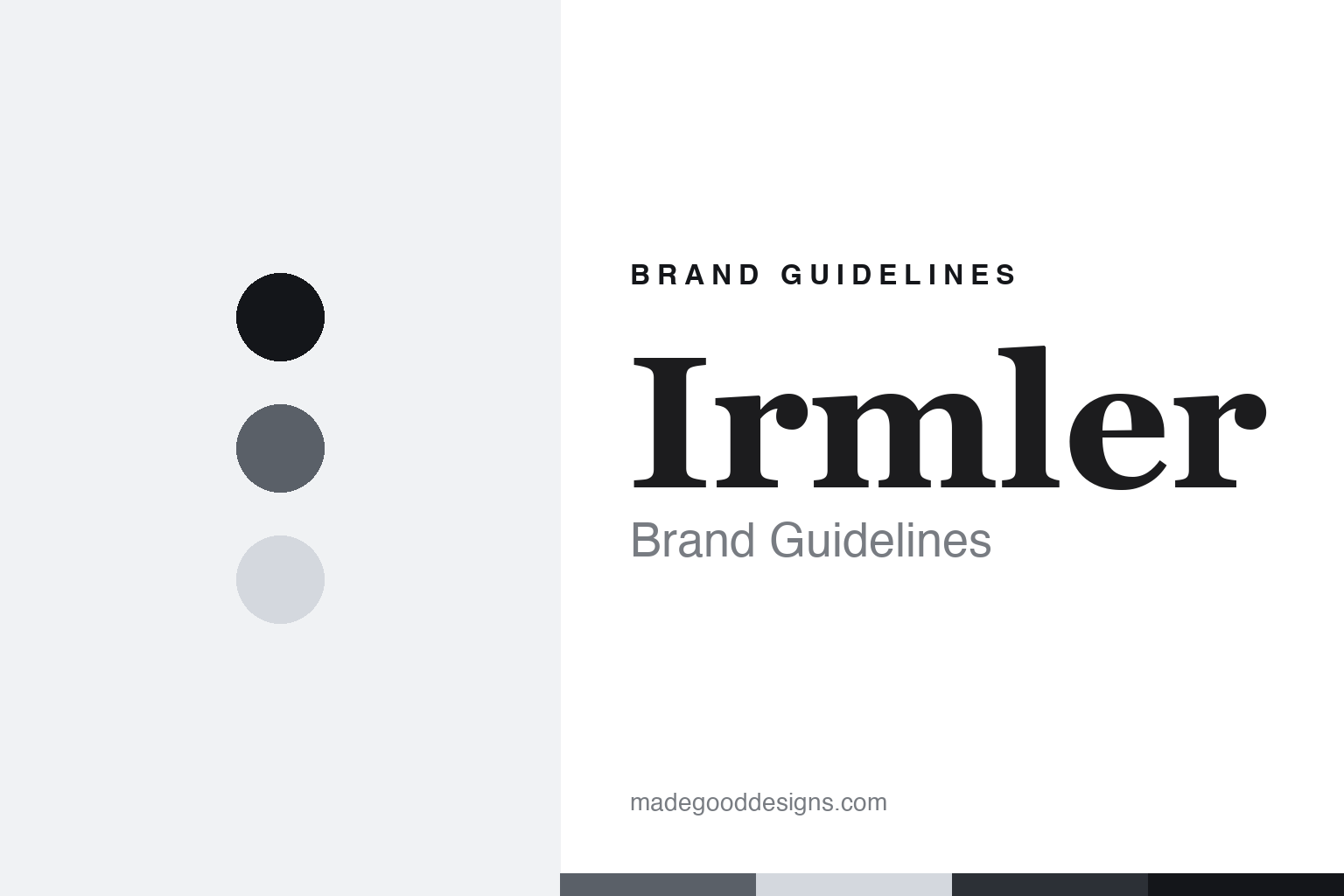
For this guide we use a silver grey and a pale silver with a serif stand-in for the script. These are an unofficial interpretation, not Irmler’s colour values, and nothing of its logo is reproduced.
Explore & save
Keep Irmler’s identity on hand — save it to a board in the Made Good inspiration library.
Irmler identity set
Pin the silver-grey palette and the script register to your own board.