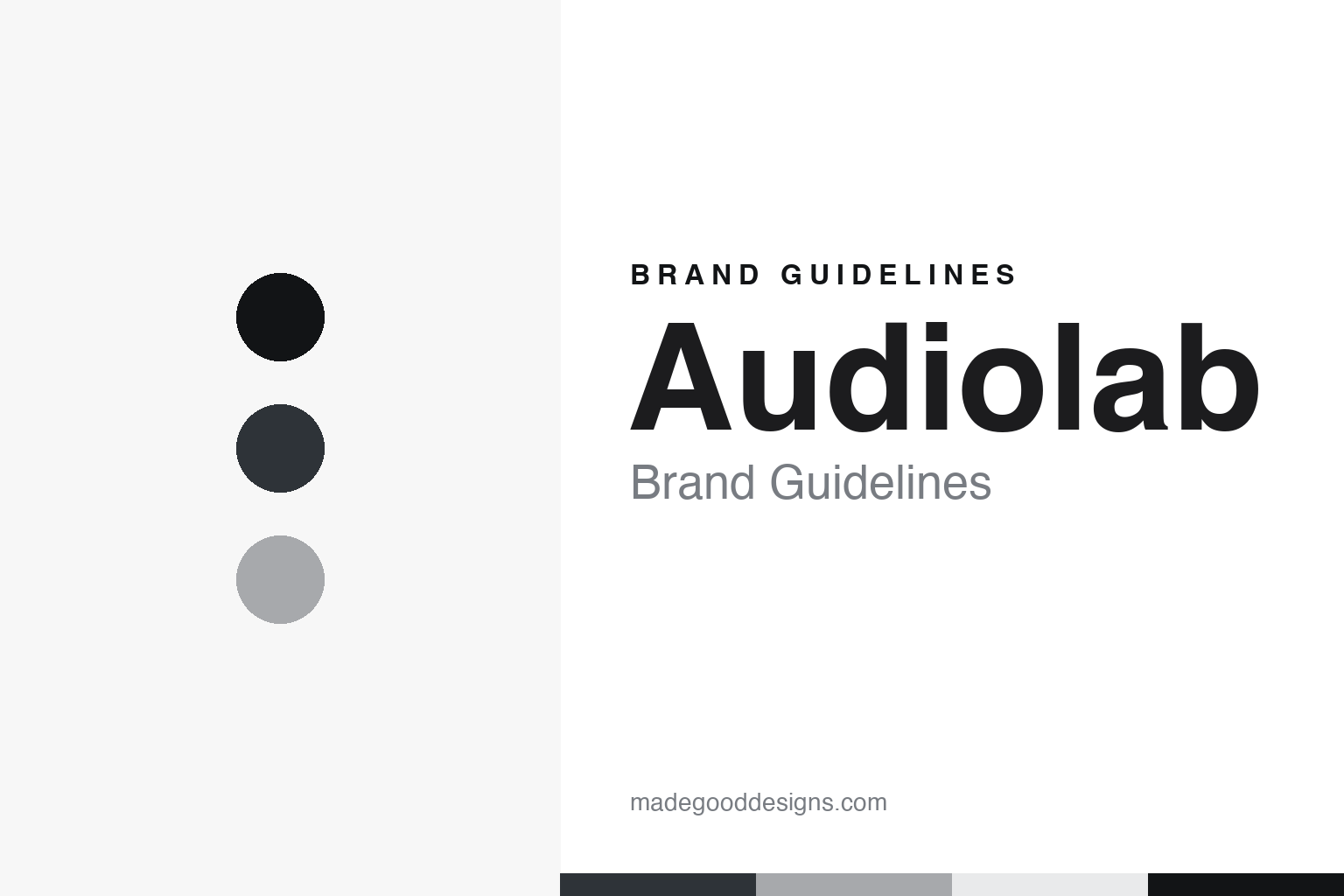
Audiolab Brand Guidelines
The 8000A amplifier maker that passed from TAG McLaren to IAG.
Aa
Two constants: an Audiolab gunmetal and grey palette, built around the one colour its brand guide publishes, and a Wide sans register. Abstract homage — not an Audiolab product or mark; no amplifier, logo or nameplate is reproduced.
Affordable high end
Two graduates, a bedroom and an amplifier.
Audiolab was founded in 1983 by Philip Swift and Derek Scotland. English Wikipedia and the company’s own history say the two met as students at Imperial College London and shared a frustration with the high cost and complexity of hi-fi equipment. The radio-history database Radiomuseum gives the trading company’s name as Cambridge Systems Technology Ltd, “trading as Audiolab.”
A 2013 retrospective on the zstereo blog, which quotes Swift at length, fills in the start: “It all started in a Cambridge bedroom,” it says, in the autumn of 1982, after Swift left his job as a director of Lentek Audio. That piece describes Swift as a physics graduate of Cambridge University and Scotland as a mechanical engineer, so the sources differ on where Swift studied; we note both. Swift’s stated aim, in the same piece, was “affordable high end.”
The first product was the 8000A integrated amplifier, launched in October 1983, according to the 2013 piece. It quoted 50 watts per channel into 8 ohms and, in its first form, came in “a dark gunmetal grey colour, made from sturdy sheet steel.” Its tone controls worked at 100Hz and 10kHz and were laid out horizontally, and Swift claims it was the first amplifier with a dedicated CD input — his claim, which we could not check. Audiolab’s own history calls the 8000A the brand’s first commercial success and one of the reference amplifiers of the 1980s British hi-fi press.
The range grew around it: the 8000C preamplifier, the 8000P power amplifier and the 8000M mono-blocks, then CD players, the 8000T tuner and a digital-to-analogue converter, the 8000 DAC. IAG’s brand page adds the 8000S, a remote-controlled amplifier, and the 8000PPA phono stage. English Wikipedia notes that the products were sold under the name Camtech in Germany and the Netherlands.
Colour
TAG McLaren, then IAG.
Audiolab stayed independent for about fifteen years. At the end of 1997 it was taken over by the TAG McLaren Group, the company linked to the McLaren Formula One team. Stereophile reported the takeover that December, saying a new holding company, TAG Electronics Holdings Ltd, had become the parent of both Cambridge Systems Technology and TAG Electronic Systems, and that Audiolab’s annual turnover had reached about $8.8 million. Companies House records show that holding company was registered in October 1997 and took the TAG Electronics Holdings name that month. Audiolab’s own history and English Wikipedia give the year as 1998.
Under TAG McLaren the products changed their name. IAG’s brand page says the line was reintroduced as the TAG McLaren Audio F3 range. English Wikipedia says the business suffered in the economic slump of the early 2000s and ceased development in mid-2003; Stereophile reported a “strategic review” in October 2003 after redundancies at TAG’s factory in Huntingdon. Audiolab’s own history is blunt: the new branding “failed and sadly ceased operations in 2003.”
The buyer was International Audio Group (IAG), the Shenzhen-based company that English Wikipedia says is owned and run by the twin brothers Bernard and Michael Chang. Stereophile’s Paul Messenger reported on 31 March 2004 that the deal had been signed on 25 March and that IAG had bought the intellectual property and the Audiolab name, but not TAG’s production facilities. IAG already owned Quad and Wharfedale, and says it had set up its UK company in Huntingdon in September 1997. Audiolab returned with a new range in 2005.
The modern catalogue has been built in series. The 8200 series arrived in 2010 — IAG gives 2009 — with digital products designed by John Westlake; English Wikipedia says the 8200CD was a What Hi-Fi? Product of the Year in 2010, 2011 and 2012, and that the M-DAC converter won the same magazine’s award in 2011; Audiolab says the M-DAC won five years running. The 8300 series followed in 2015 and the cheaper 6000 series, designed by the Danish engineer Jan Ertner, in 2017 — IAG says 2018. By the company’s account, the 6000N Play was its first streamer, the Omnia all-in-one arrived in 2021, the 9000 series in 2022, the 7000 series in 2023 and the 9000Q preamplifier and 9000P power amplifier in 2024.
Typography
Britain’s hi-fi electronics record.
Much of Britain’s hi-fi electronics trade clusters in Cambridgeshire. Quad, founded in London by Peter Walker in 1936, moved to Huntingdon in 1941 after being bombed out during the war, English Wikipedia says. Meridian, founded in 1977 by Bob Stuart and Allen Boothroyd, is based in the town, and Cyrus says its research team has worked from its Huntingdon head office since 1984.
Several old British names now belong to one group. International Audio Group (IAG), a Chinese company based in Shenzhen, says it set up its UK arm in Huntingdon in September 1997 after acquiring Wharfedale, Quad, Leak, Ekco and Castle, then added Audiolab in 2004 and Mission in June 2005. It says its manufacturing is centralised at its own factory in Ji’an, in Jiangxi province.
Scotland’s Linn, founded in Glasgow by Ivor Tiefenbrun — in 1973, by the company’s timeline and the company register, though the opening line of English Wikipedia gives 1972 — says each system is built by hand at its factory at Waterfoot, outside the city.
Today, by their own accounts and the records we checked, Audiolab, Leak and Mission give IAG’s address on Glebe Road in Huntingdon; Cyrus, still based in Huntingdon, says it moved its manufacturing to SMS Electronics in Nottingham in 2019; Meridian, on Latham Road in Huntingdon, says its research, design and engineering have been led from Britain since 1977; and Roksan, founded in 1985, has belonged since November 2016 to Monitor Audio, of Rayleigh in Essex.
This guide sets out what can be checked about each brand — who founded it, who owns it, and what it says about where its products are made — and marks clearly what rests only on the company’s own word.
Aa
A wide sans — the brand guide names Eurostile Extended for headings. (Specimen set in Michroma, a wide sans STAND-IN for Eurostile Extended; NOT the Audiolab logo.)
audiolab
A brand guide with one grey.
Unusually for a hi-fi brand, Audiolab publishes a brand guide. A one-page “Audiolab Brand Guide Book,” offered on its website with a file name dated 2020, shows the name as a lower-case “audiolab” wordmark. It names Eurostile Extended Roman as the header font, “for titles, product names, subtitles,” and Open Sans for “all descriptive text,” with Open Sans Italic to be used “very sparingly for awards / quotations.” It gives one colour, a mid grey, #A7A9AC (CMYK 36, 28, 24, 5), which “can be used as an alternative text colour and colour for logos and miscellaneous graphics.” The guide does not name the typeface of the wordmark itself, so we make no claim about it. Its website uses Open Sans and the line “The Sound of Science.”
On manufacturing, the company’s wording is careful. Its team page says Audiolab has been “Designed and Engineered in the UK, since 1983,” names Jan Ertner as a design consultant to IAG working mainly on Audiolab and Quad, and describes an R&D manager working closely with “the IAG factory.” Its website gives its address as IAG House, Glebe Road, Huntingdon, and its history says the brand kept its headquarters and operations in the town. We found no statement on its website about where its products are built. IAG says its manufacturing is centralised at its own factory in Ji’an, in China’s Jiangxi province, and in June 2025 Trusted Reviews said the 6000A MkII amplifier “is made in China.” The fair summary is designed in Britain, by the company’s account, and made in China.
For a design guide, Audiolab shows how a name, a lower-case wordmark and a grey can carry a brand through three owners. Compare Quad, its Huntingdon stablemate in IAG, and Leak, another old British name revived by the same group. For this guide we use Audiolab’s published grey with a gunmetal and near-black and a wide sans; apart from that grey it is an unofficial interpretation, and no product or logo is reproduced.
Explore & save
Keep Audiolab’s identity on hand — save it to a board in the Made Good inspiration library.
Audiolab identity set
Pin the Audiolab gunmetal and grey palette and the Wide sans register to your own board.