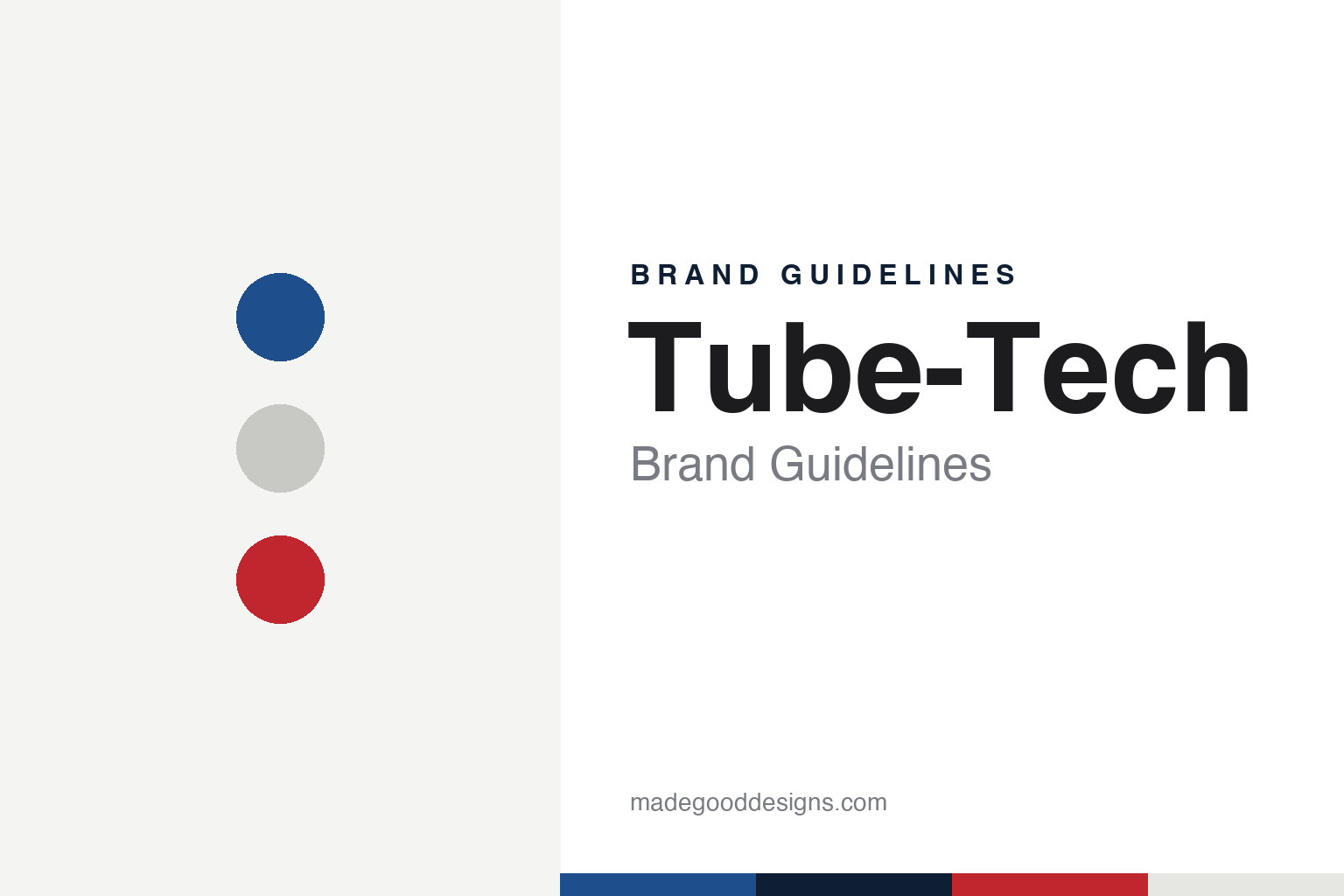
Tube-Tech Brand Guidelines
The Danish valve-gear maker that calls its products “Blue Gear.”
Aa
Two constants: a Tube-Tech blue and red palette and an engineering sans register. Abstract homage — not a Tube-Tech product or mark; no instrument, logo or nameplate is reproduced.
Lydkraft
A broadcast engineer, a PA company and a garage.
Tube-Tech is a brand, not a company. The units are made by Lydkraft — Danish for “sound power,” the company says — which it says was founded in Denmark in 1977 by John G. Petersen and two partners. Lydkraft first served the live-sound (PA) market, but in 1980, by the company’s account, Petersen took over the business and turned it towards direct boxes, mixing desks and speaker systems.
Petersen’s background was broadcast engineering. The company says he trained as an electronics engineer with the Danish Post and Telegraph service in 1969, worked from 1972 as a maintenance engineer for the Danish Broadcasting Corporation, received factory training from makers including Solid State Logic, EMT, Studer and Neumann, and designed record and playback amplifiers for Lyrec tape machines. It also says he rebuilt a console from London’s Workhouse Studios for a Copenhagen studio, MOX, which bought it in 1979.
In the early 1980s, the company says, Petersen came across classic valve processors such as Pultec equalizers and the Teletronix LA-2A compressor, and in 1984 began developing his own. The first unit to carry the Tube-Tech name, the PE 1A program equalizer, shipped in 1985 and was built in Petersen’s garage. The company is candid that the PE 1A and the ME 1A midrange equalizer that followed were “almost direct copies of the Pultec units,” and says the later range was designed by Petersen from the ground up. Sound On Sound confirmed the timeline in December 2005, when Paul White wrote that “the Danish company Tube-tech recently celebrated their 20th birthday.”
Colour
CL 1B, SMC 2B and the RM series.
The product most associated with the brand is the CL 1B optical compressor. By the company’s own timeline, the hard-wired CL 1A of 1987 became the CL 1B in 1991 — the same circuit built on circuit boards — alongside board-built versions of the equalizers, the PE 1C and ME 1B. The MP 1A two-channel microphone preamplifier dates from 1987, the LCA 2B stereo compressor, which the company says uses a valve as its gain element, from 1993, and the EQ 1A parametric equalizer from 1995.
Later units combined functions. The MEC 1A recording channel of 1997 put a preamplifier, equalizer and optical compressor in one box. The SMC 2B of 2000, which Tube-Tech calls “the World’s first Tube Multiband Compressor,” a claim we have not been able to check, was followed in 2004 by the MMC 1A, a microphone preamplifier with multiband compression. Reviewing the MEC 1A and MMC 1A for Sound On Sound in 2005, Paul White noted that engineers had found the earlier multiband compressors “sounded great on vocals,” which led to the MMC 1A. Summing amplifiers followed in 2004 and 2005, a modular RM series in 2008 and 2009, the MP 2A preamplifier in 2012 and the HLT 2A shelving and tilt equalizer in 2014, which the company says won a TEC Award at NAMM in 2016.
The brand also reaches software users. The plug-in maker Softube sells a Tube-Tech CL 1B plug-in, now in a Mk II version, which it calls “a modern classic and hip hop hero.” The Tube-Tech site quotes users including the engineer Al Schmitt on the SMC 2B; we give those endorsements as the company presents them.
Typography
Valves in the studio.
Studio outboard — the reverbs, delays, compressors, equalisers and preamps that sit in racks beside a mixing console — is a small trade, much of it started by engineers working for themselves. The seven makers in this guide span digital effects, valve processing and licensed recreations of vintage studio equipment.
Two are American digital pioneers of the early 1970s. Eventide began that year in New York City and now dates its press releases from Little Ferry, New Jersey; we found no record of a sale to a larger group. Lexicon began in 1969 as American Data Sciences, took the Lexicon name in 1971, was based in Waltham, Massachusetts, and was bought by Harman in 1993, Harman announced at the time; Samsung completed its purchase of Harman in March 2017.
TC Electronic was founded in Aarhus, Denmark, in 1976 by the brothers Kim and John Rishøj. In April 2015 MusicRadar reported that its parent, TC Group, had been bought by Music Group, the Behringer owner now called Music Tribe.
The analogue makers are smaller. Empirical Labs, founded by Dave Derr, who had helped design Eventide’s H3000, lists a New Jersey address and says all its products are made in the USA. Manley Laboratories builds valve equipment in Chino, California, and was bought in July 2025 by Rockforce Tech Holding, a company founded by Dirk Ulrich, Mix reported. Tube-Tech is the brand of Lydkraft, near Copenhagen. Chandler Limited, which Wade Goeke founded in 1999, is in Shell Rock, Iowa, and the company names him as its owner.
This guide sets out what can be checked about each brand — who founded it, who owns it, and what it says about where its products are made — and marks clearly what rests only on the company’s own word.
Aa
An engineering sans — the brand writes its name in capitals as TUBE-TECH. (Specimen set in Archivo, a sans STAND-IN; NOT the Tube-Tech logo.)
Blue Gear
Five axioms and a factory outside Copenhagen.
Tube-Tech’s design rules are written down. Its “design manifesto” sets out five axioms: only valves in the audio path; get the best from each valve; keep circuits and controls simple; use transformers on every input and output; and “design everything to last.” The site quotes Petersen, from a 2012 interview with Mix, saying that valves “place serious constraints on how much circuitry you can build into a unit,” so a circuit “has to stand by itself.” Sound On Sound found the same in 2005: “Tubes are used throughout the audio path — no hybrid circuitry here.”
The look is just as consistent. The company calls its products the “Blue Gear” and says more than 15,000 “Blue Units” have been shipped from Lydkraft. Paul White described units “impeccably engineered, with retro Bakelite-style knobs, metal switches, and red power lamps that could double as aircraft warning lights.” The brand writes its name in capitals as TUBE-TECH, with the slogan “Gear for Life.”
On ownership and manufacturing we rely on the company. Its website names Lydkraft ApS of Rødovre, Denmark, as the maker, says the factory is about 6 km from the centre of Copenhagen, and describes Lydkraft as “a small, 6-person company” with Petersen as president and designer — on a page first published in 2017. We found no report of a sale or change of control in the sources we checked, and the company’s product and distribution pages were still being updated in 2026. No other manufacturing site is described.
For a design guide, Tube-Tech shows how one colour and one set of rules can hold a range together for four decades. Compare Manley, the Californian tube-gear maker whose owner named Tube-Tech as one of the few valve studio brands of the late 1980s, and SPL, the German studio-processor maker. For this guide we use panel blue, night blue and a lamp red with a sans, an unofficial interpretation; no product or logo is reproduced.
Explore & save
Keep Tube-Tech’s identity on hand — save it to a board in the Made Good inspiration library.
Tube-Tech identity set
Pin the Tube-Tech blue and red palette and the engineering sans register to your own board.