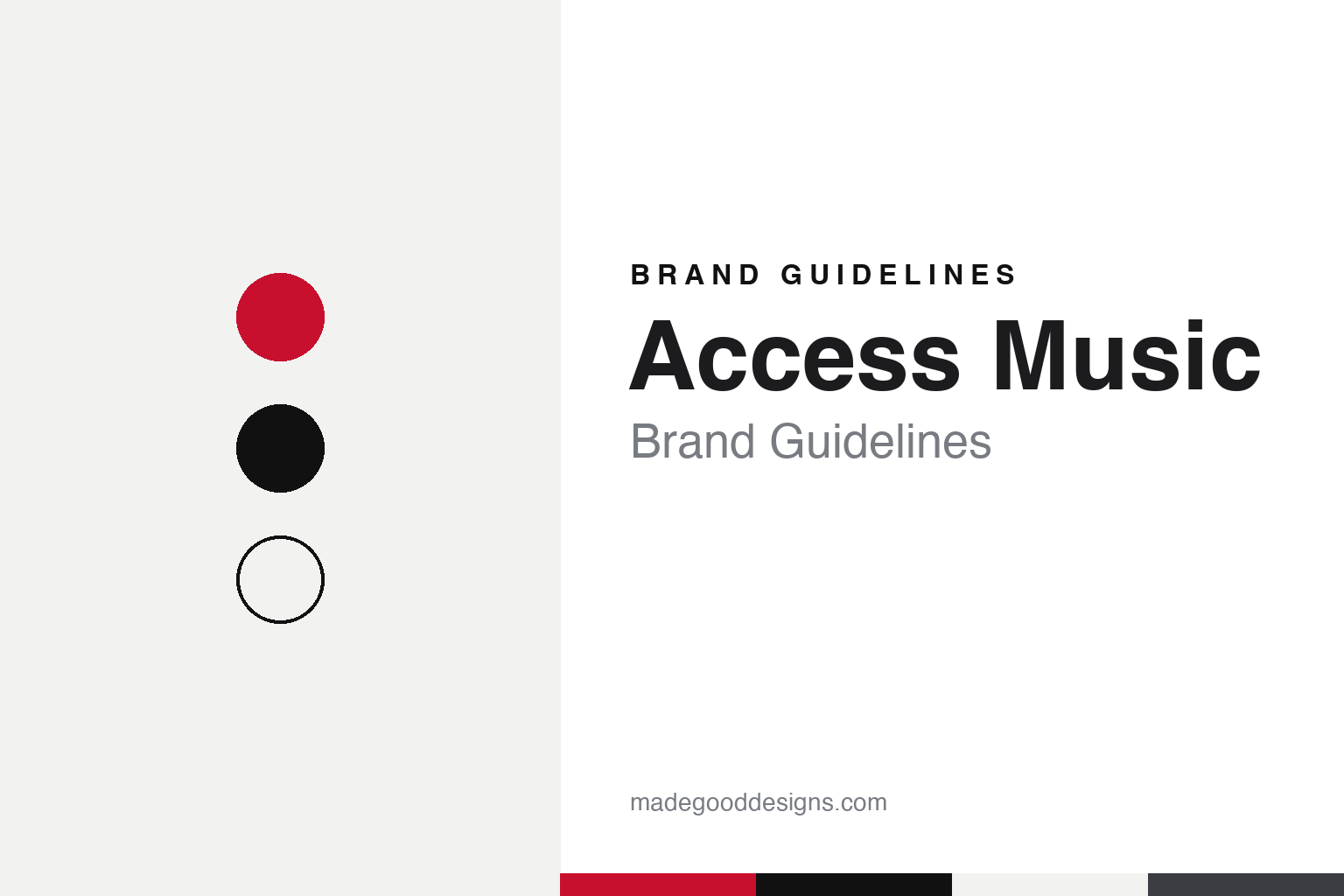
Access Music Brand Guidelines
The Ruhr company whose one instrument, the Virus, became its whole identity.
Aa
Two constants: an Access red and black palette and a Condensed sans register. Abstract homage — not an Access product or mark; no instrument, logo or nameplate is reproduced.
Access MIDI Tools
Programmers for other people’s synthesizers.
Access Music is best known for one instrument, the Virus, but it began by making accessories for other people’s synthesizers. Its first products were hardware programmers — boxes of knobs for synthesizers that had few controls of their own — sold under the name Access MIDI Tools for the Oberheim Matrix-1000 and the Waldorf Microwave, according to English Wikipedia, which cites a Sound On Sound review of September 1996. The company later explained its name in the same terms: its mission, it said, had been to build hardware editors to “access” the sound parameters buried in menu-driven synthesizers.
The founder named in the sources is not Christoph Kemper. The German magazine Sound & Recording wrote in 2018 that Guido Kirsch had founded Access, and that Christoph Kemper, whom it called “the father of the Virus,” teamed up with him; English Wikipedia says the same. By 2002 the company’s website imprint listed Kemper and Kirsch as its two managing directors. Kirsch left in 2007 to start Neo Instruments, according to English Wikipedia, and Kemper stayed. The company itself later gave 1997, the year of the Virus, as its founding year, though its programmers were being reviewed the year before; we give both.
Kemper is a Recklinghausen man, in Sound & Recording’s phrase. The magazine says he studied electrical engineering in Bochum, played keyboards in rock bands and in the 1990s began writing effects and filters for Motorola’s 56000-series signal processors, aiming for a digital filter that behaved like an analogue one even under fast modulation. That filter, it says, defines the sound of the Virus. Access was based in Recklinghausen, in the Ruhr, too: a 2003 profile in Welt am Sonntag described six offices on the fourth floor of an ordinary office building, with no sign on the door.
Colour
Twenty-odd years of one synthesizer.
The trigger was another synthesizer. When Clavia’s Nord Lead appeared in 1995 — a digital instrument that imitated analogue synthesis — Kemper decided to build his own, Sound & Recording says. The first Virus, later called the Virus A, was unveiled at the Frankfurt Musikmesse in February 1997, a red-and-black desktop module. Welt am Sonntag reported that 300 were sold that year, and that by 2003 Access was selling about 4,200 instruments a year, at €800 to €2,300 each, with 80 per cent of its business abroad.
Its own pages stressed that the Virus “wasn’t trying to clone any particular vintage product,” and that free software updates had become its hallmark: the first Virus had 12 voices, and by 2014, the company said, the count had grown to nearly a hundred. The Virus B of 1999 brought better converters and more voices, with keyboard, rack and Indigo versions; the Virus C, unveiled at the Musikmesse in 2002, extended it again. The Virus TI — for “Total Integration” — could work as a plug-in inside music software over USB, and the TI2 followed in March 2009, in Desktop, Keyboard, Polar and Darkstar versions, alongside a compact Snow model. In November 2009 Access announced a white limited edition of 100 TI Desktops, each with a laser-engraved serial number. Versions of the Virus also ran on Pro Tools TDM systems and on TC Electronic’s PowerCore cards.
The line ended quietly. In February 2024 MusicRadar, citing an interview in Amazona, reported that Kemper had confirmed that the TI2, the final model, had been out of production for a few months; German Wikipedia says no Virus has been made since February 2024. MusicRadar added that Kemper had not ruled out a TI3 but was concentrating on his amplifier business — and that the closest thing to a new Virus was probably Waldorf’s Kyra.
Typography
Design and documentation.
Beyond the largest names in electronic instruments sits a tier of smaller synthesizer makers, some dating from the 1960s and others barely a decade old. Many have changed hands.
Oberheim, founded by Tom Oberheim in 1969, passed to Gibson after a 1988 bankruptcy; English Wikipedia says Gibson returned the trademark to its founder in 2019. Focusrite plc says it bought the Oberheim brand and trademarks from Tom Oberheim in 2022, and the brand, based in San Francisco, now works alongside Focusrite’s Sequential. Buchla began with Don Buchla in Berkeley in 1963; Australian investors bought it in 2012, and in 2018 its assets passed to Buchla U.S.A., which says many products are hand-built to order.
Waldorf, founded in 1988, went insolvent in 2004; Waldorf Music GmbH, set up in 2006, gives its address as Remagen, Germany. Access, maker of the Virus, calls itself a privately held German manufacturer; its website is published by Kemper GmbH of Recklinghausen, and German Wikipedia says no Virus has been produced since February 2024.
Modal Electronics, a British company incorporated in 2013, entered administration in 2023; after a 2024 restructuring involving Alltronics Holding, Modal calls itself a brand of a Hong Kong–registered company. Polyend, founded by Piotr Raczyński, is based in Olsztyn, Poland. 1010music, which debuted in 2016, gives Los Angeles as its home and lists China as the country of origin for its current hardware.
This guide sets out what can be checked about each brand — who founded it, who owns it, and what it says about where its products are made — and marks clearly what rests only on the company’s own word.
Aa
A condensed sans — a stage-panel register. (Specimen set in Barlow Semi Condensed, a sans STAND-IN; NOT the Access logo.)
Access
From Access to Kemper.
That amplifier business is Kemper. English Wikipedia says Christoph Kemper, “inventor of the Access Virus synthesizer,” turned to guitar products in 2006, and his company showed the Profiler, an amplifier that captures digital “profiles” of real guitar rigs, at the NAMM show in 2011. The two businesses were close from the start: in 2009 Access’s website named Kemper Digital GmbH, in the same Recklinghausen building, as its international sales and distribution arm, and by 2014 it named Kemper GmbH. Today the Virus website, virus.info, carries a Kemper GmbH copyright, and its imprint names Kemper GmbH of Recklinghausen, represented by Christoph Kemper and Thorsten Matuschowski. We found no dated record of a formal merger, so we say only that the Access brand is now presented by Kemper.
On manufacturing the record is thin. Welt am Sonntag reported in 2003 that the Virus was made by contract manufacturers — “Lohnfertigung,” or outsourcing, in the paper’s words — rather than in Access’s own workshop; we found no statement of where those factories were. In 2014 Access described itself as a privately held company with about 20 full-time employees, each of them, it said, with a background in music. We found no published brand guidelines; the palette here draws on the red-and-black Virus A and the later white and dark editions.
For a design guide, Access shows how one instrument can become a whole identity: a single product name, carried through colour editions for more than two decades. Compare Waldorf, whose Microwave was one of Access’s first targets, and Nord, whose Nord Lead prompted the Virus. For this guide we use a Virus red and black with a condensed sans, an unofficial interpretation; no product or logo is reproduced.
Explore & save
Keep Access Music’s identity on hand — save it to a board in the Made Good inspiration library.
Access Music identity set
Pin the Access red and black palette and the Condensed sans register to your own board.