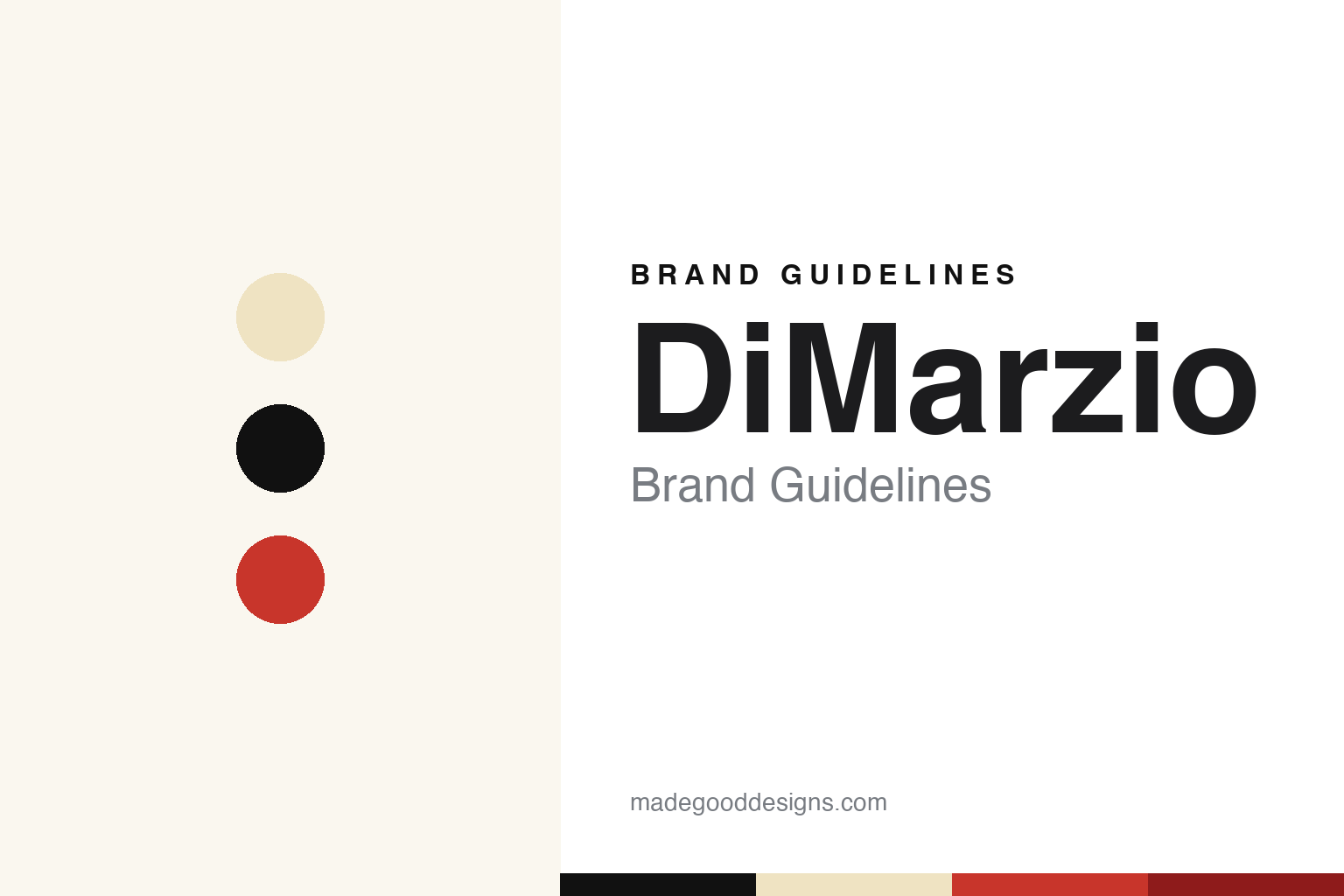
DiMarzio Brand Guidelines
The Staten Island pickup maker that made a colour its trademark.
Aa
Two constants: a double cream, black and red palette and a condensed sans register. Abstract homage — not a DiMarzio product or mark; no pickup, logo or trade dress is reproduced.
A repairman on Staten Island
From Guitar Lab to a pickup of his own.
DiMarzio is the pickup company of Larry DiMarzio, a New York guitarist and repairman, and it is still based on Staten Island. Guitar World, in a 2023 feature by Chris Gill, credits him with creating the market for replacement pickups — parts a player buys to swap for the ones fitted at the factory — by developing and marketing the Super Distortion humbucker in the early 1970s.
In his own long account on the company website, DiMarzio says he studied at Brooklyn Tech, switched from electronics to music at Richmond College on Staten Island after the Kent State shootings in 1970, and worked at Guitar Lab, a Manhattan repair shop run by Charlie LoBue that was authorised to service both Gibson and Fender guitars. One of the most common jobs, he told Guitar World in 2023, was refitting Les Paul Deluxes with full-size humbuckers; the magazine adds that he spent a stint working for the pickup designer Bill Lawrence.
His first design, by his account, was a modified Stratocaster pickup he called the Fat Strat — renamed the FS-1 because Fender had trademarked “Strat” — which David Gilmour went on to use. The Super Distortion followed. He says he built the first ones from Gibson bobbins and baseplates after the spring of 1971; Guitar World describes the recipe as finer wire and more turns per coil around a strong ceramic magnet, in a pickup sized to drop into a standard Gibson humbucker mount.
The date is often given as 1972, including by English Wikipedia, but the Guitar World feature it cites says only “the early ’70s.” DiMarzio’s own 2021 trademark history says Larry DiMarzio created the first commercially available aftermarket pickups in 1973, and the trademark record, as Guitar.com reported, gives 1974 as the first use of the double-cream design. He dates his first Guitar Player advertisements to about 1973, and says he sold Ace Frehley, soon of KISS, three Super Distortions that year at the Staten Island ferry terminal; English Wikipedia says the introduction came through Gene Simmons, his college friend.
Colour
Cream bobbins and a trademark fight.
The look came before the logo. DiMarzio says he first wrapped cream tape around black Gibson bobbins to tell his work apart, then moved to cream plastic so that his pickups could be identified “at fifty feet away in a dark smokey club.” Once he could afford a mould, he says, he mixed a custom cream colour, and even printed price lists and catalogues on cream paper. The double-cream open humbucker became a registered trademark: Guitar.com reported that the mark was granted in 1981, while the company’s “PAF” wordmark was granted in 1978, with first use in 1976. Guitar.com also noted that uncovered Gibson pickups of the period sometimes had cream bobbins, so DiMarzio’s was not the first double-cream pickup in the world.
The company has had to defend that colour. In May 2021 it said a four-year challenge at the US Trademark Trial and Appeal Board had ended when the petitioner withdrew before trial. In late 2023 Gibson filed to cancel both the PAF and double-cream marks, arguing among other things that they had become generic, Guitar.com reported in December 2023; in January 2024 the magazine reported that DiMarzio had moved to dismiss. We could not find a reported outcome in the sources we checked.
The pickups spread fast. By the company’s account, early Super Distortions went into guitars played by Earl Slick, David Bowie’s guitarist; DiMarzio shared its booth with Hamer guitars at a Chicago trade show in June 1975; and the business was incorporated that autumn as DiMarzio Musical Instrument Pickups, Inc. — today DiMarzio, Inc. Guitar World lists Super Distortion players from Joe Perry and Rick Nielsen to Randy Rhoads, Kurt Cobain and Kim Thayil, and notes that new American makers such as B.C. Rich, Charvel, Dean and Hamer fitted it as standard. Later signature models were made for Steve Vai, Joe Satriani and John Petrucci, the company says.
Typography
Design and documentation.
A guitar pickup — a coil of fine wire around magnets that turns a vibrating string into an electrical signal — is a part many electric-guitar players choose to replace. Several American firms have built businesses on making those replacements.
In California, Seymour Duncan, founded in 1976, gives Santa Barbara as its home on its website, while Wikipedia places its headquarters in neighbouring Goleta; EMG, also founded in 1976, is based in Santa Rosa, Wikipedia says, and its website says “Made in California Since 1976.” In Washington State, Lollar Pickups says every pickup is made in its Tacoma workshop, and TV Jones, founded in Whittier, California, in 1993 according to Wikipedia, now gives its address as Poulsbo.
In the East, DiMarzio’s website gives an address on Staten Island, New York; Fishman, known for acoustic-guitar pickups, lists Andover, Massachusetts; and Lindy Fralin Pickups, which dates itself to 1989, is based in Richmond, Virginia.
Ownership, as far as the public record shows, is private. Wikipedia describes Seymour Duncan, DiMarzio, EMG, Fishman and Lollar as privately held; the other two websites name TV Jones, Inc. and Lindy Fralin Pickups, LLC. We found no report of any of the seven being bought by a larger group in the sources we checked.
Founding dates are not always settled: Wikipedia gives both 1987 and 1995 for Lollar, and the early 1990s for Fralin, which says 1989.
This guide sets out what can be checked about each brand — who founded it, who owns it, and what it says about where its products are made — and marks clearly what rests only on the company’s own word.
Aa
A condensed sans — a catalogue register. (Specimen set in Oswald, a sans STAND-IN; NOT the DiMarzio logo.)
DiMarzio
Made in the US, by its own account.
DiMarzio has stayed independent. English Wikipedia describes it as privately held, and Larry DiMarzio writes that it is “built in America by the same people in the same place and not allowed to be watered down by corporate take overs or financial banking groups.” He says much of the original team is still there, that his daughters now work in the business, and that he still oversees the design and production of its pickups, straps, cables and hardware. We found no record of an acquisition in the sources we checked.
On manufacturing, the company is categorical. Its website carries a “Made in USA” line, and in the statement it gave Guitar.com in 2023 it said millions of its double-cream pickups had been sold “and that all have been made in the US.” DiMarzio says every coil is hand wound one at a time, and that the Super Distortion is still wound on machines he designed about 50 years ago. We give these as the company’s claims.
The brand’s image is unusually home-made, too. DiMarzio says he set up an in-house advertising agency in the early 1980s, still shoots most artist sessions and all the product photography for the website himself, and recalls an early packaging card printed with a red “medieval sun.” Four US patents in his name, granted between 1979 and 1984, cover pickups, a soundhole mount and a display container for selling them.
For a design guide, DiMarzio shows how a single colour can become a brand. Compare Seymour Duncan, another American replacement-pickup maker, founded in Santa Barbara in 1976, and Gibson, whose humbuckers DiMarzio set out to improve and which later challenged his trademarks. For this guide we use double cream, bobbin black and a sun red with a condensed sans, an unofficial interpretation; no product or logo is reproduced.
Explore & save
Keep DiMarzio’s identity on hand — save it to a board in the Made Good inspiration library.
DiMarzio identity set
Pin the DiMarzio double cream, black and red palette and the condensed sans register to your own board.