Spector Brand Guidelines
The Brooklyn bass with the curved body Ned Steinberger drew.
Aa
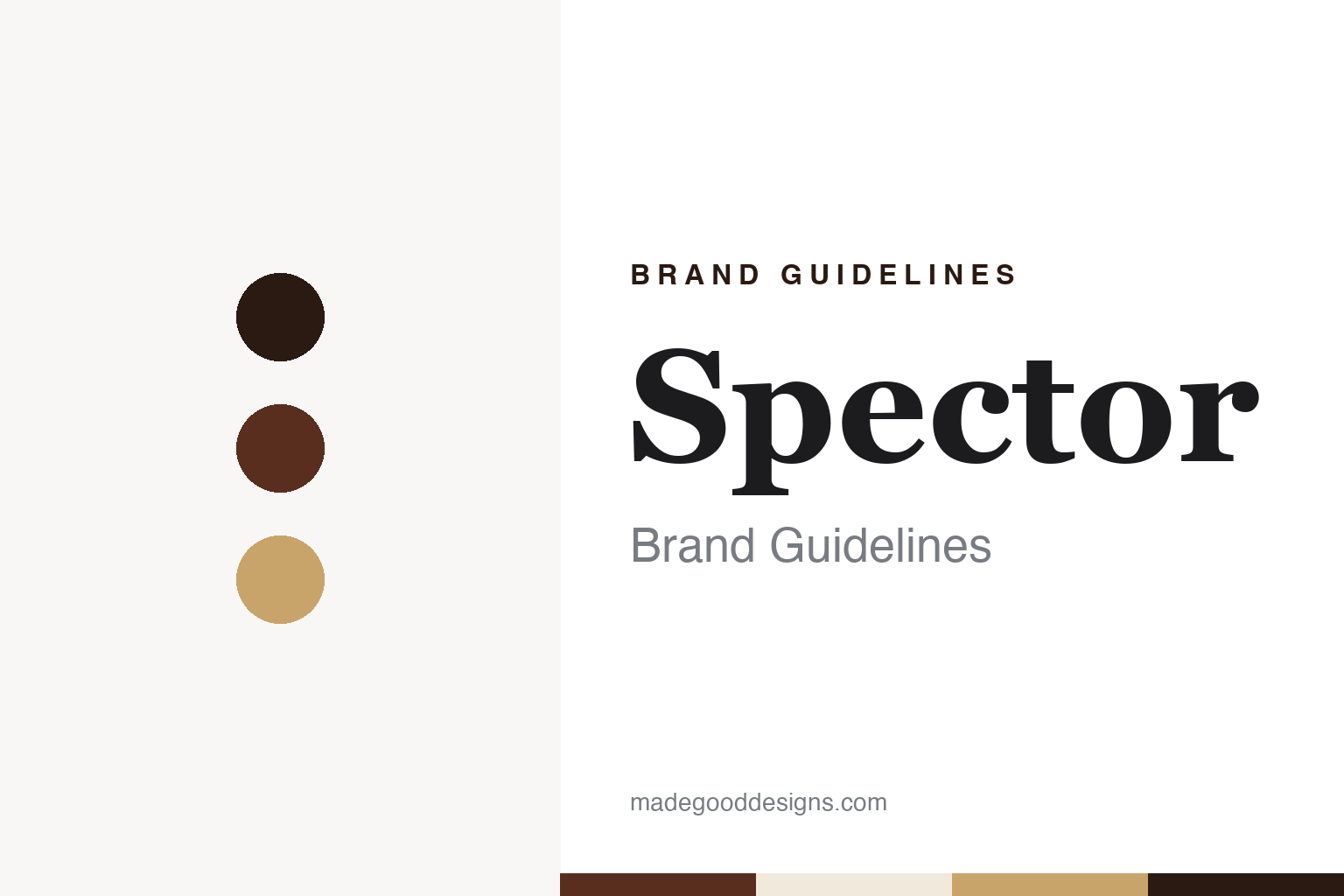
Two constants: a Spector walnut, maple and burl palette and a Soft serif register. Abstract homage — not a Spector product or mark; no instrument, logo or headstock is reproduced.
The co-op
A woodworkers’ co-op and a furniture designer next door.
Spector began in Brooklyn in 1976. The company’s own history, which English Wikipedia follows closely, says Stuart Spector and Alan Charney founded Spector Guitars as members of the Brooklyn Woodworkers Co-op, which shared space in an old factory building, and that Spector learned machine woodworking there from the co-op’s founder, Billy Thomas. Bass Magazine gave the same founders and place in 2021. PJ Rubal, Spector’s later business partner, writes on his collector site that Spector built his first instrument, a guitar, by hand in his apartment in 1974, and his first basses in 1975. The first catalogue pairing, the company says, was the SB-1 bass and the G-1 guitar, both Spector’s designs, first sold through Gracin Music on 48th Street in Manhattan.
The shape that made the name came from a neighbour. Ned Steinberger, another co-op member, had trained in furniture design, and offered to design a bass. Working to the principle that “form follows function,” the company says, he drew an ergonomically curved body to go with the neck-through construction Spector already used. The company dates the first NS-1 to March 1977, and the two-pickup NS-2 to 1979; Wikipedia’s article on Steinberger, citing Sound On Sound, gives the same order. Steinberger went on to found Steinberger Sound in 1980 and its headless instruments, but the NS initials stayed with Spector. Bass Magazine credited the NS with a clear, piano-like tone and comfortable playing.
The company says that by 1977 it had taken a whole floor below the co-op, and that its first full-time employee was Vinny Fodera, who later started his own bass brand. A contract to make replacement necks for DiMarzio taught it production methods, until it dropped that work in late 1982 to concentrate on its basses.
Colour
Kramer, a lost name and a Woodstock shop.
Exposure came in 1983. The company says it sold a white NS-2 to Sting at the start of the Police’s Synchronicity tour, where it was seen and filmed for the rest of the tour, and that the bass was later given to the Rock and Roll Hall of Fame museum in Cleveland; we give that as the company’s account. Later players named by Bass Magazine include Doug Wimbish, Ian Hill, Rudy Sarzo and Alex Webster.
Then Spector lost its name. Rubal writes that Spector and Charney sold the company to Kramer Guitars in December 1985, and that production moved during 1986 from Brooklyn to Kramer’s factory in Neptune, New Jersey, with Charney running Spector production there. In the Kramer years, the company says, output reached about 100 instruments a month and the NS-2 began to be made in South Korea. When Kramer went bankrupt around 1990, Spector production stopped, and Rubal writes that the script Spector name stayed with Kramer’s trademark assets in the bankruptcy court.
Stuart Spector started again near Woodstock, New York, as Stuart Spector Design, and its instruments were labelled “SSD.” Rubal dates the company’s trade-show debut to the summer NAMM show in Atlantic City in June 1992, and production at the Woodstock workshop to that autumn. A 1987 consulting visit to Czechoslovakia, the company says, began a lasting link with the factory now called NBE, which makes the Euro line. By 1998, the company says, Spector had bought back the trademark, and Rubal writes that the relaunched instruments carried an “SS” logo.
Typography
Design and documentation.
The basses in this guide come from small workshops, most started in the 1970s and 1980s by a luthier or a luthier-and-player partnership. Several are connected: English Wikipedia says Vinny Fodera was Spector’s first full-time employee, in 1977, and that he and Joey Lauricella started Fodera after working with Ken Smith Basses.
Three are in New York State. Fodera says it has been in Brooklyn since 1983 and is now a family business with Laura Fodera as partner and chief executive. Sadowsky, founded by Roger Sadowsky in 1979, gives an address in Long Island City, Queens; since 2019, under a licence with Germany’s Warwick, its MetroLine, MasterBuilt and Custom Shop basses have been made in Germany, Wikipedia and Warwick’s Sadowsky website say. Spector, founded by Stuart Spector in Brooklyn in 1976, was bought by Korg in 2019, Bass Magazine reported in 2021; it builds its US basses near Woodstock.
Lakland, founded in Chicago in 1994, was bought in 2010 by a group led by Hanson Musical Instruments, according to the announcement of the deal. It says its USA Series basses are built in Chicago.
Ken Smith Basses says every instrument is handmade at its shop in Perkasie, Pennsylvania. Dingwall, founded by Sheldon Dingwall in 1987, is based in Saskatoon, Canada; its own spec sheets list most models as made in Canada and a few lower-priced ones as built in China or Indonesia and finished in Canada. Alembic is run by the Wickersham family in Rohnert Park, California, the company says.
This guide sets out what can be checked about each brand — who founded it, who owns it, and what it says about where its products are made — and marks clearly what rests only on the company’s own word.
Aa
A soft, curved serif — for a body drawn by a furniture designer. (Specimen set in Fraunces, a serif STAND-IN; NOT the Spector logo.)
Spector
A Korg brand with a New York shop.
The last change came with Korg USA, which took over distribution in the United States and Canada in 2015. No Treble reported on 17 January 2019 that Korg USA had acquired the company; its president, Joe Castronovo, said Korg had “worked out the acquisition” once Stuart Spector decided the time was right, and Spector called the choice “an emotional and simple decision all at once.” Rubal writes that he and Spector sold the business in late 2018 and are no longer involved, and his site names the trademark owner as Korg NA LLC, doing business as Spector Musical Instruments.
Where the basses are made depends on the line. Bass Magazine toured the USA Custom Shop in 2021 and reported that, as part of the Korg deal, it had moved into a larger building on Route 28 outside Woodstock, a former gardening-equipment factory, where the NS Neck Through, NS Bolt On and CodaBass are built; the company’s history page says USA basses still come from the Woodstock woodshop Spector moved into decades ago. Headquarters are on Long Island. Other lines, Korg’s brand manager John Stippell told the magazine, come from production in Europe, Korea and Indonesia. The magazine also reported that Spector was one of the first brands to use EMG pickups, and that its preamps have come from HAZ Laboratories since the early 1980s.
For a design guide, Spector shows how one shape can carry a brand through four owners and a lost name. Compare Fodera, founded by Spector’s first employee, and Warwick, another maker of neck-through basses in figured woods. For this guide we use walnut, maple and burl tones with a serif, an unofficial interpretation; no product or logo is reproduced.
Explore & save
Keep Spector’s identity on hand — save it to a board in the Made Good inspiration library.
Spector identity set
Pin the Spector walnut, maple and burl palette and the Soft serif register to your own board.