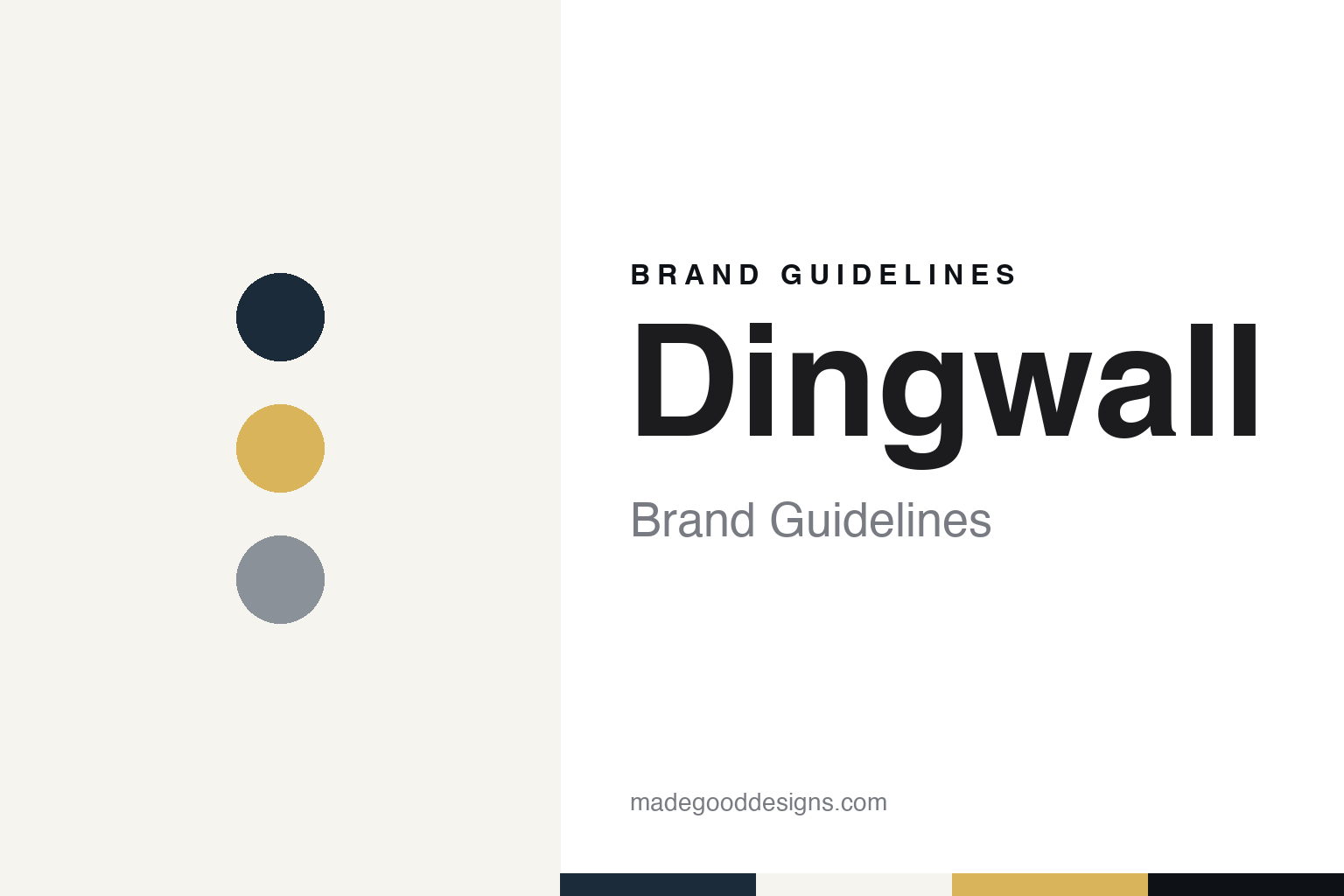
Dingwall Brand Guidelines
The Saskatoon bass maker built on fanned frets.
Aa
Two constants: a Dingwall night blue, wheat and steel palette and a Prairie sans register. Abstract homage — not a Dingwall product or mark; no instrument, logo or headstock is reproduced.
Saskatoon
A guitarist, an uncle’s workshop and a repair bench.
Dingwall Guitars is a bass maker in Saskatoon, Saskatchewan, founded by Sheldon Dingwall. The company’s website says it was “founded in 1987”, and English Wikipedia gives the same year. The date describes the business rather than its basses: by Sheldon Dingwall’s own account, the first complete bass he built was finished in January 1993. In its early years on the web the firm called itself Dingwall Designer Guitars, the name still used as the title of its Wikipedia article; today it trades as Dingwall Guitars.
In a 2016 interview with Bass Musician Magazine, Dingwall said he grew up in a musical household — baritone ukulele at four, piano at five, drums at nine, guitar at twelve and bass at about sixteen — and taught drums and guitar until he was twenty. His uncle, Alfred Wilson, built acoustic guitars as a hobby and taught him woodworking, metalworking and finishing. His first project was a locking tremolo bridge, followed by necks and bodies.
He started a repair business, he said, “to create a job and to learn from the mistakes of other manufacturers,” and in the late 1980s and early 1990s built custom bass necks and bodies for local musicians. English Wikipedia, citing Jim Roberts’s 2003 book American Basses, says the shop grew out of a local music store, moving from necks to bodies to whole instruments. In the same interview Dingwall named Glenn McDougall of Fury Guitar as his most important mentor, and the guitar maker Tom Anderson as a friend and mentor too.
Colour
Fanned frets, agreed with a handshake.
The idea that defines Dingwall came from someone else. Writing on the company blog in February 2023, Sheldon Dingwall recalled that in 1992 he was trying to improve the low B string on his five-string basses, thinking of the way a piano’s scale length shapes its tone. When he saw a photograph of a Novak fanned-fret guitar in Guitar Player, he wrote, he realised the system would give the B string the extra length it needed while keeping a normal scale on the G. Two months later he met Ralph Novak of Novax Guitars at a luthiers’ convention at the University of South Dakota; they agreed that Novak would concentrate on guitars and Dingwall on basses, and “shook hands.”
The result was the Voodoo bass, which Dingwall took to the NAMM Show in 1993. He told Bass Musician that the prototype was completed “at 7:30 AM on January 13th 1993” and evolved into today’s Z-series. “We didn’t invent fanned-frets, that was Ralph Novak,” he said in the same interview. “But we were the first company other than Ralph to base our entire company on them.” The company’s FAQ still refers to the “Novax Fanned-Fret System®,” and its long-scale models stretch the B string to 37 inches.
In 1996 a fire destroyed the shop. The company’s own history of its pickups says the fire “levelled the Dingwall shop,” and Dingwall credited McDougall with helping him rebuild. Pickups became the next step: Dingwall said the firm used Bartolini pickups from 1993 to 2000 and has made its own since 2000, starting with the FD1, developed with McDougall’s help; the later FD3, the company says, has been in production for more than twenty years. It also claims to have pioneered neodymium magnets in pickups, a magnetic battery compartment and “dual-density” bodies — two woods side by side, such as walnut on the bass side and maple on the treble side of the Prima Artist. We give these as the company’s claims.
Players shape the range. Leland Sklar, Dingwall said, was its first big-name endorser, and he has a signature model. The Adam “Nolly” Getgood signature grew out of conversations with Getgood and Doug of Darkglass, which led to the Tone Capsule preamp. Later signature models include one for Kyle Konkiel, announced in 2023, and one for Duran Duran’s John Taylor, announced in 2024, according to Bass Musician.
Typography
Design and documentation.
The basses in this guide come from small workshops, most started in the 1970s and 1980s by a luthier or a luthier-and-player partnership. Several are connected: English Wikipedia says Vinny Fodera was Spector’s first full-time employee, in 1977, and that he and Joey Lauricella started Fodera after working with Ken Smith Basses.
Three are in New York State. Fodera says it has been in Brooklyn since 1983 and is now a family business with Laura Fodera as partner and chief executive. Sadowsky, founded by Roger Sadowsky in 1979, gives an address in Long Island City, Queens; since 2019, under a licence with Germany’s Warwick, its MetroLine, MasterBuilt and Custom Shop basses have been made in Germany, Wikipedia and Warwick’s Sadowsky website say. Spector, founded by Stuart Spector in Brooklyn in 1976, was bought by Korg in 2019, Bass Magazine reported in 2021; it builds its US basses near Woodstock.
Lakland, founded in Chicago in 1994, was bought in 2010 by a group led by Hanson Musical Instruments, according to the announcement of the deal. It says its USA Series basses are built in Chicago.
Ken Smith Basses says every instrument is handmade at its shop in Perkasie, Pennsylvania. Dingwall, founded by Sheldon Dingwall in 1987, is based in Saskatoon, Canada; its own spec sheets list most models as made in Canada and a few lower-priced ones as built in China or Indonesia and finished in Canada. Alembic is run by the Wickersham family in Rohnert Park, California, the company says.
This guide sets out what can be checked about each brand — who founded it, who owns it, and what it says about where its products are made — and marks clearly what rests only on the company’s own word.
Aa
A plain, modern sans for a maker defined by its slanted frets. (Specimen set in Archivo, a sans STAND-IN; NOT the Dingwall logo.)
Dingwall Guitars
Made in Canada — and, for some models, not only there.
Where a Dingwall is made depends on the model, and the company states it in each specification table. The Z, Prima Artist, Lee Sklar Signature, Afterburner I and II, ABZ, the headless Effigy and the Rob van der Loo signature are listed as “Made in Canada”, and the company says its pickups are handmade in Saskatoon. The Combustion, the Nashville Combustion, the D-Roc Standard and the NG “Nolly” signature are listed as “China/Canada (Hybrid Manufacturing)”; the Combustion page says each bass gets a final fret level and set-up from the team in Canada, and an archived copy of that page from November 2022 carries the same wording. The newest model, the SP1, is listed as “Indonesia / Canada (Hybrid Manufacturing)”; in September 2026 the company said it had completed a successful first year and lowered its price. English Wikipedia’s statement that two models are made in China is unsourced and now out of date.
Ownership looks simple. Wikipedia describes Dingwall as privately held, with Sheldon Dingwall as chief executive; we found no record of a sale or an outside owner. The company also sells its own strings, apparel and accessories through international and US online stores, and runs a podcast, Comfortably Strung.
For a design guide, Dingwall shows how one borrowed idea, credited openly, can become a whole visual signature: the slanted frets are what people recognise first. Compare Darkglass, the bass-electronics maker behind its Tone Capsule preamp, and Warwick, another bass specialist that mixes home-made and imported lines. For this guide we use a prairie wheat, a night blue and a steel grey with a sans, an unofficial interpretation; no product or logo is reproduced.
Explore & save
Keep Dingwall’s identity on hand — save it to a board in the Made Good inspiration library.
Dingwall identity set
Pin the Dingwall night blue, wheat and steel palette and the Prairie sans register to your own board.