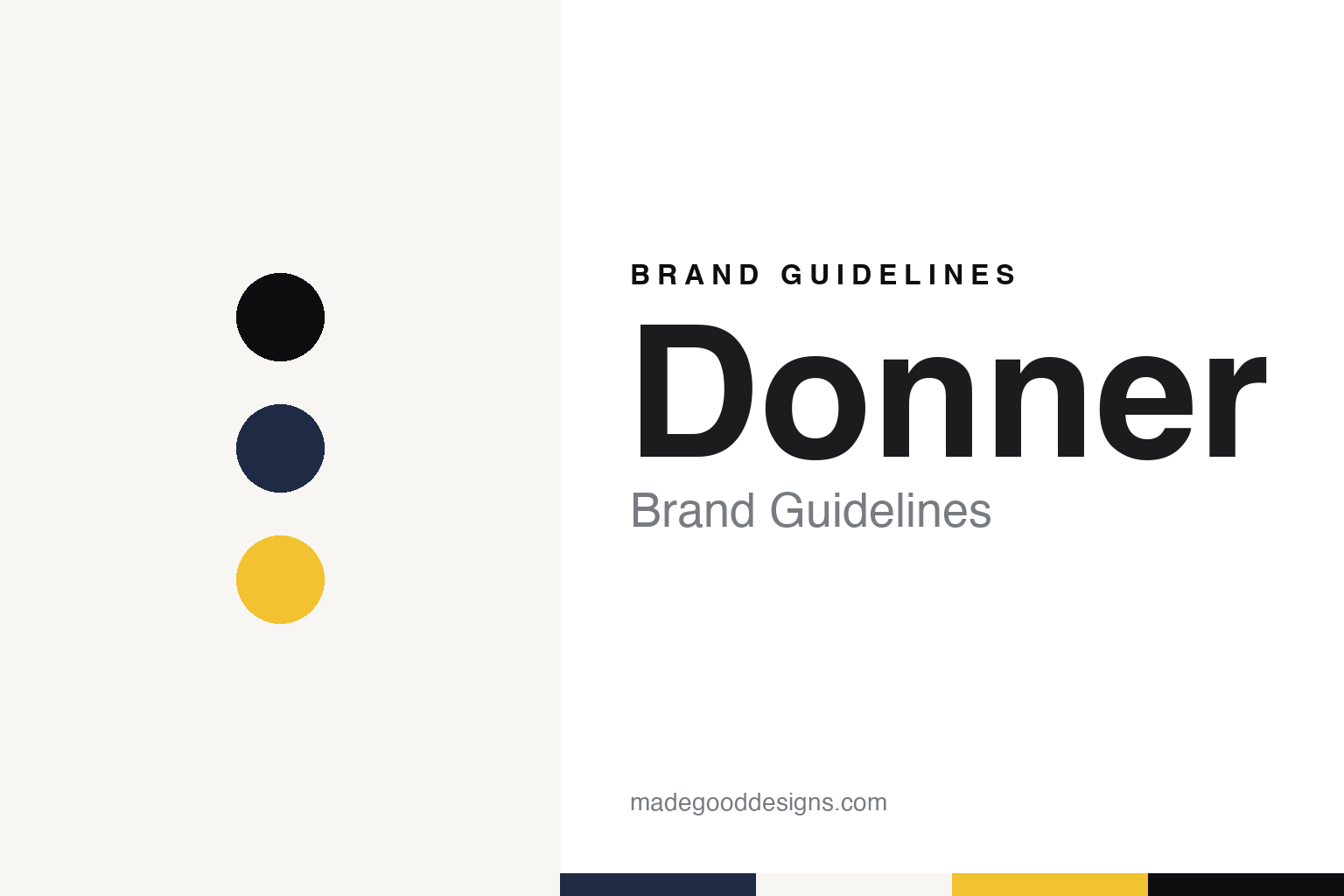
Donner Brand Guidelines
The Guangzhou instrument brand that grew up on Amazon.
Aa
Two constants: a Donner navy, ink and pedal yellow palette and a Clean geometric sans register. Abstract homage — not a Donner product or mark; no instrument, pedal or logo is reproduced.
Rantion
A Guangzhou e-commerce company and its instrument brand.
Donner is the musical-instrument brand of Guangzhou Rantion Technology Co., Ltd. The brand’s own press material says: “Founded in 2012, Donner and its parent company, Guangzhou Rantion Technology Co., Ltd., have grown into a global music technology enterprise.” The Red Dot design awards, which publish their winners online, list the same company, in Guangzhou, as the manufacturer of Donner’s award-winning products. The company is a Guangzhou business, not a Shenzhen one: on its Chinese-language website, Rantion says its headquarters are in Guangzhou, with branch offices in Shenzhen and in California.
The parent company is older than the brand. Rantion — 蓝深科技, or Lanshen Technology, in Chinese — says it was founded in August 2009 and began in cross-border e-commerce, selling through Shopify and eBay. By its own timeline, it set up a US company in April 2012 and began selling on Amazon.com that month, then on Amazon’s British, German and French sites that August. That matches Donner’s “since 2012.” Rantion says it formed its first brand division in 2013 and five in 2014, renamed itself Guangzhou Lanshen E-commerce in 2017 and Guangzhou Lanshen Technology in 2018, and raised outside funding in 2018 and 2021. It does not name its investors, and we give these as the company’s own dates.
Donner gives more than one founding date. Its about page is headed “Founded in 2012,” but the timeline on the same page reads “2014 — Brand Founded. Donner introduced the revolutionary mini guitar pedals and setup the Amazon store.” The page carries a letter signed by Hevin He, “Founder of Donner,” who writes that his first guitar, in high school, “always helped me to find my voice when words failed me,” and that “the business took off with our lines of effect pedals.” Rantion’s own website does not name a founder, and we found no independent source for the name, so it is the company’s account. In the United States, the website is run by Donner LLC, which gives a registered address in Charlotte, North Carolina.
Colour
Mini pedals first, then nearly everything else.
Pedals came first. According to Third Man Hardware, Jack White’s equipment company, Donner’s first pedal was the Yellow Fall delay, released in 2013, and its Alpha series followed in 2017. Donner says it was “among the first to introduce mini guitar pedals,” a claim we could not test. MusicRadar gives it credit for something narrower: in 2025 it wrote that “the Chinese budget gear brand established the proof of concept for budget-friendly threefers,” putting distortion, chorus and delay into one pedal on its Alpha Force and Alpha Crunch.
Amazon carried the brand. Donner’s timeline says its ukulele reached No. 1 on Amazon’s best-seller list in 2014, and that by 2020 it was among the top three musical-instrument brands on Amazon worldwide, the year it also launched its own website. Rantion’s Chinese site makes the same top-three claim. Neither can be checked from outside Amazon.
The range is now wide. Donner’s press material lists HUSH headless guitars, OURA digital pianos, electronic drum kits, Essential synthesizers, MIDI controllers and Mini pedals. The HUSH-I, Donner says, made its debut at the NAMM show in 2022. Among the synthesizers, MusicRadar said the B1 was “a budget monosynth based on the design of the TB-303,” Roland’s bass machine, and that the L1 of 2025 “evolves the SH-101 template.” The company also says it runs the Eastar and Moukey brands.
Its best-known collaboration is with Third Man. In January 2024 Third Man Hardware announced the Triple Threat, a three-in-one analogue pedal with distortion, phaser and echo, “designed by Third Man Hardware and manufactured by Donner,” at $99, or $129 in a limited yellow edition. White said he had long hoped “to make an affordable pedal for beginning musicians,” and that its sounds suited “all genres. Maybe not opera though.” In 2026 Donner announced signature pedals with the Japanese guitarist MIYAVI, whom it calls its creative director, and with Ruben Wan, as well as drum kits for Guitar Center.
Typography
Budget gear and where it comes from.
The seven brands in this guide sell affordable guitar gear, much of it online. Six are Chinese companies; the seventh is the house brand of a German retailer.
Most are in Guangdong province. Mooer is the brand of Shenzhen Mooer Audio, created in 2010, according to English Wikipedia. NUX says it is one of three brands owned by Cherub Technology, which lists its headquarters in Shenzhen and an industrial park in Zhuhai; NUX dates its debut to 2006. Joyo’s website names Joyo Technology, in Shenzhen’s Bao’an district. Donner belongs to Guangzhou Rantion Technology, according to its own press material and the Red Dot award records.
Two brands come from Changsha, in Hunan. The Chinese-language websites of Hotone and Valeton both name the same company, Changsha Hotone Technology, in their footers. Valeton says its team spent more than ten years designing and building products for other brands before launching its own.
Harley Benton is different: it is the house brand of Thomann, the music retailer founded in 1954 by Hans Thomann Sr. in Bavaria and still family-owned, according to English Wikipedia. Thomann GmbH, of Burgebrach, runs the brand’s website. Not all of its guitars are made in China; MusicRadar listed one 2026 model as made in Indonesia.
Few of the companies’ websites we checked name a factory; where a country of manufacture is documented, it is usually in reviewers’ specification lists.
This guide sets out what can be checked about each brand — who founded it, who owns it, and what it says about where its products are made — and marks clearly what rests only on the company’s own word.
Aa
A clean geometric sans — a brand built for online shop listings. (Specimen set in Manrope, a sans STAND-IN; NOT the Donner logo.)
Donner
Red Dot awards, and “Made: China.”
Design awards are the best-documented part of the story. The Red Dot awards list Donner products in 2021, 2022, 2023, 2024 and 2025, each made by Guangzhou Rantion with “in-house design.” Among them are the DED-60TX of 2021, a drum pad built into a Bluetooth speaker; a carbon-fibre violin in 2022; the INTEGRA-1 smart guitar in 2023; an acoustic looper and preamp in 2024; and the OURA S300 and R300 digital pianos in 2025. Of the S300, the jury wrote that “the piano becomes both a style-defining piece of furniture and a musical statement.” Donner also says it has won iF, European Product Design and Chinese design awards, which we did not check.
Where Donner’s products are made is less clear. Donner says the company is “dedicated to research, manufacturing, and the sale of musical instruments,” and describes inspection, quality and supplier-management departments. Rantion’s Chinese site says it uses its own research and “supply-chain integration” to sell made-in-China products around the world through Amazon and its own websites. Neither names a factory. Independent reviews say the same: MusicRadar’s review of the HUSH X Pro in 2025 and Guitar World’s review of the HUSH X Live Pro in 2026 both list it as “Made: China.” Guitar World called Donner “probably the best-known of the budget-friendly Chinese brands out there.”
For a design guide, Donner shows a brand built for online shops and refined later through design awards and artist partnerships. Compare Behringer, whose own version of the SH-101 MusicRadar set against Donner’s L1, and Mooer, a Shenzhen maker of compact pedals. For this guide we use a navy, an ink black and a pedal yellow with a sans, an unofficial interpretation; no product or logo is reproduced.
Explore & save
Keep Donner’s identity on hand — save it to a board in the Made Good inspiration library.
Donner identity set
Pin the Donner navy, ink and pedal yellow palette and the Clean geometric sans register to your own board.