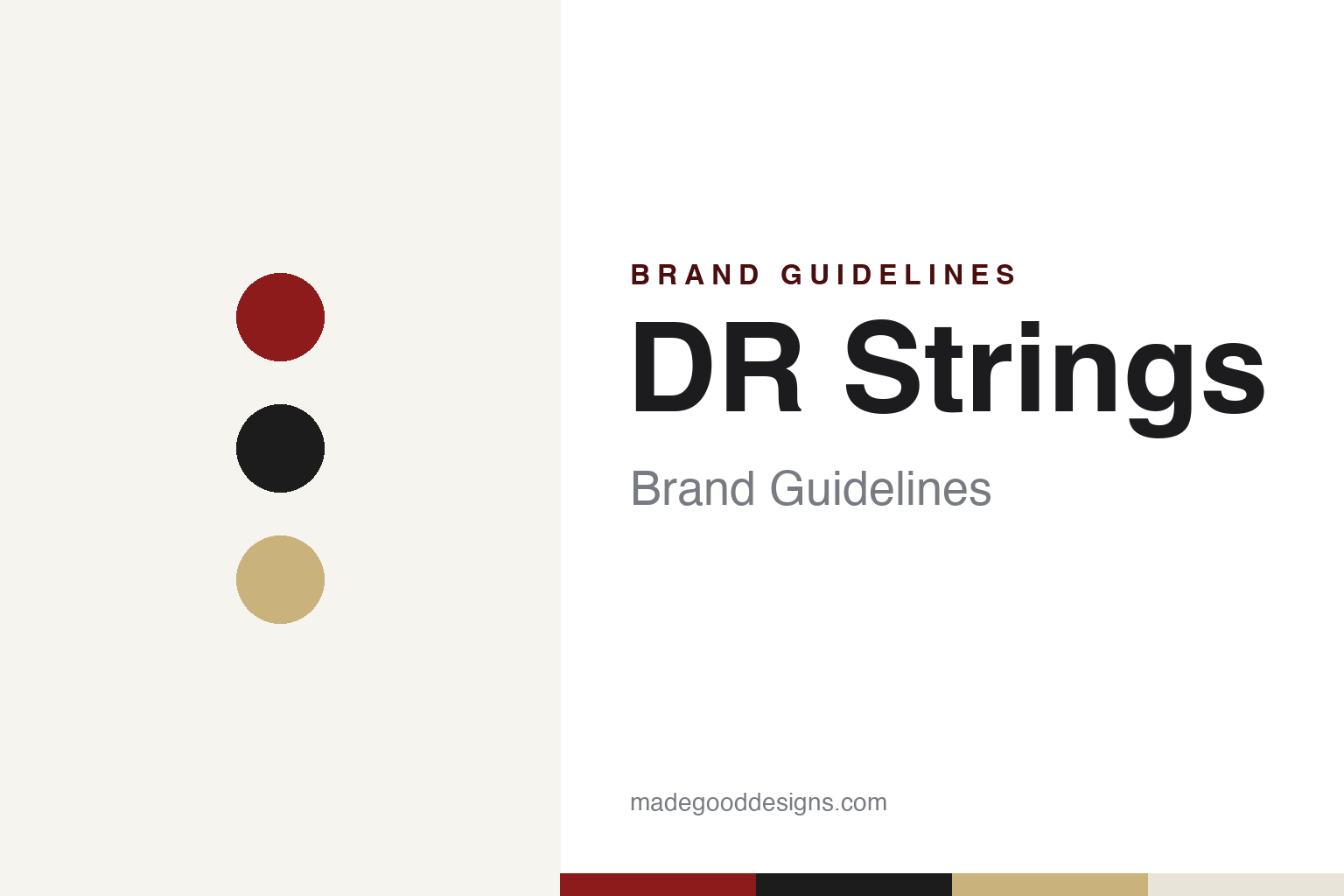
DR Strings Brand Guidelines
The D and the R: hand-wound strings from a Guild family founder.
Aa
Two constants: a DR red, black and gold palette and a condensed sans register. Abstract homage — not a DR Strings product or mark; no string pack or logo is reproduced.
Dronge and Rapoport
The D and the R.
DR Strings is named after its two founders. The company’s own 1997 website called Mark Dronge “the ‘D’ in DR” and his partner Dr. Benzion Rapoport “the ‘R’,” and English Wikipedia lists both as founders. Production began in 1989. Dronge was the son of Alfred Dronge, who founded the Guild Guitar Company in Manhattan in 1952 and later moved it to Hoboken, New Jersey, English Wikipedia says; Mark worked at Guild before starting DR, Music Connection reported in 2016.
The idea was older than the company. In DR’s telling, it began in 1967, when Alfred and Mark Dronge wanted to buy some used string-winding machines and install them at the Guild factory in Hoboken, but there was no room. In spring 1987 Mark Dronge and Rapoport agreed to start a string company, and spent about two years experimenting before they had redeveloped what DR calls the old way of making stainless-steel, round-wound, round-core bass strings. That string became the Hi-Beam. DR says the bassist Marcus Miller tested it, and that the first sets it ever sold — twelve of them, gauged 45–105 — went to a New York session bassist, Jeremy Alsop.
Rapoport, the 1997 page says, ran the administration, finances and quality control, and brought family into key roles: his son-in-law Les O’Connor managed the factory, and Faye Rapoport became general manager of the administrative side in 1992. The company moved four times in its first five years, each time to bigger premises, the page says. In 1997 its address was in Emerson, New Jersey; today it is in Westwood, New Jersey.
Colour
Handmade, round core.
DR’s pitch since the start has been that its strings are wound by hand. Music Connection wrote that in 1989, when DR began production, computer-assisted and semi-automatic winding machines were becoming common, and that the DR team believed it could feel and hear the difference in a handmade string. The company now says its winders take at least six months to learn the craft, and that wire is inspected on arrival, during winding and again when the strings are packed by hand.
The second idea is the round core. DR says it re-introduced hand-made round-core string making to the general market in 1989. Its 1997 page described the method: the core wire is held under weights at more tension than it will have at pitch, so the finished string settles quickly into tune, and it is wrapped in nickel-plated steel, pure nickel, phosphor bronze or stainless steel around an iron-carbide core.
Coatings came later. According to Music Connection, DR introduced colour-coated strings in 2001 and the fluorescent Neon range in 2010, using a hard coating it calls K3 and describes as the first of its kind. More recent lines include Veritas, with what DR calls Accurate Core Technology and a Quantum-Nickel wrap, and Dragon Skin+ coated strings. DR also made Zebra sets, alternating phosphor-bronze and nickel-plated steel windings for acoustic-electric guitars.
Its users have included Stanley Clarke, Johnny Winter, Derek Trucks, Sting, Verdine White, Victor Wooten and Melissa Etheridge, as well as the bands of Beyoncé, Lady Gaga and Bruno Mars, Music Connection reported. Its 1997 site added James Taylor and Pantera. By then, the same page says, DR made five types of bass string, four of electric guitar string and two of acoustic, plus nylon and mandolin sets. Today’s range runs from Pure Blues, Tite-Fit and Black Beauties to Sunbeam acoustic and Lo-Rider bass strings, along with a Fodera collaboration and guitar straps.
Typography
String makers and their materials.
Six of the seven guitar-string makers in this guide are American, ranging from a division of a large materials company to small workshops. Elixir strings are sold by W. L. Gore & Associates, the privately held fluoropolymer company of Newark, Delaware, best known for Gore-Tex; Elixir’s contact page gives an address in Elkton, Maryland.
GHS takes its name from its founders, Gould, Holcomb and Solko, who began making strings in 1964; the company says Robert McFee bought it in 1975 and that it remains family-owned, based in Battle Creek, Michigan. DR Strings was founded in 1989 by Mark Dronge, son of the Guild founder Alfred Dronge, and Benzion Rapoport, English Wikipedia says; it is based in Westwood, New Jersey, and says its strings are made in the USA.
Dean Markley began in 1972, when Dean Markley, a Santa Clara, California, music-store owner, started selling his own strings; English Wikipedia now places the company in Glendale, Arizona. Curt Mangan, founded in 2004 by a former Ernie Ball sales and marketing director, says it makes its strings in Cortez, Colorado. Stringjoy says its strings are made in its own facility in Nashville, Tennessee.
The European maker is Savarez, of Caluire-et-Cuire on the edge of Lyon, which dates itself to 1770 and says its strings are handmade in France; it does not publish who owns it.
This guide sets out what can be checked about each brand — who founded it, who owns it, and what it says about where its products are made — and marks clearly what rests only on the company’s own word.
Aa
A narrow, workmanlike sans for a hand-winding shop. (Specimen set in Barlow Condensed, a sans STAND-IN; NOT the DR Strings logo.)
DR Strings
The fine art of fine tuning.
DR says its strings are “made in the USA with USA sourced materials,” from the wire to the ball ends and the packaging; Music Connection called it a New Jersey-based manufacturer. We found no record of an outside owner. English Wikipedia describes it as private, the website’s copyright line names DR Music Inc., and a retailer’s brand page calls it family-owned. In 2016 Music Connection reported that Mark Dronge’s daughters, Annika and Camilla, had joined the business.
Mark Dronge gave a NAMM oral-history interview in 2014. NAMM’s summary says he had been involved in the trade since he was four, in his father’s music shop, and that the sale of that shop in 1948 funded the start of Guild, which his father formed when Mark was fourteen. He died in 2022, according to NAMM’s library; DR’s website carries a tribute to him. The Guild link has continued: DR says that from 2025 all Guild USA acoustic guitars ship with its Dragon Skin+ phosphor-bronze strings. Guild itself is now part of Córdoba Music Group, which Yamaha’s guitar group bought in 2023, English Wikipedia says.
The brand’s current line is “The Fine Art of Fine Tuning,” and its 2010 website used “The handmade string in good hands. Yours.” DR publishes no official colours or typefaces.
For a design guide, DR Strings shows how a small maker can build an identity on process — hand winding and round cores — and on a family story. Compare Rotosound, another maker known for roundwound bass strings, and La Bella, a family string maker. For this guide we use a deep red, black and a muted gold with a condensed sans, an unofficial interpretation; no product or logo is reproduced.
Explore & save
Keep DR Strings’s identity on hand — save it to a board in the Made Good inspiration library.
DR Strings identity set
Pin the DR red, black and gold palette and the condensed sans register to your own board.