GHS Brand Guidelines
Three surnames, one Boomer: a family string maker in Battle Creek.
Aa
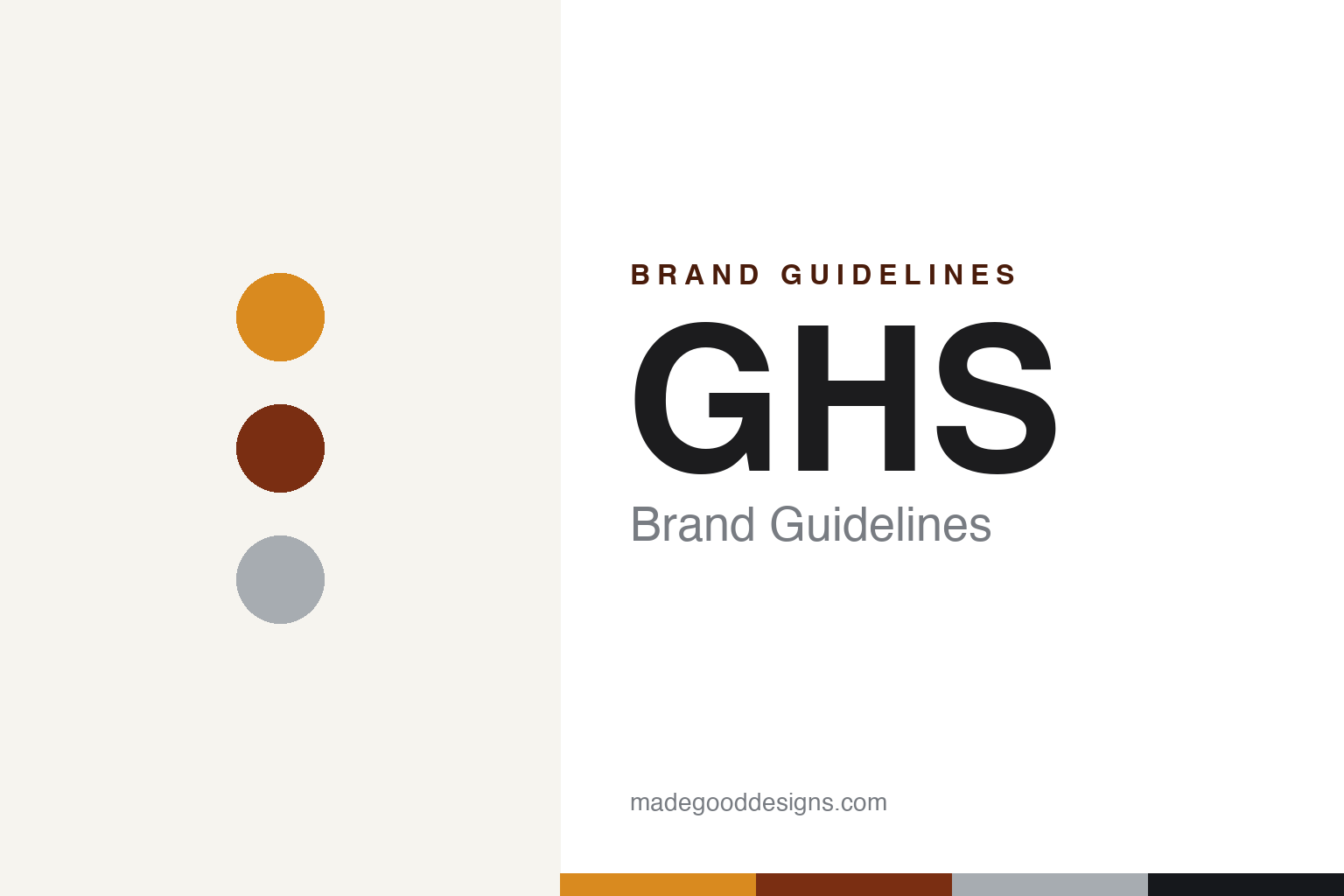
Two constants: a GHS amber, rust and nickel palette and a condensed sans register. Abstract homage — not a GHS product or mark; no string pack, Brightness Bar or logo is reproduced.
Gould, Holcomb and Solko
Three surnames, three letters.
GHS Strings takes its name from three people. According to the company’s own FAQ, the letters are the initials of its original founders, Gould, Holcomb and Solko, and English Wikipedia, citing that FAQ, gives the same three surnames. Neither the company nor Wikipedia gives the founders’ first names.
The company dates itself to 1964. English Wikipedia, citing a 2017 Battle Creek Enquirer article, gives the founding date as 1 August 1964, and the company says it celebrated its 50th anniversary in August 2014 at its corporate headquarters in Battle Creek, Michigan, where it is still based. An archived version of its website from the early 2000s says the founders “had a wealth of string making experience when they started the small family-owned business in 1964.”
In 1975 the business was bought by Robert McFee, whom the company describes as a “labor attorney/entrepreneur.” GHS says he still serves as chairman of the board of what it calls a family-owned company, with his son Russ McFee as president; English Wikipedia, citing the same Enquirer article, lists Russell McFee as president. The legal name on its older websites is GHS Corporation. We found no record of the company changing hands since 1975.
Colour
Boomers and the catalogue around them.
The product most associated with GHS is the Boomers string. The company says it released Bass Boomers in 1975 and that they “altered the course of rock and roll” — its words, not an independent judgement — describing them as a nickel-plated steel cover wound over a hex core, with “a distinct low-mid bump.” Guitar Boomers followed. GHS’s FAQ says most of the wound guitar strings in that range are built on a round core, with hex cores kept for the thinnest and thickest wound gauges, and that it puts a slight “swage” on its round cores so the cover wire anchors along the whole length of the string. There are thin-core and thick-core variants, seven- and eight-string sets and, since 2023, a 12-pack box aimed at touring guitar techs.
Around Boomers sits a long catalogue. GHS’s FAQ explains its winding types in some detail: roundwound; rollerwound, which it sells as Pressurewound, where the cover wire is run through two rollers that squeeze it towards an oval; groundwound, sold as Brite Flats, which start as roundwounds and are ground smooth; and flatwound. The range also includes Nickel Rockers, Progressives, Super Steels, Precision Flatwounds, Vintage Bronze and Silk & Bronze sets, plus strings for banjo, mandolin, ukulele, pedal steel and bajo, and Innovation double-bass strings. The company also says it makes “private label” sets for other companies, which it declines to name.
Artists are central to how GHS presents itself. An archived FAQ from the 2000s said Stevie Ray Vaughan’s most-used set was a Nickel Rockers set, and that Pearl Jam’s Mike McCready and Stone Gossard used Boomers. In September 2024 a GHS press release called David Gilmour a “GHS Strings artist” and pointed to signature David Gilmour Boomers sets. Those are the company’s statements; endorsement lists change, and the long list of users on English Wikipedia is mostly uncited, so we do not repeat it.
Typography
String makers and their materials.
Six of the seven guitar-string makers in this guide are American, ranging from a division of a large materials company to small workshops. Elixir strings are sold by W. L. Gore & Associates, the privately held fluoropolymer company of Newark, Delaware, best known for Gore-Tex; Elixir’s contact page gives an address in Elkton, Maryland.
GHS takes its name from its founders, Gould, Holcomb and Solko, who began making strings in 1964; the company says Robert McFee bought it in 1975 and that it remains family-owned, based in Battle Creek, Michigan. DR Strings was founded in 1989 by Mark Dronge, son of the Guild founder Alfred Dronge, and Benzion Rapoport, English Wikipedia says; it is based in Westwood, New Jersey, and says its strings are made in the USA.
Dean Markley began in 1972, when Dean Markley, a Santa Clara, California, music-store owner, started selling his own strings; English Wikipedia now places the company in Glendale, Arizona. Curt Mangan, founded in 2004 by a former Ernie Ball sales and marketing director, says it makes its strings in Cortez, Colorado. Stringjoy says its strings are made in its own facility in Nashville, Tennessee.
The European maker is Savarez, of Caluire-et-Cuire on the edge of Lyon, which dates itself to 1770 and says its strings are handmade in France; it does not publish who owns it.
This guide sets out what can be checked about each brand — who founded it, who owns it, and what it says about where its products are made — and marks clearly what rests only on the company’s own word.
Aa
A tall, compact sans for a dense technical catalogue. (Specimen set in Oswald, a sans STAND-IN; NOT the GHS logo.)
GHS
The string experts.
GHS has also grown sideways. In 2000 it bought Rocktron, the Michigan guitar-electronics company, which moved about 100 miles from the northern suburbs of Detroit to Battle Creek, Rocktron’s own history page says; English Wikipedia records the same deal. Rocktron says its founder stayed on to run the division, and that while its products are now made offshore, design and development continue in Michigan. That statement is about Rocktron’s electronics, not GHS strings.
Where GHS strings are made is less clearly stated than one might expect. The company calls itself a manufacturer — its older website said that “since 1964 GHS has manufactured” guitar strings — and gives its Battle Creek headquarters as its address, but we found no page that names a plant or carries a made-in claim, so we do not add one.
For designers, GHS has one genuinely useful idea: the Brightness Bar. Its websites from the early 2000s described it as a scale printed on select packages to show which strings produce which kinds of tone — a small piece of information design that turns a technical choice into something a shopper can read at a glance. The company’s tagline has moved from “the Strings Specialists” to today’s “The String Experts.” GHS publishes no official colours or typefaces, and its packaging varies from line to line.
For a design guide, GHS shows how a family-owned specialist can make a dense technical catalogue legible, with a named flagship product and a simple tone scale on the pack. Compare Rotosound, another maker whose name rests on a roundwound bass string, and Ernie Ball, known for its Slinky strings. For this guide we use a warm amber, rust and nickel grey with a condensed sans, an unofficial interpretation; no product or logo is reproduced.
Explore & save
Keep GHS’s identity on hand — save it to a board in the Made Good inspiration library.
GHS identity set
Pin the GHS amber, rust and nickel palette and the condensed sans register to your own board.