Stringjoy Brand Guidelines
The Nashville custom-gauge string brand that brought its winding home.
Aa
Two constants: a navy, gold and cream palette and a soft serif register. Abstract homage — not a Stringjoy product or mark; no packaging, logo or label is reproduced.
Play your way
A custom-gauge idea sold online from Nashville.
Stringjoy began with a simple question on its home page: “Every guitarist is different. So why do we all play the same strings?” The earliest archived copy of stringjoy.com, from November 2014, offers custom sets from $5, with buyers choosing every gauge themselves, under the line “Play Your Way,” now one of the company’s registered trademarks. The domain was registered in October 2014. The company’s website does not state a founding year in its text, and we found no earlier public record, so we date the brand’s public start to late 2014.
The founder is Scott Marquart. The company’s own pages call him only “Scott”: a 2017 letter on its About page begins “Hey, I’m Scott. Stringjoy is my company,” and by 2019 he described himself as “founder/owner/president,” joking that at a company that size he was the chief executive half the time and the janitor the other half. Podcast and video interviews name him in full as Stringjoy’s founder and chief executive. In that letter he said he started the company because the strings he used lost their tone after about three days, and he set out to make better ones.
Stringjoy says it “began as the world’s first guitar string custom shop.” That is the company’s claim, and we have not been able to test it; what the archive does show is that custom sets were the whole offer at launch. From the start it presented itself as a guitarists’ company rather than an industry one: a 2014 question page asked “Are you a corporate offshoot/part of the music industrial complex?” and answered “Most certainly not.”
Colour
From supplier to its own winding machines.
The most useful thing the archive shows is how Stringjoy’s answer to “who makes the strings?” changed. In 2014 its question page said plainly that it did not wind them itself: “We work with an incredible supplier that has been producing guitar strings for decades, on winding machines that they hand-built. They make all of our strings to our specs, right here in the USA.” Orders were shipped from Nashville.
By June 2017 the About page described a different setup: “a small shop on the West Coast where we make our strings,” with every string “wound by real human hands, out of all American nickel, bronze, and steel,” after which the strings came to Nashville to be checked and packed. The company said the West Coast machines had originally been made for the luthier Jimmy D’Aquisto; we give that as its claim, which we could not confirm.
A year later the winding had moved. In a video posted in August 2018 Marquart introduced himself from “our shop in Nashville, Tennessee” and showed a winding machine he said dated from the early 1980s and had “passed through a lot of different companies’ hands” before being heavily modified. He described setting the angle of the wrap wire and the tension of the core by hand, running new gauges “excruciatingly slow” at first. In March 2019 the About page said Stringjoy made its strings “right in the heart of Nashville” — “winding, testing, coiling, packaging, the works.” Today it says it “built our own manufacturing facility in Nashville” and prints “Proudly Made in Nashville, TN U.S.A” at the foot of every page. In 2021 it posted a tour of that factory, led by its founder, with the YouTuber Rhett Shull.
The range has grown well beyond custom sets. Its registered names include Signatures (nickel-wound electric and bass), Broadways (pure nickel), Naturals (phosphor bronze), Foxwoods (coated phosphor bronze), Rangers (stainless bass) and Flyers (flatwound), alongside Orbiters coated electric sets, Brights 80/20 bronze, mandolin and banjo strings, artist sets and accessories.
Typography
Design and documentation.
Six of the seven guitar-string makers in this guide are American, ranging from a division of a large materials company to small workshops. Elixir strings are sold by W. L. Gore & Associates, the privately held fluoropolymer company of Newark, Delaware, best known for Gore-Tex; Elixir’s contact page gives an address in Elkton, Maryland.
GHS takes its name from its founders, Gould, Holcomb and Solko, who began making strings in 1964; the company says Robert McFee bought it in 1975 and that it remains family-owned, based in Battle Creek, Michigan. DR Strings was founded in 1989 by Mark Dronge, son of the Guild founder Alfred Dronge, and Benzion Rapoport, English Wikipedia says; it is based in Westwood, New Jersey, and says its strings are made in the USA.
Dean Markley began in 1972, when Dean Markley, a Santa Clara, California, music-store owner, started selling his own strings; English Wikipedia now places the company in Glendale, Arizona. Curt Mangan, founded in 2004 by a former Ernie Ball sales and marketing director, says it makes its strings in Cortez, Colorado. Stringjoy says its strings are made in its own facility in Nashville, Tennessee.
The European maker is Savarez, of Caluire-et-Cuire on the edge of Lyon, which dates itself to 1770 and says its strings are handmade in France; it does not publish who owns it.
This guide sets out what can be checked about each brand — who founded it, who owns it, and what it says about where its products are made — and marks clearly what rests only on the company’s own word.
Aa
A soft, high-contrast serif — a warm, vintage register. (Specimen set in Fraunces, a serif STAND-IN; NOT the Stringjoy logo.)
Stringjoy
A brand built in public, online.
Stringjoy is a privately held company; its website names it as Stringjoy, LLC, and in 2019 its founder described himself as the owner. We found no record of a sale or outside investor, though that is an absence in the sources we checked rather than a confirmed fact. Much of the brand has been built online rather than through shops: its first website sold direct with free US shipping, and today it runs a string-gauge finder, a tension calculator, a subscription service and a long blog of guitar history and gear articles that Wikipedia editors have cited as sources on subjects from Stevie Ray Vaughan’s string gauges to the 12-string guitar.
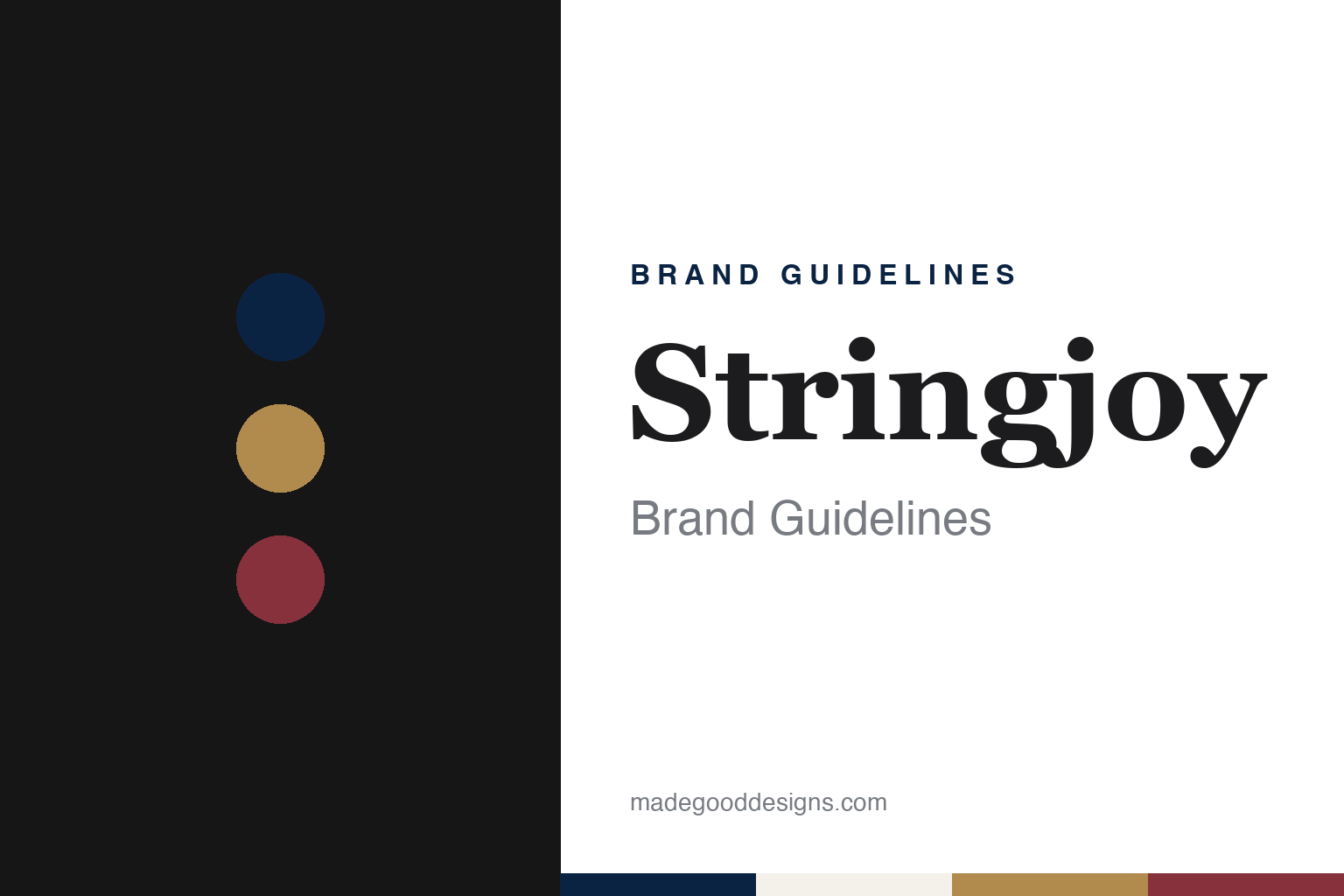
The visual identity leans on navy and gold. The company’s current website, read from its own page code, sets headings and backgrounds in a deep navy, a gold used for its logo and badges, a warm cream and a burgundy for small headings; the logo image on its story page is labelled “gold.” Stringjoy does not publish an official palette, so we treat those as what the website shows rather than a brand standard. Its 10th-anniversary T-shirt, sold from early 2025 with a “celebratory banner logo,” fits the late-2014 start.
Read in order, the archive tells a clearer story than the slogans do: a direct-to-player brand that began with a supplier, moved to a small West Coast shop and then brought winding to Nashville, where it now says every string is made.
For a design guide, Stringjoy shows how a young brand can grow from an online custom-order idea into a maker with its own factory, and why the dates matter when it describes where its strings are made. Compare Ernie Ball, whose Slinky sets set the gauges many players start from, and D’Addario. For this guide we use navy, gold, cream and burgundy with a serif, an unofficial interpretation; no product or logo is reproduced.
Explore & save
Keep Stringjoy’s identity on hand — save it to a board in the Made Good inspiration library.
Stringjoy identity set
Pin the Stringjoy navy, gold and cream palette and the soft serif register to your own board.