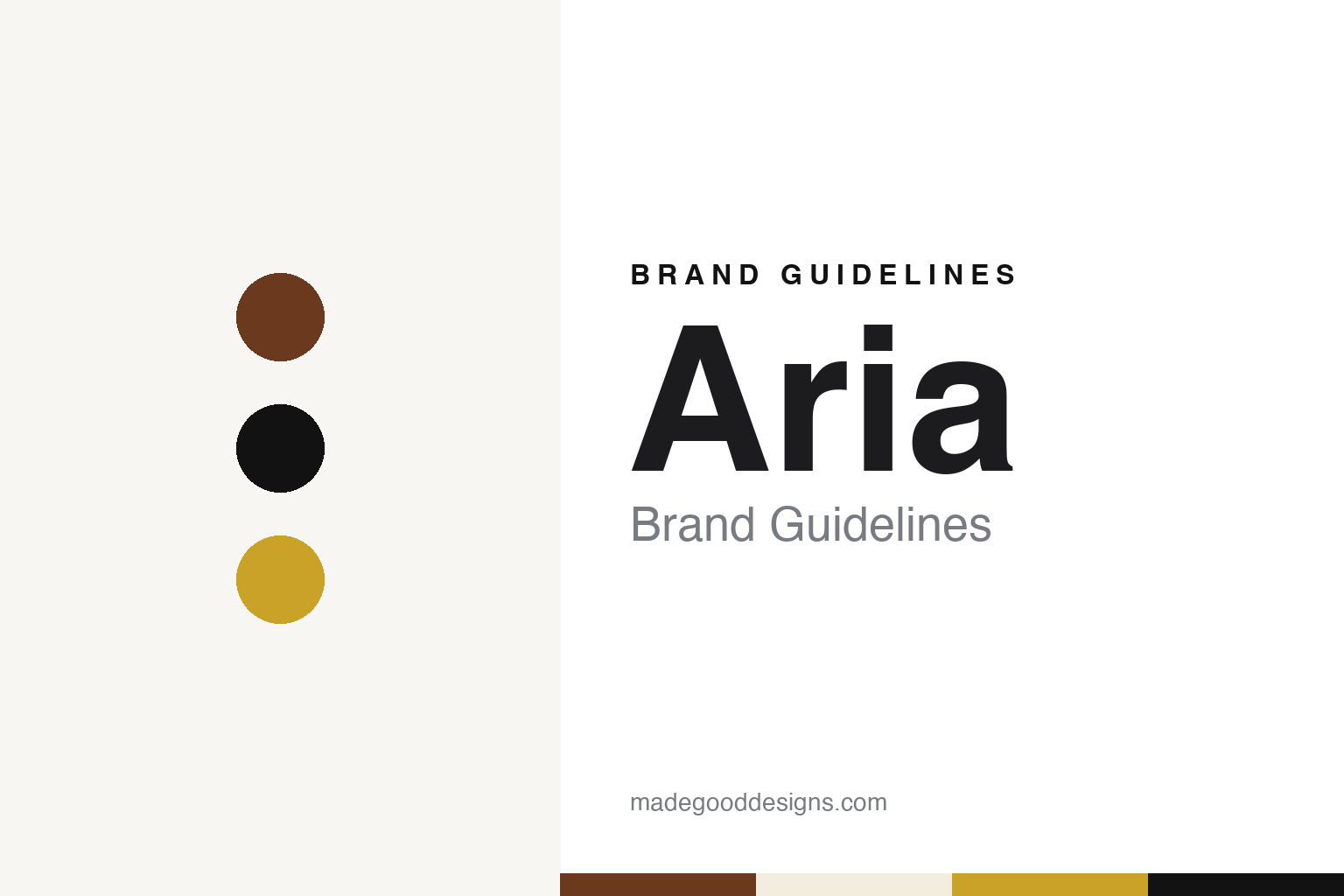
Aria Brand Guidelines
The Nagoya importer whose contract-built guitars became Aria Pro II.
Aa
Two constants: an Aria antique-violin brown, black and gold palette and a Condensed sans register. Abstract homage — not an Aria product or mark; no instrument, logo or headstock is reproduced.
Arai & Co.
A classical guitarist’s import business in Nagoya.
Aria began as a trading company. Its Japanese website dates the founding to August 1956, when Shiro Arai set up Arai & Co. (Arai Bōeki) in Nagoya. The company’s English-language history, which quotes a 2023 Guitar World feature by Joe Matera, says Arai was a classical guitarist who could not find nylon strings in Japan and began importing them from Augustine in New York; as demand grew, Arai & Co. was formed to handle the sales. Guitar World says Arai also imported guitars “including Framus models from Germany” — a link to another maker in this round, Framus.
NAMM, the American music-products association, recorded an oral-history interview with Arai in January 2006. It describes him as “a trained classical guitarist and educator” and its archive records that he died in 2019.
The name came next. Aria’s Japanese site says the company sold guitars as “Arai Guitar” before launching its own Aria brand in 1960; it calls the word a musical term, while its English site calls it an anagram of Arai. Sources differ on when the company began having guitars made. Its English history and Guitar World say acoustic and hollowbody models from 1960 and solidbody electrics from 1963; its Japanese timeline says it began selling domestically made instruments in Japan in March 1964; and a 2007 history by the Japanese vintage dealer Dai-Show says the Aria name was used on classical guitars exported to Asia from 1958. We give all three.
Electric guitars carried other names for a time. The Japanese site says electrics were sold as Aria Diamond from around 1966. Guitar World says Aria was used for solidbodies and Aria Diamond for hollowbodies and basses; English Wikipedia, citing a 2004 Shinko Music history, links the Diamond variants to a trademark conflict with Kawai. The company’s own timeline adds branches in Tokyo and Osaka in 1975 and a London subsidiary, Aria UK, in November 1978.
Colour
A woodworking firm in Matsumoto, and Aria Pro II.
Aria did not build its own guitars. As demand grew it contracted Matsumoku Industrial, a woodworking company in Matsumoto, Nagano Prefecture, the company and Guitar World say. English Wikipedia says Matsumoku was founded in 1951 as Matsumoto Mokkō and made cabinets for Singer sewing machines; Guitar World says it turned to instruments after Singer moved cabinet production to the Philippines in the early 1960s. Matsumoku built for many other badges, but English Wikipedia says none had as many models made there as Aria.
In the late 1960s Aria’s range included the angular 1532T solidbody of 1968 alongside copies of American models. Guitar World credits Aria and Matsumoku with starting the Japanese Les Paul copies that Fujigen and Tokai followed — a claim we report rather than confirm — and says that when Norlin, then Gibson’s owner, threatened Hoshino over trademarks, Aria shifted toward original designs for export. Hoshino’s own brand is Ibanez.
The result was Aria Pro II. The company dates the name to 1975 — “Pro” for professionalism and “II” for being one step ahead — and its first original model, the PE-1500, to 1976; Guitar World and English Wikipedia, citing Shinko Music, place the PE-1500 on the market in 1977. It had a carved maple-and-mahogany single-cutaway body, DiMarzio Super Distortion humbuckers, an “Antique Violin” finish and a heel-less neck joint, Guitar World says. Much of the design is credited to Nobuaki Hayashi, Matsumoku’s young chief designer, who worked as “H. Noble”; some headstocks read “Designed & Approved by H. Noble.” Sources differ on when he left; he later founded Atlansia Guitars.
The SB-1000 bass followed in the late 1970s, and with it a run of well-known players. Guitar World reports Cliff Burton of Metallica, John Taylor of Duran Duran and Cronos of Venom on SB basses; Andy Summers of the Police playing a PE on The Old Grey Whistle Test in 1978; and the jazz guitarist Herb Ellis as the first high-profile endorser, in 1978, with the PE-175 archtop.
Typography
European and Japanese makers.
The seven European and Japanese guitar brands in this guide have been owned and run in different ways: some are one-maker workshops, some sit inside larger music groups, and one has stopped trading.
In Germany, Framus was founded by Fred Wilfer in Erlangen in 1946 and went bankrupt in the later 1970s — sources differ on the year; his son Hans-Peter Wilfer revived the name in 1995 as part of Warwick, in Markneukirchen, English Wikipedia says. In Sweden, Hagstrom began in 1925 as Albin Hagström’s accordion business and made guitars at Älvdalen from 1958; the brand returned in the mid-2000s, and its website today is published by Musik Meyer of Marburg, Germany, its European distributor. In Finland, Ruokangas, founded by the luthier Juha Ruokangas in 1995, has worked from Harviala manor in Janakkala since 2011 and is solely owned by him, English Wikipedia says.
In France, LAG was founded in Toulouse in 1981 by Michel Chavarria and has belonged since 2002 to Algam of Thouaré-sur-Loire, near Nantes, French Wikipedia says.
In Japan, Tokai Gakki was founded in 1947 and is based in Hamamatsu, according to its website; English Wikipedia says the Grace Company bought it in 2021. Aria grew from Shiro Arai’s Nagoya trading company of 1956, Arai & Co. Fernandes, founded in 1969, stopped trading in July 2024, and a Tokyo court opened bankruptcy proceedings in July 2025, Tokyo Shoko Research reported.
Where the guitars are made varies too — French Wikipedia says LAG’s entry-level and mid-range guitars come from China and South Korea — and the makers do not always say.
This guide sets out what can be checked about each brand — who founded it, who owns it, and what it says about where its products are made — and marks clearly what rests only on the company’s own word.
Aa
A condensed sans for a brand of the carved-top era. (Specimen set in Oswald, a sans STAND-IN; NOT the Aria or Aria Pro II logo.)
Aria
After Matsumoku: Korea, Japan and a revived Pro II.
Matsumoku closed in early 1987; English Wikipedia says its factory site in Matsumoto became a public park. “When Matsumoku shut down its factory in 1987, Aria moved its primary guitar manufacturing efforts to Korea and outsourced production of several models to other factories in Japan,” Guitar World reported. English Wikipedia names the Korean maker as Samick, but on thin sourcing, so we do not rely on it; compare Samick. In the 1990s the Fullerton line was made in Korea apart from two USA-made models, Guitar World says. In 2000 the Aria Pro II name gave way to plain Aria outside Japan; it was revived in all markets by 2013.
Today the business is still Arai & Co., Inc., based in Nagoya with branches in Tokyo and Osaka and an affiliate in Britain, its Japanese site says. It sells electric, acoustic and classical guitars, basses, ukuleles and accessories under names including Aria, Aria Pro II, Fiesta and Pepe, lists the portable-amplifier maker Pignose as a family brand, and calls itself an export agent for Gotoh parts and Augustine strings.
On where its guitars are made, the company’s FAQ answers only for its top line: “The Platinum Collections are Made in Japan,” a range that revives the PE-1500, the SB-1000 and the TA-Tonic. A 2023 Black ’n Gold limited edition was also sold as “Proudly Made in Japan.” The standard product pages we checked do not name a country of manufacture, so we do not state one.
For a design guide, Aria shows how a distributor’s brand built a reputation of its own through original designs made by a contract factory. Compare Ibanez, another Japanese name that moved from copies to originals, and ESP, founded in Tokyo in 1975. For this guide we use antique-violin brown, black and gold with a condensed sans, an unofficial interpretation; no product or logo is reproduced.
Explore & save
Keep Aria’s identity on hand — save it to a board in the Made Good inspiration library.
Aria identity set
Pin the Aria antique-violin brown, black and gold palette and the Condensed sans register to your own board.