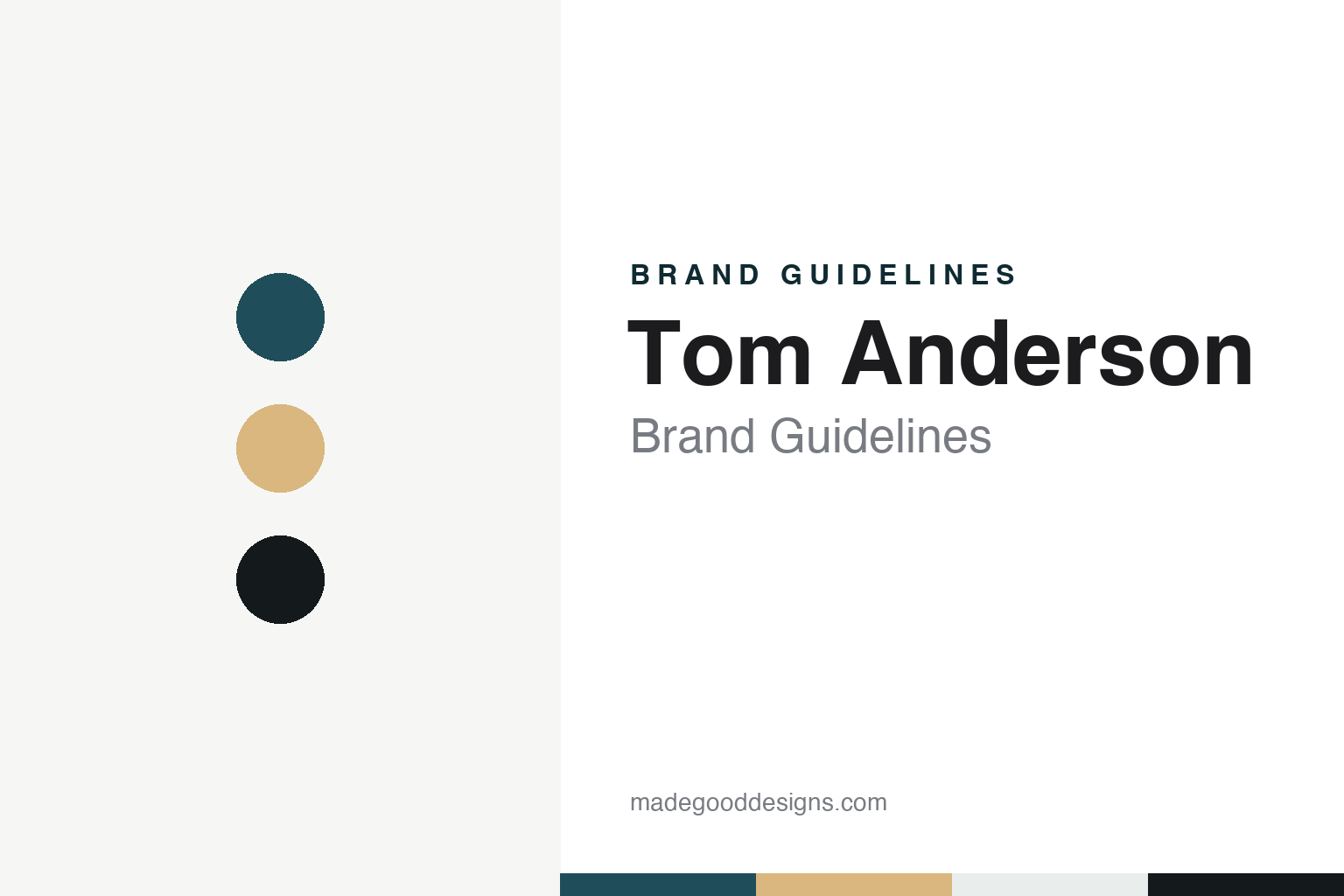
Tom Anderson Brand Guidelines
The former Schecter builder’s Newbury Park guitarworks.
Aa
Two constants: a Tom Anderson teal and maple palette and a precise sans register. Abstract homage — not a Tom Anderson product or mark; no instrument, logo or headstock is reproduced.
From Schecter
A garage, a kitchen and 300 pickups.
Anderson Guitarworks — long known as Tom Anderson Guitarworks, and still “TAG” in the company’s own shorthand — is a private electric-guitar maker in Newbury Park, California, in Ventura County. Its website gives its location there, as an archived 2010 version did, and dates the business to 1984: it was, the company says, “born out of Tom’s garage, 42 years ago in 1984, as a pickup and guitar parts (necks and bodies) business.” The current site mostly styles the brand as Anderson Guitarworks; English Wikipedia still uses the longer name.
Its founder came from Schecter. Tom Anderson told Premier Guitar in 2010 that he had made a living playing around Los Angeles for about five years after high school, doing repairs in music shops by day, and went to work building guitars with Dave Schecter in 1977. In a 2026 interview with Guitar World he described himself as one of the first employees of Schecter Guitar Research, which then made its own metal parts, wood parts, plastic parts, pickups and finishes.
He left in 1984. By his account, Schecter had brought in investors in 1982 who wanted to make parts overseas, and he was sent to Japan to source them — “that wasn’t what I wanted to do.” Dave Schecter encouraged him to go: “If you really want to do what you want, you need to start your own company.” Anderson said he had a two-year-old and a baby due in two months. What kept the family going in the first year, he said, was an order from Schecter Japan for 300 Stratocaster-style pickups, wound in his kitchen at night while he made necks and bodies in the garage by day.
Colour
Parts supplier, then machines and finishes.
The business began as a supplier to other builders. After about a year it moved into a 1,500-square-foot industrial unit, Anderson told Premier Guitar, and sold bodies and necks to John Suhr at Rudy’s Music Stop in New York, to Roger Sadowsky and to Jim Tyler, as well as to shops building parts guitars. A Hollywood dealer suggested assembling complete instruments. Sources differ on when that began: the company says 1985, Anderson told Guitar World 1986, and English Wikipedia, citing the Fretboard Journal, says it first brought finished guitars to the NAMM show in 1987. The accounts agree that by 1990 it had stopped selling parts to others; Anderson said it began painting its own guitars around 1992 and by 1993 bought in only metal parts such as tuners and bridges.
Its reputation rests on production methods. In 1988, Anderson told Guitar World, it bought its first CNC vertical machining center — a machine designed for metalworking that cost “four times our house payment each month” — after the supplier showed it could reproduce one of his necks. English Wikipedia, citing the Fretboard Journal, calls it the first guitar company to use such a multi-purpose machine. With Bob Taylor of Taylor Guitars, Anderson experimented with finishes cured by ultraviolet light, and by 1992, he said, the company was showing fully UV-finished guitars at NAMM; it describes the process as “pioneered here.” In 2006 it introduced the A-Wedgie, a compound-wedge neck joint held by two screws instead of the usual four, and it has long fitted the Buzz Feiten tuning system.
Its models are organised in families: the S and T, after Fender’s Stratocaster and Telecaster; the 24-fret Angel and the seven-string Angel 7; the long-scale Baritom; the single-cut Bobcat; the Cobra; the Crowdster acoustic-electric; the Raven; and the short-scale Wolfhound, joined in March 2026 by the Direwolf. In 2011 Guitarist magazine included its Atom in a list of “50 guitars to play before you die,” English Wikipedia notes, and Anderson told Guitar World that Kirk Hammett’s use of the guitars helped put the brand on the map.
Typography
Boutique electric guitar makers.
Boutique guitar makers often began at repair benches or larger firms. John Suhr did repairs at Rudy’s Music Stop in New York and worked at the Fender Custom Shop, Tom Anderson worked for Schecter, and Joe Knaggs spent 25 years at Paul Reed Smith before going it alone, Wikipedia and Maryland’s Times Record say.
Three of the makers in this guide are in southern California. Suhr is at Lake Elsinore and was founded in 1997 by John Suhr and Steve Smith, Wikipedia says; Guitar World called him an independent builder in 2025. Tom Anderson’s company, founded in 1984, based at Newbury Park and now called Anderson Guitarworks, has a business partner, Markus Spohn, Guitar World reported in 2026. James Tyler Guitars, whose founder died in 2024, Guitar World reported, says the work on its American line is still done in Los Angeles.
Knaggs Guitars was founded in 2009 by Joe Knaggs and Peter Wolf and works in Greensboro, Maryland, the Times Record reported in 2017. Premier Guitar profiled Bill Nash of Nash Guitars, in Olympia, Washington, in 2009.
Dennis Fano founded Fano Guitars in Pennsylvania and sold it in 2009 to the Premier Builders Guild; in January 2025 it merged with his later brand, Novo, under a British-based parent, Psonic Design Lab, with production moving from Arizona to Nashville, Guitar.com reported. Vigier, at Grigny near Paris, stayed with its founder until Audiofanzine reported in November 2024 that the workshop would close.
This guide sets out what can be checked about each brand — who founded it, who owns it, and what it says about where its products are made — and marks clearly what rests only on the company’s own word.
Aa
A precise sans for a maker built on machining tolerances. (Specimen set in Archivo, a sans STAND-IN; NOT the Tom Anderson logo.)
Tom Anderson
Since 1984, in Newbury Park.
Anderson guitars are built in Newbury Park. In 2010 Anderson said the shop stood “just across the parking lot” from its first industrial unit; English Wikipedia says it moved in 2012 to a larger building less than a mile away. The company calls itself “a small American company,” describes woodworking, finishing, final assembly and pickup winding in its own departments, and says its pickups are “designed and wound in our own pickup shop.” We give those as its claims. Its website does not, on the pages we read, use a “Made in USA” label.
The company once came close to shrinking to a single person. In November 2006, English Wikipedia records, citing Guitarist, Anderson announced that he would cut the business back to a one-man operation; weeks later he reversed the decision after what was reported as an “outpouring of support.” Today the website names Tom Anderson and Markus Spohn as co-owners and remembers an original co-owner, Laurie Berg. Anderson told Guitar World in April 2026 that after Laurie died in 2017 he began thinking about the company’s long-term future. Spohn, a San Francisco tech worker and longtime customer who first visited the factory in 2008, later moved to Southern California to join full time, and the company now calls him “Tom’s successor.” In 2024 it marked its 40th anniversary with 40 limited-edition guitars signed by Tom Anderson. We found no record of the company being sold, and it publishes no colour or typeface guidance.
For a design guide, Tom Anderson shows how a parts supplier became a brand by investing in machines and finishes. Compare Charvel, another Southern California name that grew out of parts and repairs, and Fender, whose shapes its S and T models follow. For this guide we use a deep teal, a maple and an ink with a sans, an unofficial interpretation; no product or logo is reproduced.
Explore & save
Keep Tom Anderson’s identity on hand — save it to a board in the Made Good inspiration library.
Tom Anderson identity set
Pin the Tom Anderson teal and maple palette and the precise sans register to your own board.