Empire Ears Brand Guidelines
The Georgia family company behind Zeus, Legend X and Odin.
Aa
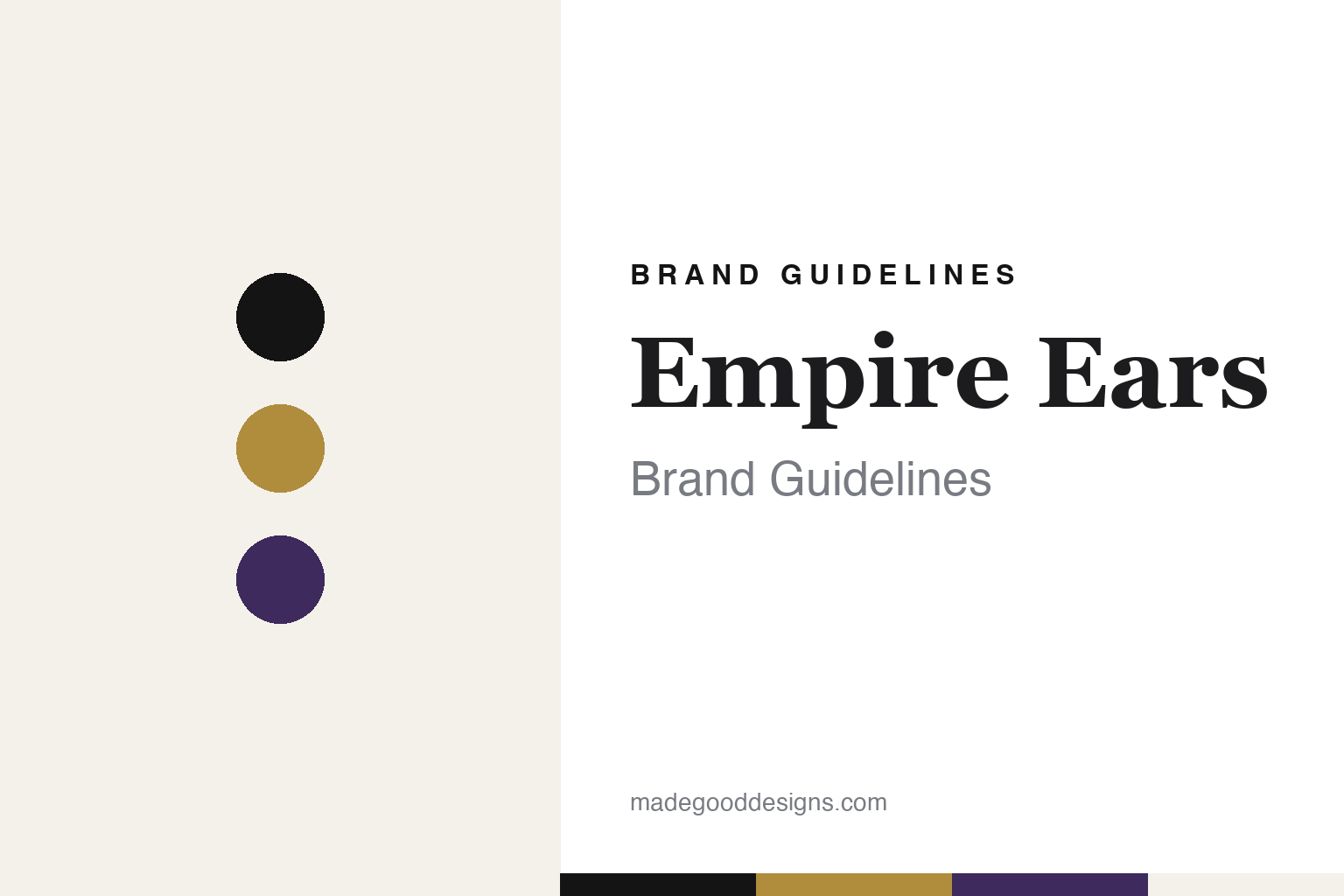
Two constants: an Empire Ears black, gold and violet palette and an Inscriptional serif register. Abstract homage — not an Empire Ears product or mark; no earphone, logo or symbol is reproduced.
From EarWerkz
A father, a son and an earlier brand.
Empire Ears grew out of an earlier custom in-ear monitor business near Atlanta. In September 2014 the website of EarWerkz, preserved by the Internet Archive, carried the line “Hand Crafted. Precision Tuned.” and gave a contact address in Lawrenceville, Georgia. It sold Pro, Hero and Legend series monitors and spoke of a foundation of “25+ years of experience.”
The review site Ear Fidelity, writing in May 2021, says EarWerkz was the brand’s “previous moniker” and that in 2015 Jack Vang and his father, Dean Vang, joined forces to create the company now known as Empire Ears. Twister6, in a review published in September 2016, likewise described Jack Vang and Dean as the people behind the EarWerkz releases, who carried their work over “when EarWerkz transitioned into a new company.” The company’s closing statement of 2026 speaks of “10 years of partnership” and of “the past decade,” which fits a launch in the middle of the 2010s.
The company described itself as family owned. An archived copy of its “About Empire Ears” page says “We are family owned in Atlanta, Georgia,” and claims “over 30 years experience in acoustic engineering and manufacturing spanning the medical, consumer, and professional markets”; we give both as the company’s own words. In 2026 Headphonesty placed it in Norcross, Georgia, a city in the north-eastern suburbs of Atlanta.
Reviewers describe a clear division of roles. Twister6 wrote in 2025 that Dean “starts with the baseline sound and makes every tuning adjustment decision,” and that he had once played guitar in a band, while Jack and Dean liked to show prototypes at CanJam headphone shows and collect feedback from listeners before a design was finished.
Colour
Greek gods, then Norse ones.
Empire Ears made its name with multi-driver monitors named after gods and heroes. Its first flagship, the Zeus-XIV of the Olympus line, released in 2016, used fourteen drivers per side; Twister6 called it the industry’s first 14-driver in-ear monitor, and its remastered successor, the Zeus-R, used an eight-way crossover. Ear Fidelity lists later versions as the Zeus XR and the Zeus XR ADEL. The Legend X, introduced at CanJam New York in early 2018, became one of the company’s best-known bass-heavy designs; it was followed in August 2021 by the Legend EVO, unveiled at Hong Kong’s HKAV show.
A Norse theme ran through the later flagships. The Odin, in its original form a “tribrid” with two dynamic drivers, five balanced armatures and four electrostatic tweeters per side, was followed in 2025 by the Odin MKII, which had an aluminium shell, a gold-plated faceplate and a cable plug bearing the Empire name and a Valknut, the interlocking-triangle symbol from Norse imagery, Twister6 reported. Other models included the Raven and, at a lower price, the ESR MKII — “Empire Ears Studio Reference” — which Ear Fidelity gave as $1,099 in 2021.
The company gave its technologies their own names: the synX crossover, which it said assigned more individual frequency bands per driver than usual; Weapon IX subwoofer drivers; EIVEC electrostatic drivers; and a treatment it called A.R.C. In 2021 the Legend EVO added a bone-conduction driver, the W10 “Weapon X.” In 2023 Empire Ears worked with the player maker Astell&Kern on the Odyssey, a limited-edition model with ten drivers per side combining dynamic, balanced-armature, electrostatic and bone-conduction types, according to Twister6.
Its own pages stressed materials. The archived “About” page lists silver-plated copper wiring, “jewel tone shells” and “imported amboyna burl wood and abalone shell faceplates,” and says “Our in-ear monitors are proudly designed and handcrafted in the USA.” Headphonesty wrote in 2026 that each unit was hand-built in the United States.
Typography
Design and documentation.
The seven brands here make earphones that sit in the ear canal, but they come from different trades. Some grew out of hearing health and earmould laboratories, others out of touring, where custom-moulded monitors replaced loudspeakers on stage.
Etymotic Research was founded in 1983 by the audiologist Mead Killion in Elk Grove Village, Illinois; in 2018, The Hearing Review reported, Lucid’s parent, Hearing Lab Technology, took a controlling interest, and in 2020 Lucid Audio bought Westone Audio from Westone Laboratories. Westone Audio says it was acquired in 2026 by The Fidelity Collective, whose Irving, Texas, address now appears on both brands’ websites; Westone Laboratories, the Colorado hearing-health firm, was bought by TLS Sound Labs in 2025.
JH Audio, founded by the monitor engineer Jerry Harvey, says its earphones are built in Orlando, Florida; Sound Devices, part of the Audiotonix group, announced its acquisition in May 2025. Empire Ears, which said it was family-owned and hand-made its monitors in Norcross, Georgia, announced that it closed in February 2026.
Vision Ears says it has made in-ear monitors by hand in Cologne since 2013; it was founded by Marcel Schoenen and Amin Karimpour, who its legal notice lists as managing directors. Noble Audio, founded in 2013 by John Moulton, now trades as Noble HiFi, LLC, of Whitehouse, Texas, and says John and Jim Moulton each own half. Unique Melody says it was founded in 2007 and gives its address as Zhuhai, in Guangdong, China.
This guide sets out what can be checked about each brand — who founded it, who owns it, and what it says about where its products are made — and marks clearly what rests only on the company’s own word.
Aa
An inscriptional serif for a brand named for an empire. (Specimen set in Cinzel, a serif STAND-IN; NOT the Empire Ears logo.)
Empire Ears
Hand-built in Georgia, closed in 2026.
Empire Ears announced its own end. A statement on its website says the company closed effective 27 February 2026, “after 10 years of partnership,” and gives reasons including “changing market conditions, and rising operational costs.” It adds that the company is proud “of the role Empire Ears played in the high-end in-ear monitor industry.” The statement does not say what will become of the brand name or the designs.
Headphonesty, reporting the closure in March 2026, grouped Empire Ears with other audio companies that had shut down in the previous six months. It described the company as widely respected at the very top of the in-ear monitor market, called flagship models such as the Odin benchmarks in the category, and said its commitment to building in the United States “brought prestige and rising costs.” It also noted that the company had tried wireless products and Bluetooth accessories while its prices stayed anchored to premium wired monitors.
That history is a useful case for anyone studying small audio brands. Empire Ears sold through specialist retailers such as MusicTeck and Bloom Audio, launched designs at enthusiast shows rather than through mass advertising, and relied on product names, materials and reviews more than on a widely recognised logo.
For a design guide, Empire Ears shows how a small family company built a premium identity from naming — Greek gods, then Norse ones — and from visible materials such as gold, burl wood and abalone. Compare 64 Audio, another American maker of high-end in-ear monitors, and Astell&Kern, its partner on the Odyssey. For this guide we use black, antique gold and a jewel violet with a serif, an unofficial interpretation; no product or logo is reproduced.
Explore & save
Keep Empire Ears’s identity on hand — save it to a board in the Made Good inspiration library.
Empire Ears identity set
Pin the Empire Ears black, gold and violet palette and the Inscriptional serif register to your own board.