Revv Brand Guidelines
The Winnipeg amp maker that named its sounds by colour.
Aa
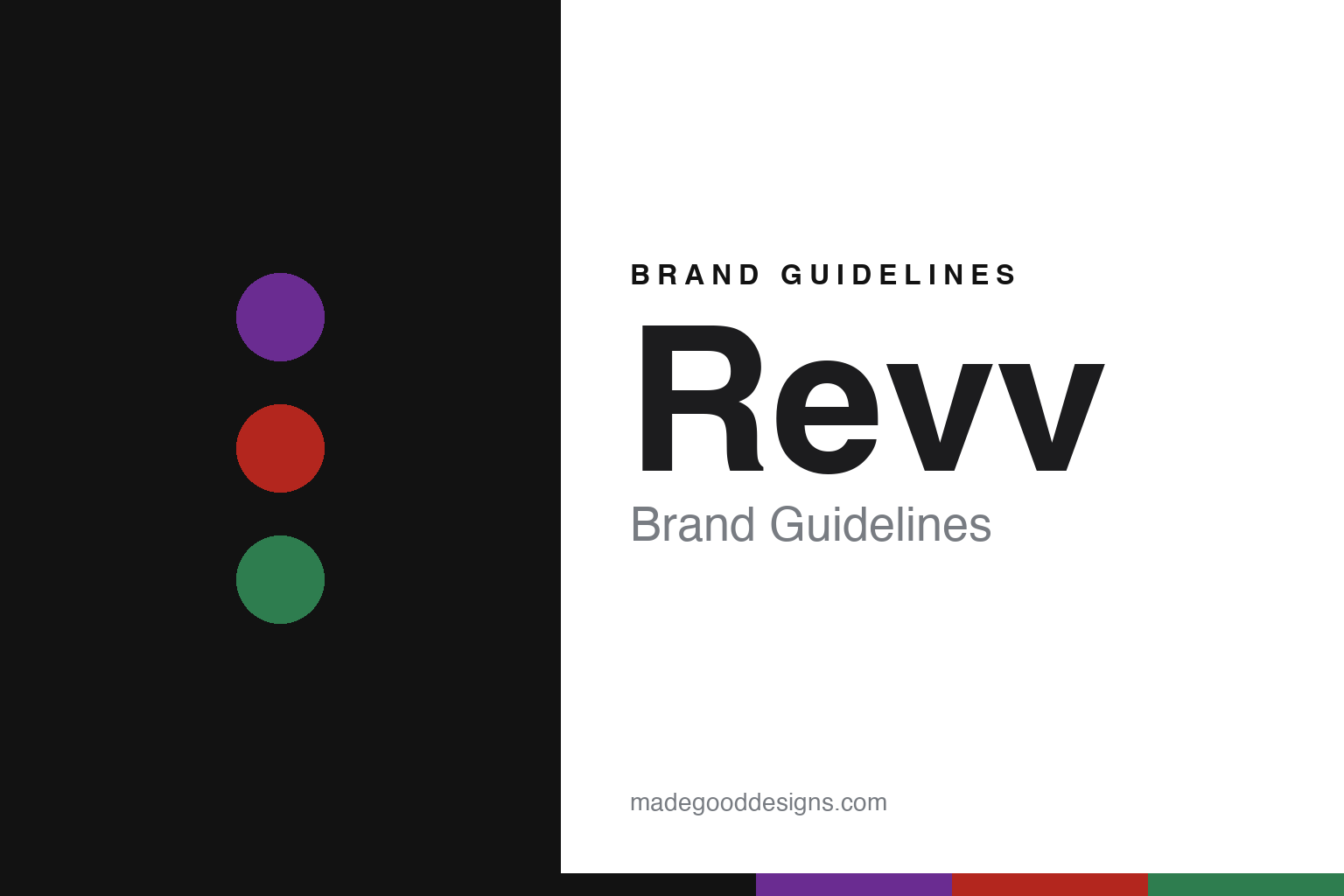
Two constants: a Revv purple, red, green and blue on black palette and a Condensed sans register. Abstract homage — not a Revv product or mark; no amplifier, pedal or logo is reproduced.
A basement in Winnipeg
A prototype amplifier and a faceplate job.
Revv Amplification is a young company by the standards of guitar amplification. It says it was founded in Winnipeg, Manitoba, in 2014 by two friends, and that it began with a prototype amplifier in a basement that local musicians heard and wanted: “Woah! This rules! You have to make me one!” The Internet Archive first captured the revvamplification.com site in December 2014, and by 2015 the site gave a contact address in Île-des-Chênes, a community just south-east of Winnipeg, which the company still lists today.
Its site tells the story through two people. Dan Trudeau, president and designer, is described as an electrical engineer and heavy-metal fan who began repairing and modifying amplifiers for Winnipeg guitarists, then designed one of his own to get a high-gain sound he could not find in other amps: the first Generator prototype. Derek Eastveld, now vice-president of sales and marketing, says he took a call that “a new amp builder in town needs a faceplate made,” walked into Trudeau’s basement and heard the amp, and brought experience in manufacturing and stage rigging to the new firm. His brother Scott Eastveld joined to build cabinets and stayed on in sales and marketing.
The aim, the company says, was a “best-of-all-worlds” high-gain sound that was not based on any particular existing amp. Independent coverage has followed the same line. Reviewing the G3 pedal in August 2018, Premier Guitar described Revv as a Winnipeg company specialising in high-gain amplifiers and said Trudeau had spent a year adapting the high-gain channel of the Generator 120 amplifier into a small pedal.
Colour
Four colours, one amp.
The Generator defined the brand. Revv describes its four channels by colour: Blue, a clean channel; Green, a touch-sensitive crunch channel reworked with help from Nashville session players; Purple, which it calls “the sound you’re imagining” when you think of Revv, with tight, clear high gain for low tunings; and Red, “a sledgehammer” for saturated leads. Voicing switches for Aggression, Bright, Cut and Fat let players tune each one, and the company calls the result “Canadian tone.” The colours carried over to the pedals: the G3 puts the Purple channel in a compact box, and Revv says it “revolutionized high gain pedals in 2018”; it returned with a V2 circuit in 2025, alongside the sister G2 and G4.
The second strand is direct recording. In 2019 Revv launched the D20, an all-valve “lunchbox” amplifier for clean and edge-of-breakup tones with a reactive load and cabinet simulation from Two notes Audio Engineering built in. “According to Revv, the D20 is the first amplifier to integrate Two Notes’ Torpedo cabinet emulation software,” Joe Gore wrote in Premier Guitar in August 2019, at a street price of $1,199. Reviewing the high-gain G20 in November 2020, the magazine said Revv had become “the first tube-amp manufacturer to incorporate cab-and-microphone impulse responses” from Two Notes directly into its design. The system then spread through the range, to the Generator 120 MK3 of 2021, the G50 and the D40, and the company now calls it its “new standard.”
The D20 belongs to the Dynamis series, which Revv says began as “not-metal” versions of the Generator for Nashville players and now includes the D25 combo and the D40, its flagship. Signature products followed with players: the Shawn Tubbs Tilt Overdrive of 2022, described as the first Revv Signature Series pedal; the Northern Mauler for the Canadian recording engineer Glenn Fricker, a two-in-one distortion that includes Revv’s take on the HM-2 sound; and the D20 JL and D25 JL amplifiers and the Dirtdog pedal for the slide guitarist Joey Landreth, whom Revv calls a longtime collaborator.
Typography
Design and documentation.
The boutique amplifier began as a reaction to mass production: small shops building tube amps largely by hand, often by one designer. Two of the makers in this guide date from the late 1980s. Dr. Z was founded in 1988 by Mike Zaite, who built his first amps in Cleveland, Ohio, while working as a medical electronics technician, English Wikipedia says. Fryette began in January 1989 as VHT Amplification, started by Steven Fryette in Studio City, Los Angeles; the company took the Fryette name in 2009, and the VHT name now belongs to a different company.
Two more followed a decade later. Bad Cat was founded in Corona, California, by James and Debbie Heidrich, with Mark Sampson as designer, its 2001 website said; John Thompson told Guitar World he bought it from James Heidrich in 2011, and it now says its amps are designed and built in Costa Mesa. Carr made its first sales in 1998 and has built its amps in Pittsboro, North Carolina, for most of its history, Premier Guitar reported in 2024.
Two are British. Hiwatt goes back to Dave Reeves, who registered his Hylight company in 1966 and later built amps under the Hiwatt name; its UK website is now published by Britampco, a Doncaster company, which says its Original range is still hand-wired to Reeves’s specifications. Victory launched in 2013 with Martin Kidd as chief designer and says its amps are designed and built in England; Guitar.com reported in 2023 that the retailer Lee Anderton is one of nine business partners behind it.
The youngest is Canadian. Revv says it was founded in Winnipeg, Manitoba, in 2014 by two friends, led by its president and designer Dan Trudeau, and that it builds its gear in Canada.
This guide sets out what can be checked about each brand — who founded it, who owns it, and what it says about where its products are made — and marks clearly what rests only on the company’s own word.
Aa
A condensed sans — compact, technical and loud. (Specimen set in Barlow Condensed, a sans STAND-IN; NOT the Revv logo.)
Revv
A small business building in Canada.
Revv describes itself as “a small business building quality guitar gear in Canada,” and Trudeau and Derek Eastveld still lead it, according to its website. Where its products are made is stated product by product. The Generator 120 MK3 page says Revv “builds to the highest durability & quality standards in Winnipeg, Canada,” the D25 is described as “Handmade in Canada,” and pedals including the Tilt Overdrive, Tilt Boost, Northern Mauler and Chatbreaker are marked as made, or “designed and built,” in Canada. In 2025 the shop added “Canadian Edition” versions of the G2, G3 and G4 pedals and the G8 noise gate, the last described as “Manufactured in Canada”; the standard G-series listings name no country. We give all of these as the company’s own statements.
The range has kept widening. A G25 high-gain head arrived in 2026, after revised D20 MK2 and D25 combos, cabinets in several sizes and Revv’s own RV30 and RV90 speakers; a Custom Shop offers choices of tolex, grille cloth, piping and faceplate. A 10th-anniversary Generator 120 in 2024 drew, the company says, on sought-after early models, including the original prototype. Revv also runs “Gear & Beer” events and livestreams and exhibits at NAMM, and says many of its amps and pedals came directly from players’ feedback.
For a design guide, Revv shows how a young maker can build an identity from one simple system, naming its sounds by colour in a scheme that runs from the amplifiers to the pedals. Compare Friedman, another builder known for high gain, and Mesa/Boogie, a longer-established maker of multi-channel heads. For this guide we use channel purple, red, green and blue on amp black with a condensed sans, an unofficial interpretation; no product or logo is reproduced.
Explore & save
Keep Revv’s identity on hand — save it to a board in the Made Good inspiration library.
Revv identity set
Pin the Revv purple, red, green and blue palette and the Condensed sans register to your own board.