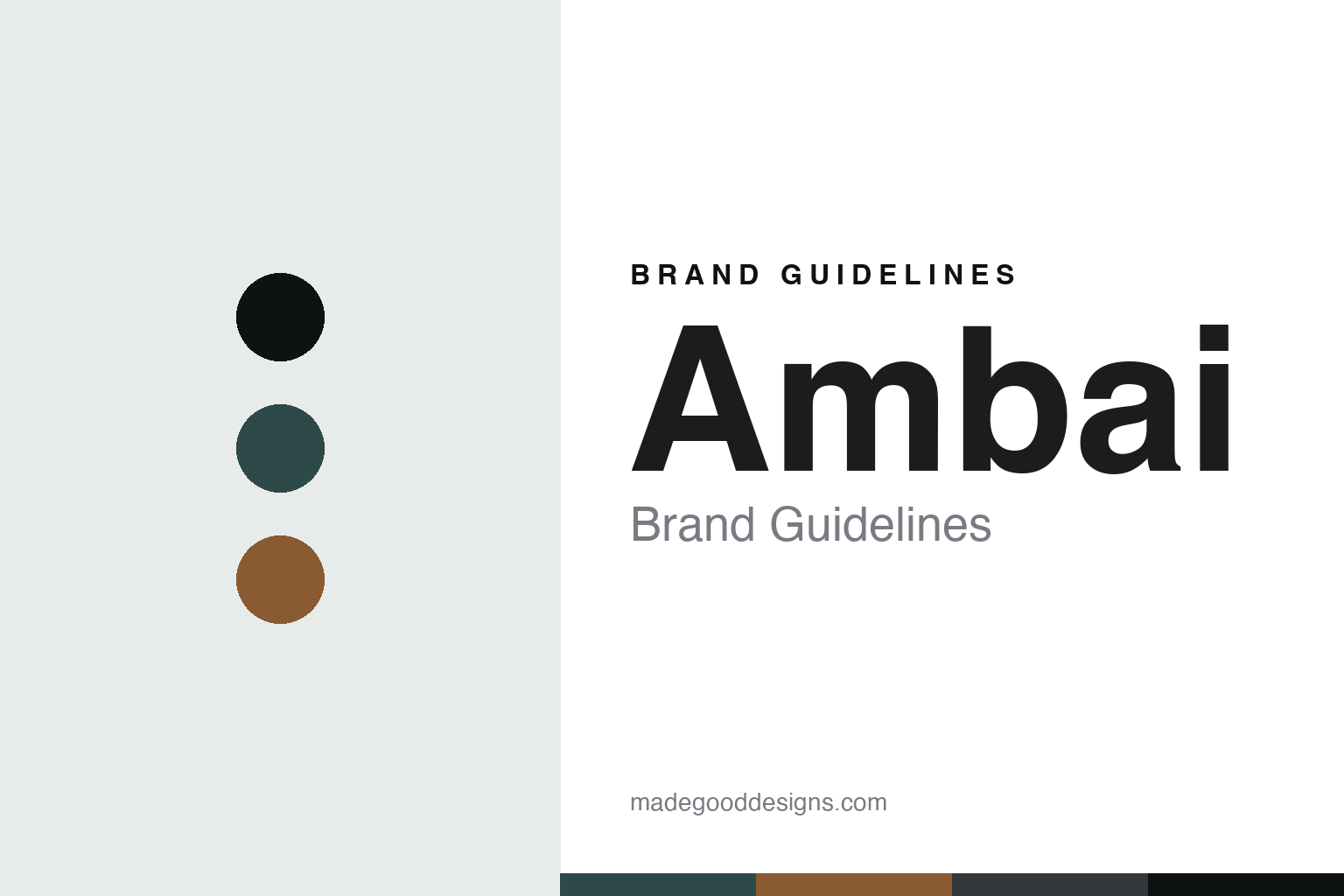
Ambai Brand Guidelines
The designed iron pan.
Aa
Two constants: an ambai-teal palette and a design-sans register. Abstract homage — not an ambai pan, handle or wordmark.
The designed iron pan
Ambai is a Japanese design brand whose iron pans are made by craftsmen in Niigata.
Ambai is a lesson in quiet design across regional makers as the identity. A Japanese everyday-tools brand from the designer Makoto Koizumi, it applies careful product design to cookware — iron frying and omelette pans with teak handles, made by specialist craftsmen in Japan. Its answer to how a durable pan is made is a designer-and-maker one: pair thoughtful design with regional metalworking, so an iron pan is both well-made and well-considered. A well-designed pan, made by the right craftsmen.
Its identity is the heirloom pan, designed and made in Japan. Ambai’s iron pans, its teak handles and its Niigata making are the work it is known for. A design and a craft, made a signature. A brand that matches the maker to the material.
(Honest notes, so the story stays precise. Ambai is a contemporary Japanese design brand led by the living designer Makoto Koizumi, and its name comes from a Japanese phrase for good balance or condition. It works as a multi-maker brand — Koizumi collaborates with craftsmen across Japan, so there is no single producing company. Its made-in-Japan reality is per material: the iron frying and tamagoyaki (omelette) pans are made by a Niigata manufacturer in the Tsubame-Sanjō metalworking area, with teak handles and a fine “fiber-line” surface finish; some pots are also from Niigata, while its clay pieces come from a different region. So we scope the metalwork to Niigata and do not claim the whole brand is made in one place. We call the pans iron with a special surface finish rather than assert a specific steel treatment, and we note it makes no copper line. Its designs and wordmark are its IP, described but never reproduced, and there is no official brand hex — these tones are an unofficial interpretation. This is design commentary and does not promote any product.)
Colour
Ambai lives in an ambai-teal palette. Click a swatch to copy the hex.
Ambai’s identity is quiet, considered and Japanese — an ambai teal, an ink, a teak, an iron, and a chalk. The palette leans ambai teal and teak: the register of an understated pan and its warm wooden handle. It signals design and hand-feel over display. The honest caveat: with no published brand hex, these values are an original, unofficial interpretation, not first-party colours.
The lesson is an ambai-teal palette signals a quiet, made-in-Japan identity. Ambai’s world is an iron, teak-handled, made-in-Niigata object. For designers, it is a reminder that a muted teal and a warm teak can carry a brand built on considered design — the teal of restraint and the brown of a wooden handle. Because these tones can fail as small text, keep type dark and let the colour live in the accents, palette and band. The takeaways: match design to maker; keep the metalwork in Niigata; scope the origin per material; and treat any single hex as unofficial.
Typography
The register is a design sans — clean, quiet, resolved.
Ambai’s identity carries a clean, quiet, resolved spirit — a designed object, not a decorated one. A quiet Japanese sans captures the mood: even, understated and considered, the register of thoughtful product design. Set in an ambai-teal palette, the design sans feels clean and quiet — exactly the personality ambai carries. It is resolved rather than expressive, mirroring a well-designed iron pan. (Ambai’s real designs and forms are things we describe but do not reproduce, and the exact typeface is not ours to use.) Because it is not ours to use, the honest description is “a design-sans spirit,” shown here in a stand-in. The type behaves like the design: clean, quiet and resolved.
Aa
A design-sans spirit — clean and quiet. (Specimen set in Murecho, a Japanese-sans STAND-IN; NOT the ambai wordmark or any pan design.)
The heirloom-metal pan
Ambai stands for matching design to the right maker.
Ambai is a lesson in making considered design plus the right maker the identity. An ambai-teal palette, a design sans and a teak-handled iron pan make one thing — a well-designed pan made by the craftsmen best suited to it — the whole maker: quiet, considered and Japanese. The design-and-maker pairing is the differentiator. The differentiator is a model where a designer works with the right regional craftsman for each material, so an iron pan is made by iron specialists and a clay pot by potters.
Put to work, the identity is design-plus-craft as design. A maker building in this spirit would pair thoughtful design with the specialists who can best execute each material, keep the making in the regions built for it, and be honest that a multi-maker brand is made in several places. It would treat restraint and hand-feel as the point, not decoration. A brand learning from it would see that good design and good making are separate skills, and that respecting both — designing carefully, then choosing the right craftsman — is a strong, honest identity. A brand learning from it would treat the network of regional makers as an asset to name and honour, not a supply chain to hide, since the maker of each piece is part of what the buyer is paying for. It would say plainly which pieces are made where. The lesson ambai teaches is that design and craft together can build a brand: the design gives it clarity, and the Niigata making gives it substance. The pairing is the personality, and the designed iron pan is the proof.
For designers and brand-builders, ambai closes this round about the heirloom-metal pan on the design pole: design carefully, choose the right maker for each material, and be honest about where each is made. The lessons: match design to craft; keep it in the region; scope the origin per material; and never reproduce a protected design. It is also a reminder to stay precise: ambai is a contemporary Japanese design brand by Makoto Koizumi, its iron pans made by craftsmen in Niigata — with the origin scoped per material, and the palette here an unofficial interpretation. Ambai made design-plus-craft the maker — proof that how and where can be the difference.
Explore & save
Keep Ambai’s identity on hand — save it to a board in the Made Good inspiration library.
Ambai identity set
Pin the ambai-teal palette and the design-sans register to your own board.