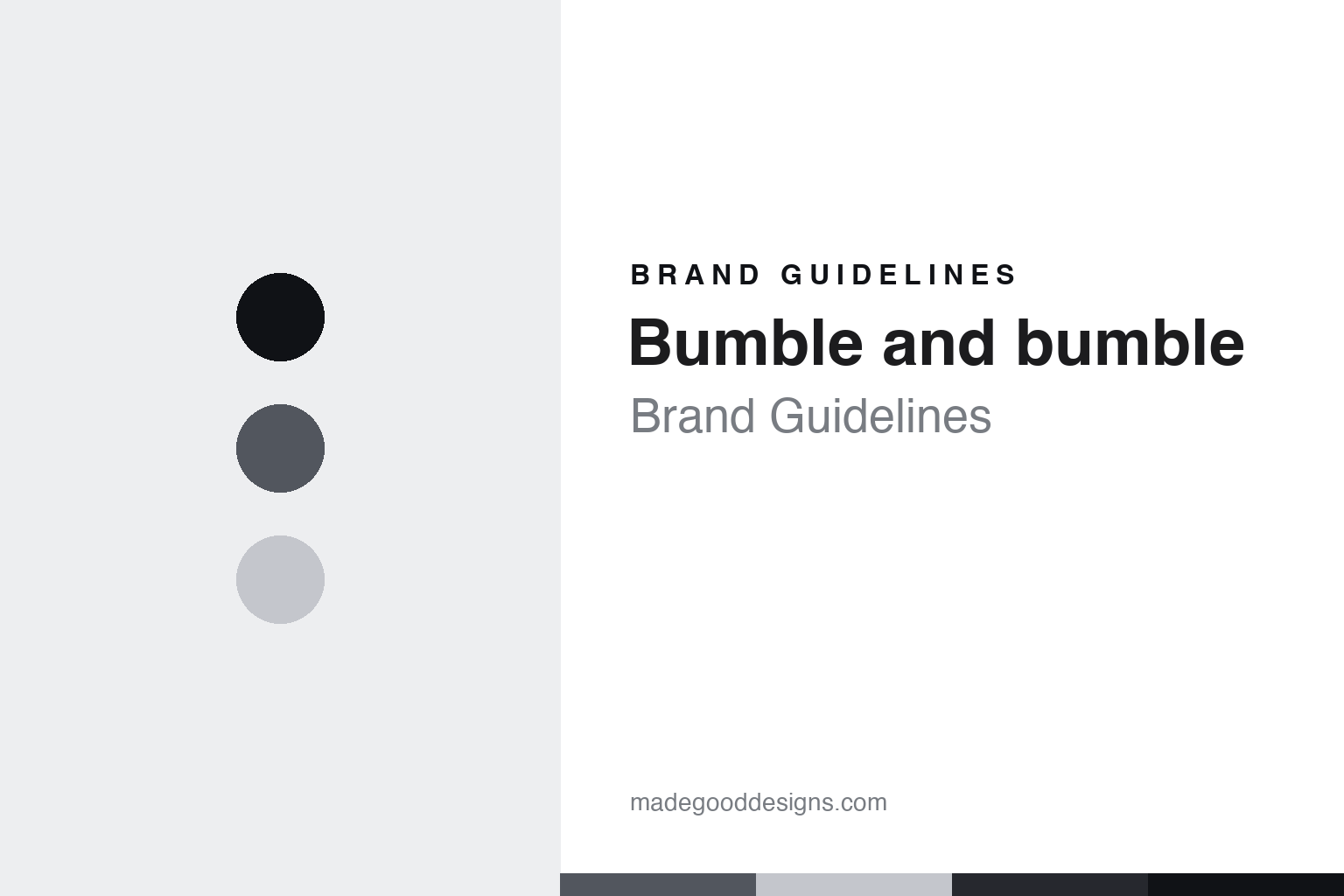
Bumble and bumble Brand Guidelines
The New York editorial salon brand.
Aa
Two constants: a graphite palette and an editorial-salon-sans register. Abstract homage — not a Bumble and bumble product or mark; not the black-and-white identity.
The New York editorial salon brand
Bumble and bumble is the New York editorial salon haircare brand, owned by Estée Lauder.
Bumble and bumble brings the round a New York edge — the editorial salon brand that began as a 1977 New York City salon and grew a fashion-week, backstage identity, with a hairdresser’s credibility. Bumble and bumble makes editorial salon haircare, and its answer to a round about the salon brands is a design-led one: a professional range born on the salon floor and the runway, sold through stylists and its own channels. A brand, editorial.
Its identity is the New York editorial salon brand. Bumble and bumble’s salon origin, its editorial identity and its ownership are the story here. A brand, editorial. The New York editorial salon brand.
(Honest notes, so the story stays precise, and the claims stay the brand’s own. Bumble and bumble, at bumbleandbumble.com, makes editorial salon haircare — styling, shampoos and conditioners, treatments, texturisers and finishing products — with heroes such as its Surf Spray and its Hairdresser’s Invisible Oil, and we report its performance and repair language as the brand’s own marketing, not established fact. It was founded in 1977 as a New York City salon by the hairstylist Michael Gordon, and built a strong editorial, backstage and design-led identity. On where it is made, a theme of this round, a country of manufacture is not documented, so we do not assert one. On ownership, a star theme of this round, it is owned by the Estée Lauder Companies, whose documented acquisition dates to 2000, so it is not independent. Its name, its product names and its minimalist black-and-white, typographic trade dress are IP we describe but do not reproduce; there is no official brand hex; these tones are an unofficial interpretation.)
Colour
Bumble and bumble lives in a graphite. Click a swatch to copy the hex.
Bumble and bumble’s identity is editorial, design-led and cool, and our stand-in palette is a graphite, a nod to its black-and-white without copying it — a graphite, an ink, a silver, a deep slate, and a paper. We choose a neutral graphite to echo the brand’s monochrome, editorial spirit while not reproducing its exact black-and-white identity. The palette leans graphite and silver: a cool, typographic register. The honest caveat: with no usable brand hex, these values are an original, unofficial interpretation, chosen to stay clear of the trade dress.
The lesson is a graphite signals an editorial, design-led identity — without copying the black-and-white. Bumble and bumble’s world is a cool, made object. For designers, it is a reminder that a neutral graphite can evoke a monochrome, editorial brand while avoiding its exact identity. Because these tones can fail as small text, keep type dark and let the colour live in the accents, palette and band. The takeaways: lead with editorial; keep it design-led; report claims as marketing; and never copy the black-and-white.
Typography
The register is an editorial-salon sans — editorial, plain, cool.
Bumble and bumble’s identity carries an editorial, plain, cool spirit — a design-led house, not a fashion in the passing sense. An editorial-salon sans captures the mood: clean, cool and confident, the register of a New York studio. Set in a graphite palette, the editorial-salon sans feels editorial and cool — exactly the personality Bumble and bumble carries. It is a studio rather than a logo, mirroring a spray and an oil. (Bumble and bumble’s real black-and-white packaging is a thing we describe but do not reproduce, and the exact typeface is not ours to use.) Because it is not ours to use, the honest description is “an editorial-salon-sans haircare,” shown here in a stand-in. The type behaves like the brand: editorial, plain and cool.
Aa
An editorial-salon-sans haircare — editorial and cool. (Specimen set in Work Sans, an editorial-salon-sans STAND-IN; NOT the Bumble and bumble logo or its black-and-white identity.)
The salon brands
Bumble and bumble stands for the New York editorial salon brand.
Bumble and bumble brings the round a New York edge. A graphite palette, an editorial-salon sans and a salon origin make one thing — the New York editorial salon brand — the whole identity: editorial, design-led and cool. The salon floor is the origin, and Estée Lauder is the owner. The point is a professional brand born in a New York salon and on the runway, with a hairdresser’s credibility.
Put to work, the identity is a salon origin told straight, as design — with the ownership stated and the black-and-white left uncopied. A maker in this spirit would lead with editorial, keep it design-led, and report claims as marketing. A reader in this spirit would keep the facts right: Bumble and bumble makes editorial salon haircare, its Surf Spray and Hairdresser’s Invisible Oil the heroes; it was founded in 1977 as a New York City salon by Michael Gordon; a country of manufacture is undocumented; and it is owned by the Estée Lauder Companies, with a documented 2000 acquisition. Bumble and bumble joins Aveda on the round’s Estée Lauder thread, and the design-led side of the salon story. The honest editorial moves are to date it to 1977, to say the making is undocumented, to state the Estée Lauder ownership from 2000, and to copy none of the black-and-white. The lesson Bumble and bumble teaches is that a salon origin and an editorial identity can define a brand, and stating the ownership keeps it credible.
For designers and brand-builders, Bumble and bumble continues the salon brands: lead with editorial — and keep it design-led. The lessons: build a brand on a genuine salon origin; make an editorial, backstage identity the differentiator; report performance language as your own; state a conglomerate ownership plainly; and never copy a black-and-white identity. It is also a reminder to stay precise: Bumble and bumble is the New York editorial salon haircare brand, owned by Estée Lauder — with the palette here a deliberate non-brand interpretation. Read that way, Bumble and bumble is less a bottle than a studio: editorial, at the salon. The lesson for a brand is that an origin and honest ownership reinforce each other, and stating the Estée Lauder ownership keeps the story earned. Bumble and bumble made the-New-York-editorial-salon-brand the identity — proof that a salon origin can carry a brand.
Explore & save
Keep Bumble and bumble’s identity on hand — save it to a board in the Made Good inspiration library.
Bumble and bumble identity set
Pin the graphite palette and the editorial-salon-sans register to your own board.