George L’s Brand Guidelines
The Madison, Tennessee solderless cable built on cut, push, tighten.
Aa
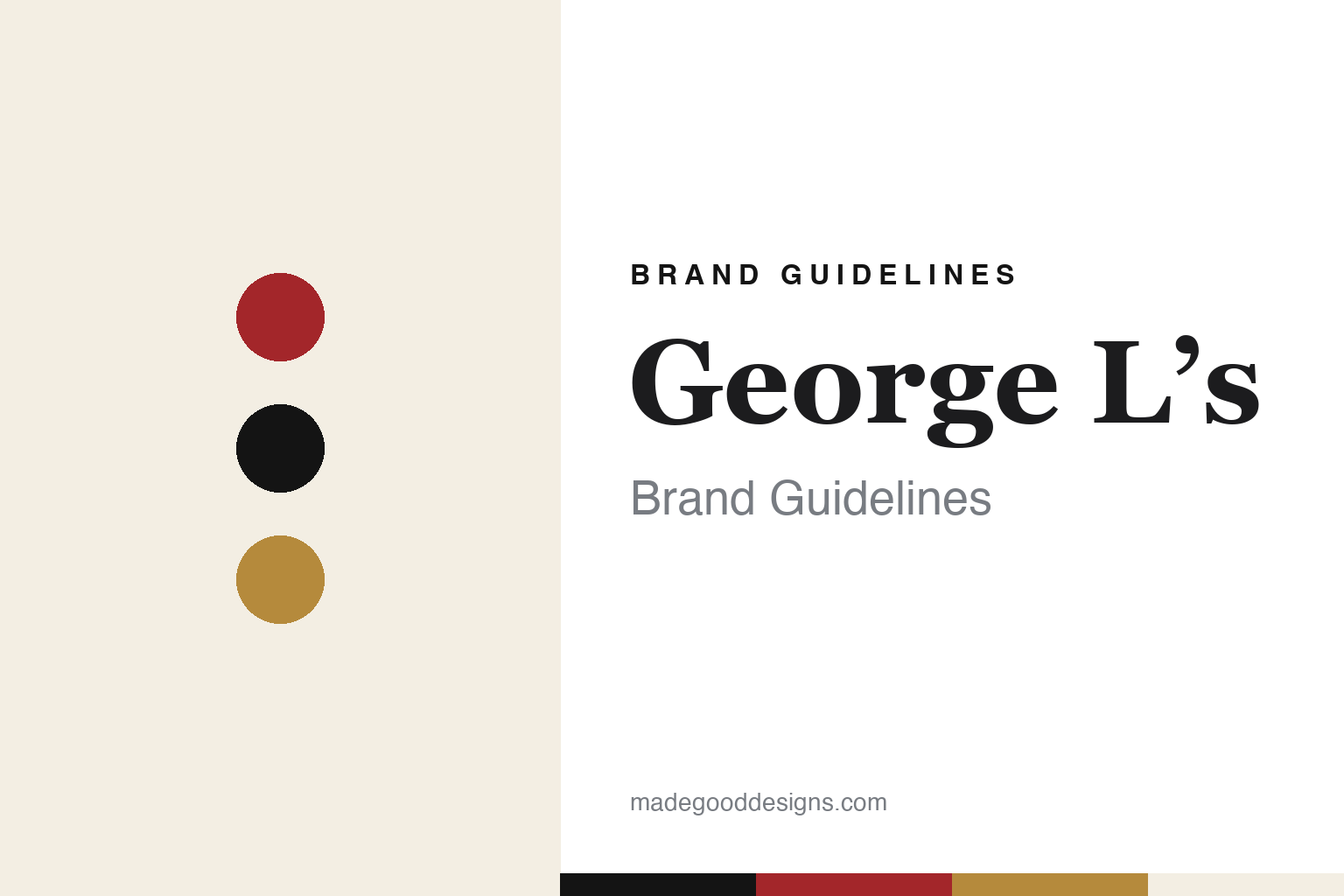
Two constants: a George L’s vintage red, black and brass palette and a Slab serif register. Abstract homage — not a George L’s product or mark; no cable, plug, logo or packaging is reproduced.
Madison, Tennessee
A steel-guitar man’s cable from Nashville’s suburbs.
George L’s is named after its founder, George L. Lewis, and has long been run from Madison, Tennessee, a suburb of Nashville — the town where Shot Jackson and Buddy Emmons started the Sho-Bud pedal steel guitar company in 1955, according to Wikipedia. The business trades as L & L Sales, Inc., the name on the copyright line of its first website, which was online by January 1998 and invited visitors to its booth at the NAMM show in Los Angeles.
What is known of the founder comes from the company’s own website. Versions archived in 2005 and 2012 call Lewis “a seasoned veteran in our musical heritage,” say he survived Pearl Harbor as a crewman of the battleship USS West Virginia, and say he had been “part owner” of businesses including the string maker GHS and Sho-Bud. Wikipedia credits the founding of GHS, in 1964, to Gould, Holcomb and Solko, and of Sho-Bud to Jackson and Emmons; the part-ownership claims are the company’s own. The 2012 site described George L’s as “Family Owned & Operated for Over 30 Years” and showed a photograph of George and Mona Lewis at the International Steel Guitar Convention.
That steel-guitar background runs through the catalogue. Alongside cable, the first website sold steel guitar strings, pickups for 10- and 12-string pedal steels and steel guitar accessories, as well as single strings, a “Pop in” pickup, T-shirts and hats. Strings in nickel and stainless steel stayed in the range for years, and the 10- and 12-string steel pickups were still listed in the online store in 2026.
Colour
Cut, push, tighten.
The idea that made the name is a cable that needs no soldering. The company calls George L’s “the FIRST HIGH-END instrument cable that requires no stripping or soldering.” The player cuts the thin coaxial cable straight across, pushes a plug onto it until it bottoms out — the “hot” connection — and turns a set screw against the cable for the ground; the instructions specify one and a half to two turns after contact, and warn against stripping the cable. Right-angle plugs take the cable into a slot under a screw-down cap, and speaker plugs use a variation with a ribbed ground side.
Two sizes define the range. The company calls the .155-inch cable “The Original High-End Cable,” recommends it for pedalboards, racks, keyboards and electronic drums, and uses it in its effects kits; the thicker .225 has the same interior with a larger core, for players who prefer the feel and weight of a traditional lead on stage. Both came in black or a “Vintage Red,” which the company says sound the same. It describes the cable as low-capacitance coax “with special anti-stat,” and gives a lifetime warranty on its plugs.
Press attention came early, and the company quotes it on its own website. It reproduces Guitar Player’s September 1997 cable shootout, in which Art Thompson wrote that “nothing beat the 20’ George L’s” and gave its capacitance as 418 pF against a highest reading of 1,150 pF; on that basis George L’s advertised itself as voted number one for sound clarity. It also quotes Chris Gill in Guitar World in March 1999, noting the approval of the guitarist Eric Johnson; Eric Kirkland in Guitar World in December 2004, who wrote that the brass, gold-plated and nickel-plated plugs each shade the tone differently; and an excerpt from Bass Player’s best-bargains feature of December 1999.
Typography
Cable makers for players.
An instrument cable looks like the simplest thing on a stage, yet the brands that make them differ widely in age, ownership and in what they say about where their cables are made. Six of the seven in this guide are based in the United States and the seventh belongs to a North American group; they fall into three rough groups.
The catalogue suppliers are the largest. Hosa was founded in 1984 by Sho Sato, who had moved to the United States from Japan, and he has since handed it to his daughter, Mayumi Allison; it is based in Buena Park, California, the company says. Kirlin says Kirlin Industries was founded in 1997 and sells in 35 countries and regions from Ontario, California. Pig Hog, of Petaluma, California, dates itself to 2011 lists more than 300 cables, adapters and accessories, and appears among the brands of Ace Products Group, which also owns Reunion Blues.
The specialists sell on engineering. George L’s, the Madison, Tennessee, company of George L. Lewis, built its name on a solderless system: cut the low-capacitance cable and tighten on the plug, its website said in 2005. Evidence Audio was founded by Tony Farinella and says its cables are hand-built in the USA from American-made material. Lava Cable is now a brand of ACT Entertainment, whose other names include RapcoHorizon and ProCo, and which says Lava brings boutique materials to a wider audience.
The braided cable has its own claimant. Spectraflex says it has made its nylon-braided “Original Braided Cables” since 1988; its website gave an address in Clifton, New Jersey, in 1996.
This guide sets out what can be checked about each brand — who founded it, who owns it, and what it says about where its products are made — and marks clearly what rests only on the company’s own word.
Aa
A sturdy slab serif — set for a plain, hardware-store kind of brand. (Specimen set in Roboto Slab, a serif STAND-IN; NOT the George L’s logo.)
George L’s
A small catalogue that has barely changed.
The effects kit is the product built most directly on that idea. A kit pairs a length of .155 cable with a set of solderless plugs, so a player can cut patch leads to the exact distance between pedals. Archived pages of the online store from 2025 and 2026 list a .155 Effects Kit and a version with gold plugs, ready-made 6-, 12- and 20-inch patch cables, cable by the foot, rolls of up to 500 feet, and straight and right-angle plugs sold in packs from four to fifty. Lava Cable’s website in the late 2000s listed George L’s among the cable brands it built leads from, before Lava developed solder-free kits of its own.
The business has stayed small and family-run by its own account. Its 2012 website said that “everything is made and inspected by our fine staff,” which we give as the company’s statement. The online store at georgelsstore.com, with a 2019 copyright line, was still online in archived snapshots from June 2026. One warning for anyone researching the brand: the original address, georgels.com, which redirected to the store for years, now shows an unrelated gambling site and should not be treated as the company’s.
For a design guide, George L’s shows how far a single mechanical idea — cut, push, tighten — can carry a brand with a plain store and a page of press quotes. Compare Switchcraft, the Chicago jack and connector maker, Lava Cable, another maker of solder-free pedalboard kits, and Pedaltrain, the Nashville pedalboard maker. For this guide we use a vintage red, black and brass with a slab serif, an unofficial interpretation; no product or logo is reproduced.
Explore & save
Keep George L’s’s identity on hand — save it to a board in the Made Good inspiration library.
George L’s identity set
Pin the George L’s vintage red, black and brass palette and the Slab serif register to your own board.