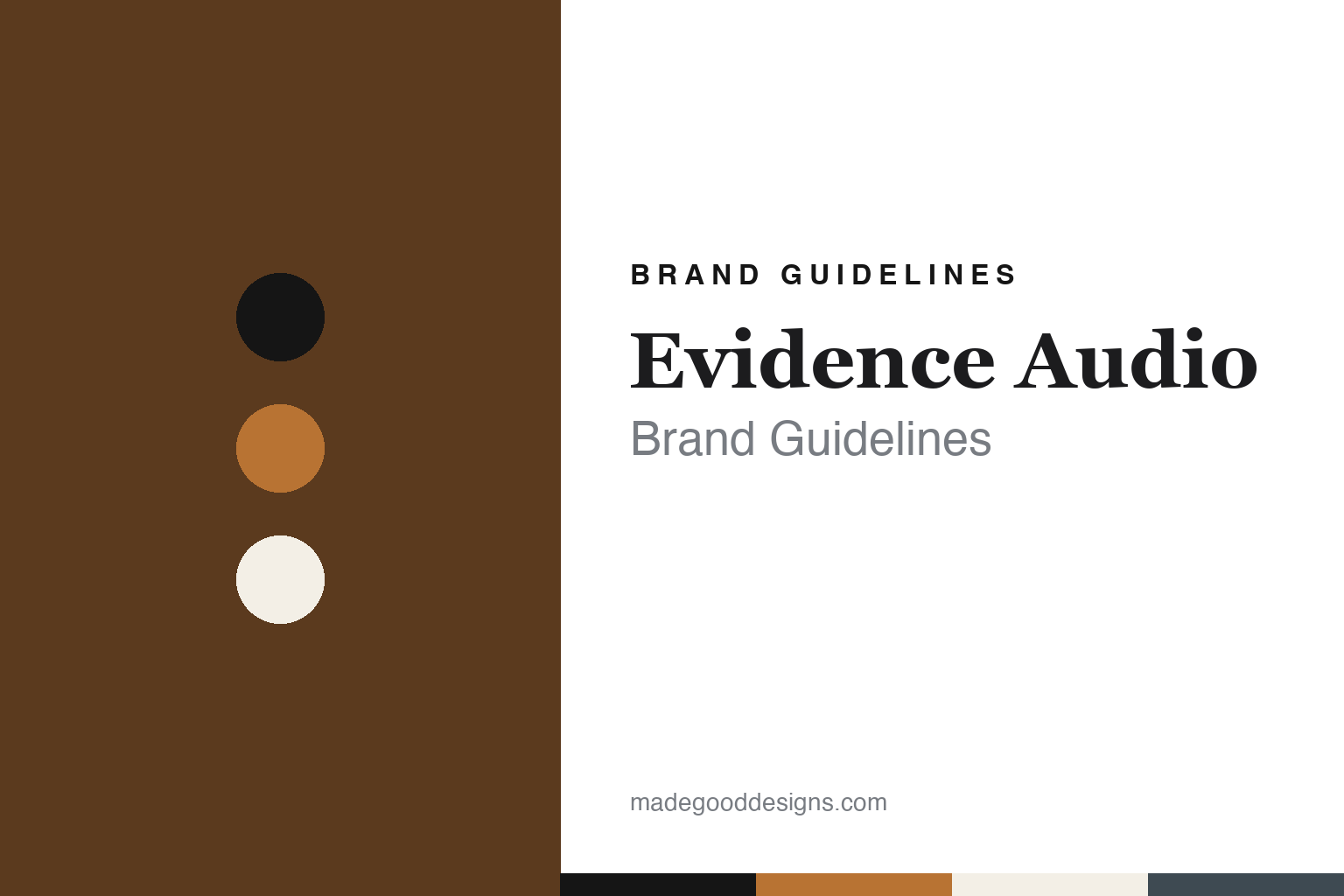
Evidence Audio Brand Guidelines
Tony Farinella’s solid-core cables, from the Lyric to Gilmour’s rig.
Aa
Two constants: an Evidence Audio copper, ink and cream palette and a bookish serif register. Abstract homage — not an Evidence Audio product or mark; no cable, logo or packaging is reproduced.
Tony Farinella
A hi-fi cable lesson applied to guitar leads.
Evidence Audio was founded by Tony Farinella in 1997. The year comes from two interviews the company reproduces on its press page: The ToneQuest Report, in September 2004, wrote that “Tony Farinella founded Evidence Audio in 1997,” and the International Institute of Bassists said the same in an October 2010 product spotlight. The company’s own “Our Story” page says Farinella “focused on design methodologies in his research lab more than 25 years ago,” and its homepage marks 25 years.
Farinella told the bassists’ institute that as a boy he took apart radios and amplifiers bought at yard sales and built Heathkit electronics kits, alongside guitar and piano lessons. As an adult, he said, he was “more capable with gear than playing music,” and went to work for “a specialty cable manufacturer in a different industry,” where he spent years in what he called an “R&D sandbox” learning how designs, materials and processes change what we hear. Evidence Audio was his way of bringing that knowledge to musicians. The company’s website in 2002 put it this way: after learning what works with cables in the hi-fi market, “a void was recognized in the music industry for cable products based on merit rather than marketing hype.”
The company is a Californian one. Its early website gave a mailing address in Mission Viejo, in Orange County, and its online store’s terms today are governed by California law. Its first product, the 2002 site said, was The Lyric.
Colour
Solid cores and the “clean window.”
The core idea is solid-core conductors. Most instrument cables use stranded wire; Farinella argues that the strands interact and blur the sound. “My cables are built around solid core conductors to eliminate the audible effects of strand interaction,” he told the bassists’ institute in 2010. His website describes the aim with a visual analogy: a perfect cable “would be like looking through a clean window, free from distortions and coloration,” and every cable is meant to “disappear” from the signal path.
The range is small and named like musical terms. The Melody is a coaxial cable with a solid centre conductor and a shield that also carries the return signal. The Lyric HG uses two solid copper conductors, one for positive and one for negative, with the shield connected at one end only so that it blocks noise without carrying audio; Farinella called it “the best cable I can build for a given budget” and, in 2010, “by far, the most popular cable I make.” The company admits it is “a bit on the stiff side.” The Forte and The Reveal follow the Lyric and Melody designs but use stranded conductors with each strand individually insulated, for flexibility.
Around them sit the Siren speaker cable and the Source AC power cable, which Farinella said he introduced in 2003. For pedalboards there is the thin Monorail cable — “essentially the working bits of the Melody with a smaller jacket,” he said — and the SIS (Screw-In-Solderless) plug, sold as a DIY patch kit, joined more recently by soldered ESP plugs. Prices on the company’s store start at $81 for a Melody guitar cable, $115 for a Lyric HG and $138 for a Forte.
Typography
Design and documentation.
An instrument cable looks like the simplest thing on a stage, yet the brands that make them differ widely in age, ownership and in what they say about where their cables are made. Six of the seven in this guide are based in the United States and the seventh belongs to a North American group; they fall into three rough groups.
The catalogue suppliers are the largest. Hosa was founded in 1984 by Sho Sato, who had moved to the United States from Japan, and he has since handed it to his daughter, Mayumi Allison; it is based in Buena Park, California, the company says. Kirlin says Kirlin Industries was founded in 1997 and sells in 35 countries and regions from Ontario, California. Pig Hog, of Petaluma, California, dates itself to 2011 lists more than 300 cables, adapters and accessories, and appears among the brands of Ace Products Group, which also owns Reunion Blues.
The specialists sell on engineering. George L’s, the Madison, Tennessee, company of George L. Lewis, built its name on a solderless system: cut the low-capacitance cable and tighten on the plug, its website said in 2005. Evidence Audio was founded by Tony Farinella and says its cables are hand-built in the USA from American-made material. Lava Cable is now a brand of ACT Entertainment, whose other names include RapcoHorizon and ProCo, and which says Lava brings boutique materials to a wider audience.
The braided cable has its own claimant. Spectraflex says it has made its nylon-braided “Original Braided Cables” since 1988; its website gave an address in Clifton, New Jersey, in 1996.
This guide sets out what can be checked about each brand — who founded it, who owns it, and what it says about where its products are made — and marks clearly what rests only on the company’s own word.
Aa
A bookish serif for a brand built on an argument. (Specimen set in Libre Baskerville, a serif STAND-IN; NOT the Evidence Audio logo.)
Evidence Audio
Hand-built, says the company, in the USA.
The best-documented user is David Gilmour. In a November 2006 interview with the Gilmour fan site Gilmourish, Farinella said that Gilmour’s guitar technician Phil Taylor contacted him “a few days before Christmas in 2004” for cables to record On an Island, and then for the Live 8 concert of 2005; he said Gilmour used the Melody on stage for Stratocasters and lap steels, the Lyric HG in the studio and Siren speaker cables between amplifier and cabinets. Today the company lists Noel Gallagher, Graham Coxon, Ed O’Brien, Guthrie Govan, Andy Timmons, Josh Smith, Guy Pratt and Steve Rothery among users of its SIS plugs and Monorail cable; we give that as its claim. The 2010 interview named the bassists Alain Caron and Stuart Hamm as endorsers.
The press has been warm. The ToneQuest Report’s 2004 review found that the Lyric HG “produced a clearly superior neutral character” against the other cables it tried, and the company’s press page quotes Guitar World calling Farinella “a legend in the cable community” and lists two Guitarist Choice awards and a five-out-of-five Guitar Player review. The homepage says: “All cables hand-built in the USA, from USA-manufactured material.” Farinella described a hands-on operation in 2010 — an eight-to-nine-week backlog, standard lengths built by him, custom lengths left to designated dealer “custom shops” — and said: “I have a feeling a part of that is staying small and focused.” No logo, typeface or brand colour is published.
For a design guide, Evidence Audio shows how a small maker can build a brand on a single technical argument, told in plain language. Compare Mogami, the Japanese maker of studio cable, and Van Damme, the London cable brand. For this guide we use copper, ink and a clean-window cream with a serif, an unofficial interpretation; no product or logo is reproduced.
Explore & save
Keep Evidence Audio’s identity on hand — save it to a board in the Made Good inspiration library.
Evidence Audio identity set
Pin the Evidence Audio copper, ink and cream palette and the bookish serif register to your own board.