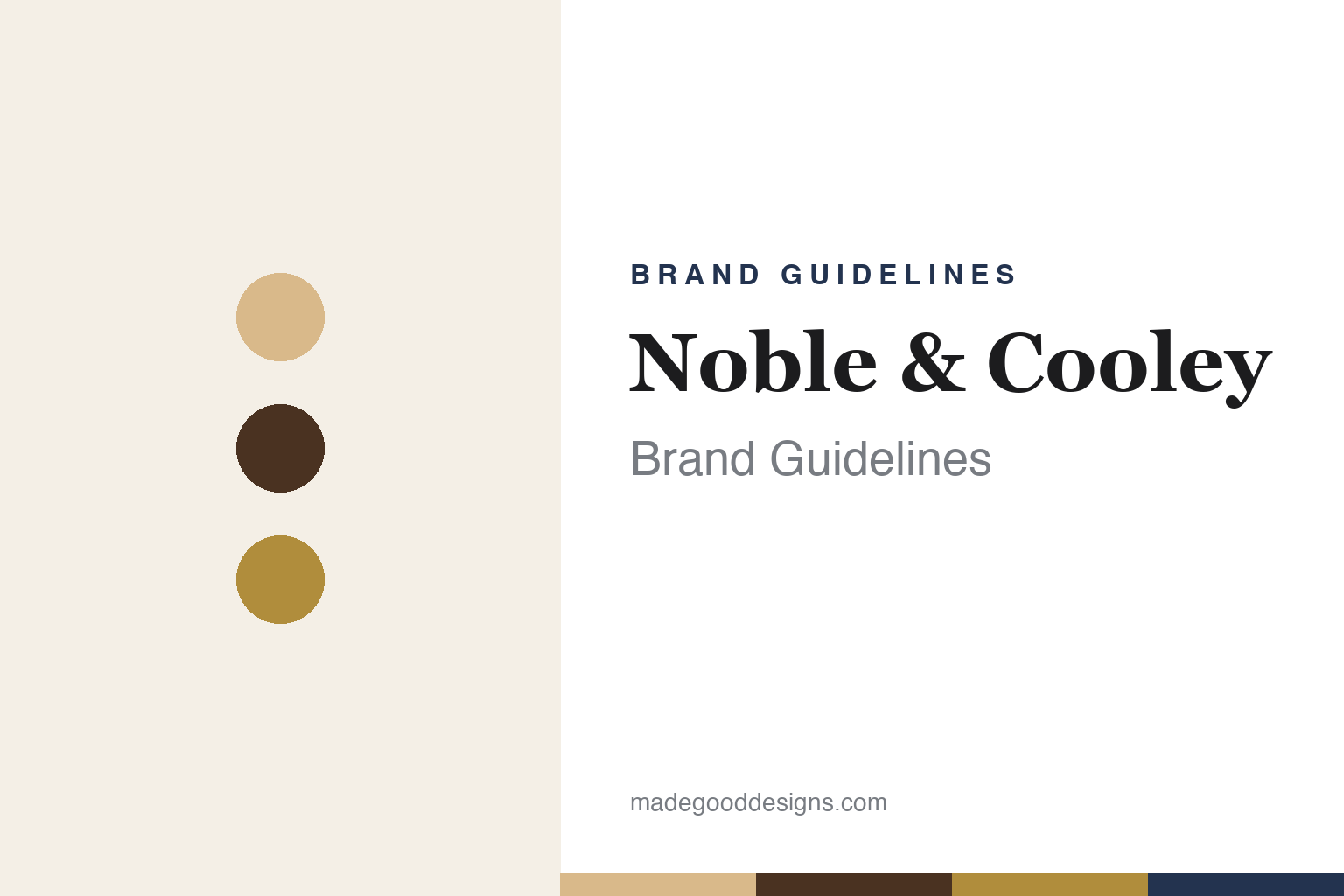
Noble & Cooley Brand Guidelines
The toy-drum maker that reinvented the solid-shell snare.
Aa
Two constants: a Noble & Cooley maple, walnut and brass palette and a 19th-century serif register. Abstract homage — not a Noble & Cooley product or mark; no drum, badge or logo is reproduced.
A farmhouse kitchen
Toy drums, Union drums and an eight-foot drum for peace.
Noble & Cooley dates its founding to January 1854, when Silas Noble and James P. Cooley began making drums in a farmhouse kitchen in Granville, Massachusetts, a small farming town in the southwest of the state. Inc. reported in 2019 that Noble, a farmer, had started making toy drums in his kitchen in 1853 to give away as Christmas presents, and that he and Cooley, a friend and fellow farmer, saw a business in it. The company built 631 toy drums in its first year. English Wikipedia calls it the oldest drum company in the United States, a description the company also uses.
Toys were the core, but not the only trade. During the Civil War the company supplied drums to Northern regiments — “hundreds of instruments,” Inc. said — and it made military drums until the 1920s. The company says it was producing 100,000 drums a year by 1873. The Cooley family’s diaries record a drum made in August 1860 from a fence rail split by Abraham Lincoln, used at rallies around New England; “Finished the Lincoln drum today, the finest thing ever made,” the entry reads, as quoted by Inc. and the Mass Cultural Council. For Patrick Gilmore’s National Peace Jubilee in Boston in 1869 it built a drum eight feet across, which the company describes as the largest in the world at the time.
The factory burned in 1889, but some equipment survived, including steam-bending machines the company still uses. Over the years it also made toothpicks, croquet sets, table-tennis paddles and giftware, Inc. reported, and in the 1960s and 1970s it was the only American supplier of toy drums, selling to Toys “R” Us, Sears and JC Penney with 120 people working two shifts.
Colour
A broken Radio King and a steam bender.
By the late 1970s, when Jay Jones, a sixth-generation descendant of James Cooley, succeeded his father, imports were taking the toy market. In 1981, Inc. reported, a customer brought in a damaged Slingerland Radio King snare, whose shell was a single steam-bent piece of wood, and asked for a new one. Jones, who said he was not a musician, worked with a percussionist — the company names the musician and designer Bob Gatzen — and Noble & Cooley showed professional drums at a trade show in 1984.
The result was the SS Classic, a solid-shell snare drum made from a single quarter-inch ply of rock maple or another domestic hardwood, bent on 19th-century machinery. The company calls it the first steam-bent solid-shell drum of the modern era. The Mass Cultural Council’s folklorist wrote in 2019 that Noble & Cooley “were the first to bring back the solid wood, steam bent shell back in the 1980s,” and that several other companies now do the same. The company also claims nodal-point lug mounting, which it says it patented, along with symmetrical venting and hybrid shells, and says it “almost single-handedly created the boutique drum market.”
Players followed. Inc. reported that Phil Collins adopted the snares in 1986 — the only musician the company ever gave drums to free — and that Heart’s Denny Carmassi was its first celebrity endorser for full kits, touring with one in 1988. In 1989, according to English Wikipedia, it worked with Zildjian on limited-edition snare drums made from the cymbal maker’s alloy, a drum the company calls one of the most prized in the collector’s market; its own Alloy Classic, in cast aluminium, followed.
Typography
Heritage and the American drum.
These seven brands fall into two camps: old American names that have passed through several owners, and small workshops that build drums by hand. Rogers began in 1849 as a drumhead maker in New York state; DRUM! Magazine reported in 2018 that the name is owned by Reliance Musical, a Taiwanese manufacturer, with drums finished in California. Slingerland, founded by H. H. Slingerland in 1912, according to English Wikipedia, was bought from Gibson by Drum Workshop in 2019, and its website says DW is now part of Roland.
Leedy, started in Indianapolis in 1897 by Ulysses G. Leedy, passed to C. G. Conn and then Slingerland; English Wikipedia says Gretsch has held the trademark since 1986 and the brand has lain largely dormant. Noble & Cooley is the exception among the old names: founded in Granville, Massachusetts, in 1854, its team page now lists Nick Jones, a seventh-generation Cooley descendant, and John Keane as owners, its site says it is part of York Creative Collective, and it says its drums are handcrafted in the USA.
The boutique makers are younger. Craviotto, founded by the drummer Johnny Craviotto, says it has made one-ply solid-shell drums since 2004 and now handcrafts them in Nashville. C&C, founded by Bill Cardwell, builds drums at its shop in Gladstone, Missouri, and says it has made its own shells since 2010.
Sakae is the outlier: an Osaka maker established in 1925 that, DRUM! reported, built Yamaha’s top-tier drums for 40 years. It suspended business in 2018, Kyodo reported; DRUM! later reported that Korg had bought the trademark, and the name now appears on drums sold as Sakae Osaka Heritage.
This guide sets out what can be checked about each brand — who founded it, who owns it, and what it says about where its products are made — and marks clearly what rests only on the company’s own word.
Aa
A 19th-century serif — for a company older than the drum kit. (Specimen set in Libre Caslon Text, a serif STAND-IN; NOT the Noble & Cooley logo.)
Noble & Cooley
Still in Granville, with new partners.
The company still works from its 19th-century buildings on Water Street in Granville. In 2019 Inc. found Jones, his son Nick and two employees building about 55 drum sets and 300 snare drums a year in 6,000 square feet, with much of the rest of the complex let to tenants. It bends eight woods — ash, beech, birch, cherry, oak, maple, tulip and walnut — which Inc. said came from within 20 miles of the factory. The company says every drum is built to order, by hand, in Granville, from locally sourced wood.
Ownership has widened. The company’s website says John Keane, a long-time Noble & Cooley player with a career in business and medical-device manufacturing, joined in 2015 to help revitalise the brand; it now lists him and Nick Jones, a seventh-generation Cooley descendant, as owners, with Jay and Carol Jones retired. Its footer says it is part of York Creative Collective, a group of companies with offices in Manchester, New Hampshire, and Boston, which lists Noble & Cooley as having joined in 2015. Newer lines include walnut drums built, the company says, with the Witt Percussion “all horizontal” approach, and the Union Series, which it describes as the only modern kit made of tulipwood, the wood of its Union Army drums. In 2026 it named Ricardo Parra, founder of Parra Drums, as master craftsman.
For a design guide, Noble & Cooley shows how a brand can lean on a long history while changing almost everything it makes. Compare Gretsch Drums, another American drum name with a long family history, and Ludwig. For this guide we use rock-maple tan, walnut brown, brass and a Union blue with a 19th-century serif, an unofficial interpretation; no product or logo is reproduced.
Explore & save
Keep Noble & Cooley’s identity on hand — save it to a board in the Made Good inspiration library.
Noble & Cooley identity set
Pin the Noble & Cooley maple, walnut and brass palette and the 19th-century serif register to your own board.