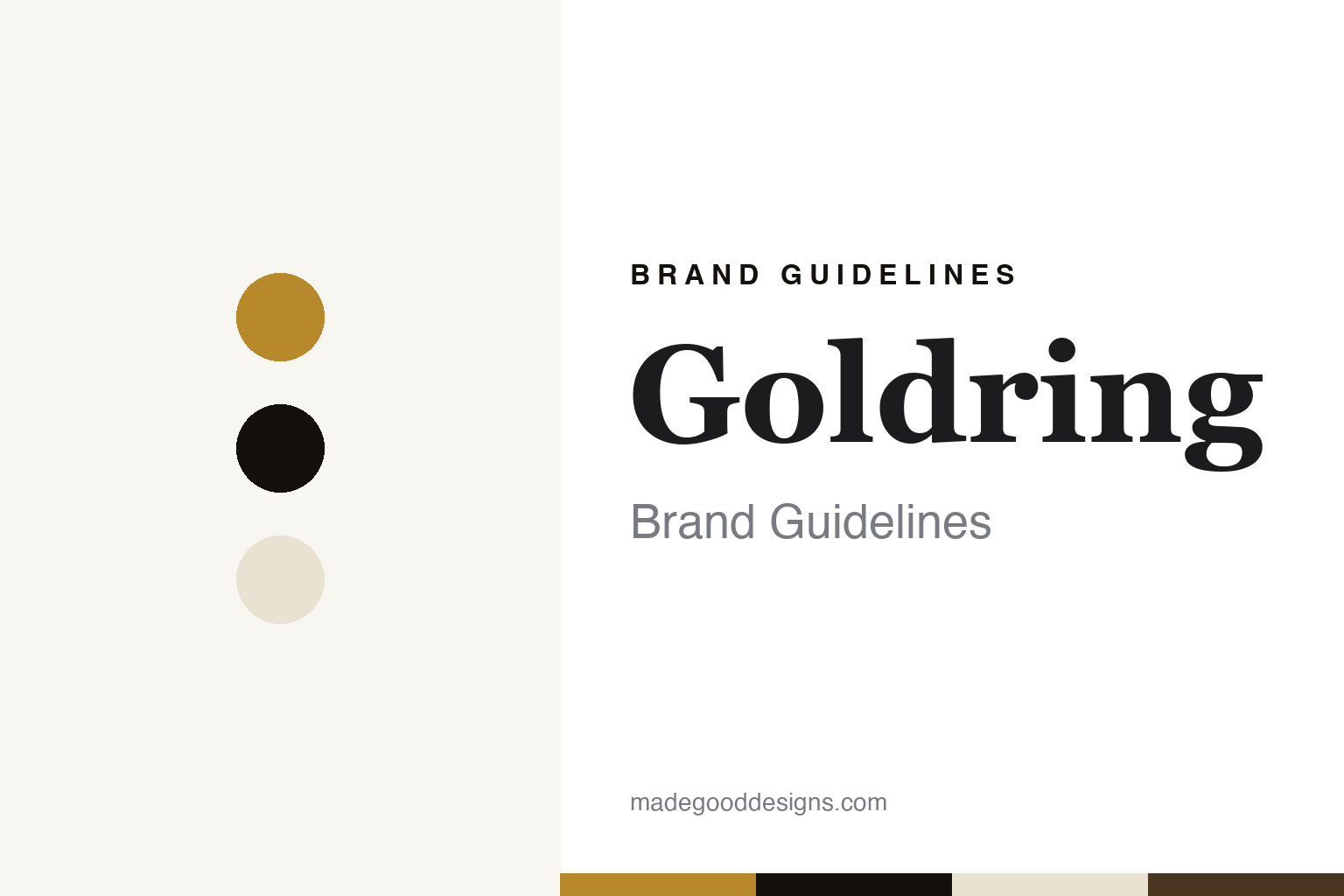
Goldring Brand Guidelines
The Berlin sound-box maker named after a 1926 quality mark.
Aa
Two constants: a Goldring ring gold and ink palette and a Heritage serif register. Abstract homage — not a Goldring product or mark; no cartridge, logo or nameplate is reproduced.
Gebrüder Scharf
Two brothers and a gramophone trade in Berlin.
Goldring began in Berlin in 1906. The company’s own history says two Czech-born brothers, Heinrich and Julius Scharf, started making parts for the young gramophone industry under the name Gebrüder Scharf — needles, clockwork motors and governor springs at first, then “sound boxes,” the all-acoustic ancestors of the magnetic pickup. English Wikipedia, and a Goldring spokesman quoted by 6moons in the 2000s, say instead that the brothers made phonographs; we follow the company’s more detailed account and note the difference.
The name came from a trademark. In 1926, the company says, it launched the Juwel Electro sound box, with a mica diaphragm, designed for the new electrically recorded discs and carrying a Gold Ring trademark “to denote superior quality.” The mark later gave the company its name.
In 1933 the business moved to England. The company says it was run there by Heinrich’s son Erwin, later joined by his brother Freddie, and re-formed as Scharf Bros in a factory at Woodford, Essex; it reproduces a February 1935 review of its 33/5 electric pickup from The Gramophone. During the Second World War, it says, the Woodford factory was destroyed by a V-1 flying bomb, and work on the model 100 magnetic pickup and the Headmaster tone arm went on at a new factory in Dalston, East London.
Colour
From the No. 500 to Bury St Edmunds.
In 1953, the company says, it was renamed Goldring Manufacturing (GB) Ltd and moved to Leytonstone, in East London, where nearly 100 people worked on every stage of manufacture. Its No. 500 was a “turnover” pickup, with two sapphire styli for 33 and 45 rpm records; Goldring says it was widely used by the BBC, and English Wikipedia dates it to 1954. The 600 and 700 followed, and in 1967 came the G800, a variable-reluctance design that could play at under two grams. Hi-Fi News, in May 1969, called the 800 Super E “the first British product of this type and class,” according to the review Goldring quotes.
Goldring also sold turntables. It says it worked with the Swiss maker Lenco for about 20 years from the 1950s, launching the GL75 in 1967; English Wikipedia describes the GL75 as a Lenco L75 marketed through Goldring. By the early 1970s, the company says, it had been floated on the stock exchange, and in 1974 it moved to Bury St Edmunds, in Suffolk, where it employed nearly 300 people and made its 900 series.
The company says it became Goldring Products Ltd in the late 1970s and returned to private ownership under Gerry Sharp, a grandson of Heinrich Scharf; the family had changed its name to Sharp, English Wikipedia says. Companies House records a Goldring Products Limited incorporated in February 1976 as Bridgepam Limited and renamed at the end of 1977; it is now listed as non-trading. Goldring’s first moving-coil cartridge, the Electro II, followed in 1983, then the Eroica and Excel, and in 1985 the first 1000 series of moving-magnet designs. What Hi-Fi? found the Eroica “very well behaved; extremely tolerant” in October 1987, in the review the company quotes.
Later decades brought new formats. The company says the high-end Elite moving coil was developed in the 1990s for “a more discerning specialist market,” and that it returned to turntables with the GR1 in 2003 — English Wikipedia gives 2004 — and the GR2 in 2005; 6moons, reviewing the GR1, reported that both deck and arm were made in Britain. A 2000 series of moving-iron cartridges followed, and the flagship Legacy moving coil arrived in 2009, the year Goldring dates to its move to Bishop’s Stortford. English Wikipedia adds a range of DR headphones from 2006.
Typography
Cartridges and documentation.
These seven makers belong to a small trade. A phono cartridge is a few grams of magnet, coil and diamond, largely assembled by hand, yet only a few of these brands say who does the work.
Goldring, which traces its roots to Berlin in 1906, belongs to Armour Home Electronics of Bishop’s Stortford, a subsidiary of Q Acoustics Limited, Companies House records show. It says its cartridges are “designed and handmade in the UK,” though its own history says it outsourced much component manufacturing in the 1990s. Soundsmith says every product is “hand-crafted” at its factory in Peekskill, New York.
Sumiko, the cartridge brand of a Berkeley, California, distributor bought by Fine Sounds of Milan in 2011, Stereophile reported, says all its cartridges are hand-built by Excel Sound in Yokohama.
Three are Japanese. Nagaoka, a family stylus maker based in Higashine, Yamagata, makes an MP-700 that is “still completely built by hand in Japan,” Hi-Fi News reported in 2025. ZYX works from Nagara in Chiba; its founder says he managed OEM cartridges for several makers at Namiki Precision Jewel before 1986. My Sonic Lab gives a Tokyo address; its US distributor, quoted by Stereophile in 2018, said founder Yoshio Matsudaira had earlier made cartridges for Air Tight.
Benz Micro, the Swiss name, is hardest to place: its website is a holding page, and the Swiss business-name index lists a Benz-Micro AG as deleted in 1997.
This guide sets out what can be checked about each brand — who founded it, who owns it, and what it says about where its products are made — and marks clearly what rests only on the company’s own word.
Aa
A heritage serif — a name taken from a 1926 quality mark. (Specimen set in Fraunces, a serif STAND-IN; NOT the Goldring logo.)
Goldring
A quality mark that became a company.
The family era ended in 1987, when Gerry Sharp sold the company to its distributor, Veda, according to English Wikipedia, whose account is uncited; Goldring’s own history does not mention the sale. Companies House shows that the trading company, Armour Home Electronics Limited, was called Veda Products Limited until 2005. Its accounts for the year to August 2025 name Q Acoustics, QED and Goldring as its key brands, record turnover of about £11.1 million, and describe it as a subsidiary of Q Acoustics Limited, whose ultimate controlling party is “a Guernsey registered trust.” Both companies are registered at an address near Bishop’s Stortford, where Goldring says it moved in the 2000s.
On manufacturing, Goldring’s website says its cartridges are “designed and handmade in the UK” and calls models such as the 1006 “hand-built”; we give that as its claim. Its own history adds that in the 1990s it “downsized considerably and outsourced much of our component manufacturing work.” The Armour accounts count three manufacturing employees across the whole business in 2025 and refer to “Far Eastern suppliers,” without saying which brands or products those cover. Its current range runs from the E series of moving-magnet cartridges — the E3 is listed as a What Hi-Fi? Awards 2025 winner — to the Ethos moving coil, launched in 2018.
For a design guide, Goldring shows how a quality mark from 1926 can become a company’s name and outlast its founding family. Compare Rega, another British analogue maker, and Ortofon, the Danish cartridge maker. For this guide we use a ring gold and an ink black with a serif, an unofficial interpretation; no product or logo is reproduced.
Explore & save
Keep Goldring’s identity on hand — save it to a board in the Made Good inspiration library.
Goldring identity set
Pin the Goldring ring gold and ink palette and the Heritage serif register to your own board.