Koronya Brand Guidelines
The Budapest hand-welt.
Aa
Two constants: a Budapest-ochre palette and a Budapest-sans register. Abstract homage — not a Koronya shoe, last or wordmark.
The Budapest hand-welt
Koronya is the Budapest bespoke atelier of Marcell Mrsán, making hand-welted Budapester shoes and teaching the craft.
Koronya is a lesson in how a bespoke maker keeps an old technique alive — and passes it on. From Budapest it makes bespoke shoes in the traditional Hungarian idiom — hand-lasted, hand-welted, in the heavy Budapester style, often with a goiser or Norwegian storm-stitch — and its maker is also a teacher of the craft. Its answer to the bespoke bench is transmission: master the old hand-welt, and hand it forward. A shoe built by hand, by a maker who also trains others.
Its identity is the Budapest hand-welted shoe, taught forward. Koronya’s hand-welting, its Budapester style and its maker’s teaching are the work it is known for. A craft, kept and transmitted. An atelier that makes and teaches the Hungarian welt.
(Honest notes, so the story stays precise, about a living maker whose public work only we describe. Koronya is a Budapest bespoke atelier led by Marcell Mrsán, an accredited master shoemaker who is also a footwear educator and industry consultant; we report those public business facts and describe his teaching as academic, studio and industry work — including a computer-aided-design instructor role — rather than public consumer masterclasses, which we could not confirm. Its shoes are hand-lasted and hand-welted bespoke in the Budapester style, with documented goiser or Norwegian storm-welt construction. On heritage, the brand states “Since 1876” and a multi-generation leatherworking lineage; we frame that as a family lineage the house traces to 1876 rather than a verified founding date for the current atelier, which public coverage shows active over roughly the last decade or so. The “Budapester” is a general shoe style, not something Koronya owns, and the atelier is distinct from the separately-run Vass house, also of Budapest. Its designs and marks are its IP, described but never reproduced, and there is no official brand hex — these tones are an unofficial interpretation. This is design commentary and does not promote any product.)
Colour
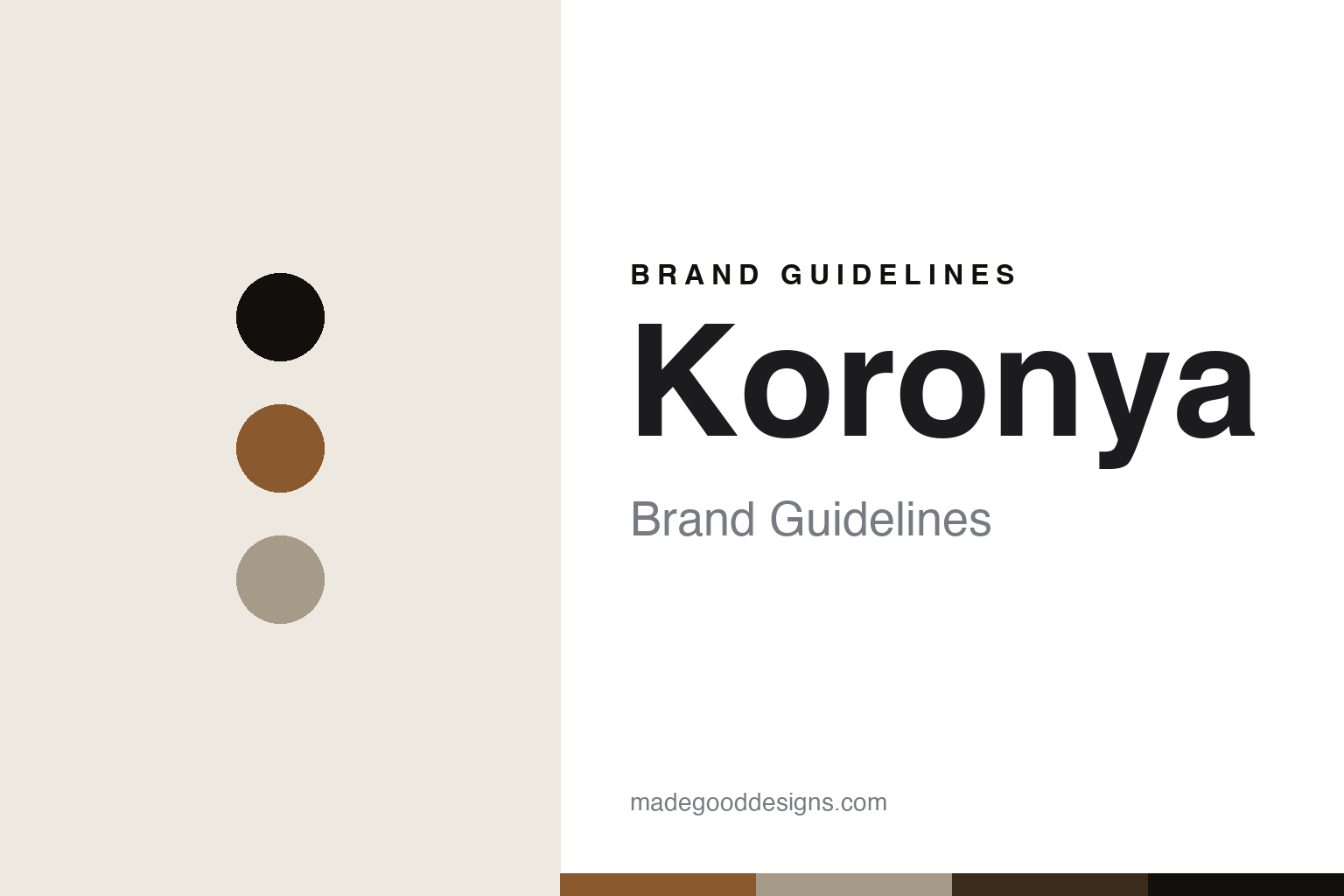
Koronya lives in a Budapest-ochre palette. Click a swatch to copy the hex.
Koronya’s identity is Hungarian, traditional and hand-made — a Budapest ochre, an ink, a calf sand, an umber, and a chalk. The palette leans Budapest ochre and sand: the register of a warm, hand-worked leather and a Budapest workshop. It signals craft and transmission over volume. The honest caveat: with no published brand hex, these values are an original, unofficial interpretation, not first-party colours.
The lesson is a Budapest-ochre palette signals a hand-welted, taught-forward identity. Koronya’s world is a hand-lasted, hand-welted, Budapest object. For designers, it is a reminder that a warm ochre and a soft sand can carry a brand built on an old method — the amber of hand-worked leather and the sand of the last. Because these tones can fail as small text, keep type dark and let the colour live in the accents, palette and band. The takeaways: keep the old method by hand; teach it forward; date the lineage honestly; and treat any single hex as unofficial.
Typography
The register is a Budapest sans — plain, warm, hands-on.
Koronya’s identity carries a plain, warm, hands-on spirit — a craft atelier and a teacher, not a factory. A Budapest sans captures the mood: even, honest and human, the register of a hand-welting workshop. Set in a Budapest-ochre palette, the Budapest sans feels plain and warm — exactly the personality the atelier carries. It is hands-on rather than slick, mirroring a hand-welted Budapester shoe. (Koronya’s real designs and marks are things we describe but do not reproduce, and the exact typeface is not ours to use.) Because it is not ours to use, the honest description is “a Budapest-sans spirit,” shown here in a stand-in. The type behaves like the maker: plain, warm and hands-on.
Aa
A Budapest-sans spirit — plain and warm. (Specimen set in Mulish, a Budapest-sans STAND-IN; NOT the Koronya wordmark or any shoe design.)
The bespoke bench
Koronya stands for the hand-welt, kept and taught.
Koronya is a lesson in how a bespoke maker keeps a craft alive by teaching it. A Budapest-ochre palette, a Budapest sans and a hand-welted Budapester shoe make one thing — a traditional Hungarian hand-welt — the whole atelier: Hungarian, traditional and hand-made. The hand-welt is the craft, and teaching it forward is the meaning. The point is a genuinely hand-welted object, made in Budapest, by a master who both makes shoes and hands the technique to others.
Put to work, the identity is transmission as design. A maker in this spirit would keep the hard, old method in his own hands, teach it so it survives past him, and be honest about the difference between a family lineage and the atelier’s own age. It would name its construction precisely — hand-welting, and where a storm-stitch is a storm-stitch. A brand learning from it would see that keeping and teaching an old craft is a distinct identity — that “we make the Hungarian hand-welt, and we teach it” secures the method’s future — and that being precise, a lineage traced to 1876 rather than a claimed founding date, a generic Budapester style rather than an owned one, and a maker distinct from his Budapest neighbours, earns trust. A brand learning from it would also treat its living maker as a public craftsman, not a personality. The lesson Koronya teaches is that a hand-welted craft plus its transmission can hold an identity: the hand-work gives it substance, and the teaching gives it a future. The craft is the personality, and the hand-welted shoe is the proof.
For designers and brand-builders, Koronya closes this round about the bespoke bench on the transmission pole: keep the old method, and teach it forward honestly. The lessons: hand-welt it; teach it; date the lineage truthfully; and never reproduce a protected design or claim a generic style. It is also a reminder to stay precise: Koronya is the Budapest bespoke atelier of Marcell Mrsán, making hand-welted Budapester shoes and teaching the craft, tracing a family lineage to 1876 — with the palette here an unofficial interpretation, and only public business facts reported of a living maker. Koronya made the hand-welt something to teach — proof that transmission can be the difference.
Explore & save
Keep Koronya’s identity on hand — save it to a board in the Made Good inspiration library.
Koronya identity set
Pin the Budapest-ochre palette and the Budapest-sans register to your own board.