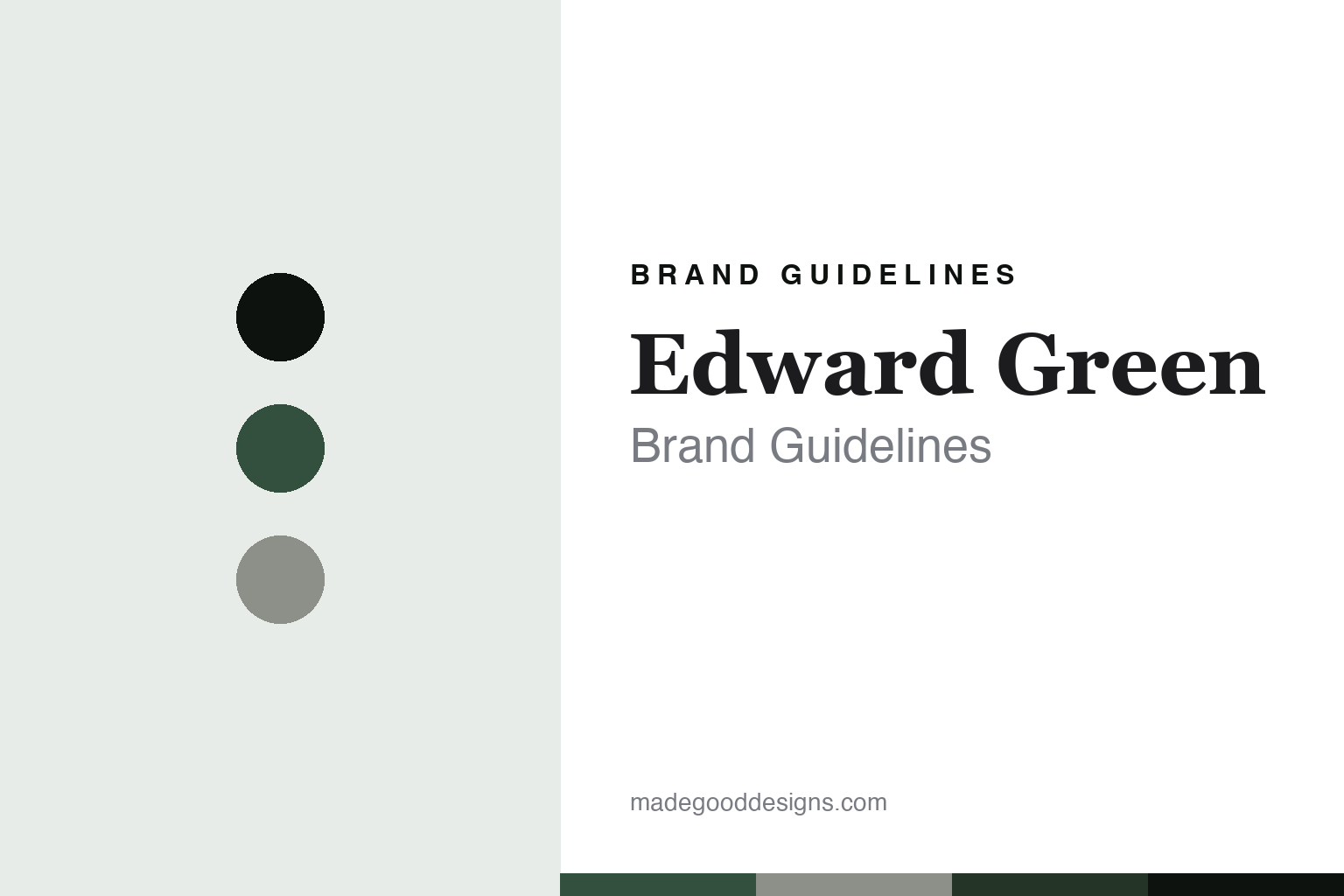
Edward Green Brand Guidelines
The top of Northampton.
Aa
Two constants: an antique-green palette and a top-tier-serif register. Abstract homage — not an Edward Green shoe, last or wordmark.
The top of Northampton
Edward Green is a top-tier Northampton house whose antiqued Goodyear-welted shoes sit a notch above the rest, made in England since 1890.
Edward Green is a lesson in how a maker sits at the top of a whole town’s trade. From Northampton it makes Goodyear-welted ready-to-wear the exacting way — small output, refined lasts, and a hand-antiquing that gives its leather a depth most factories skip. Its answer to the range of the trade is the top of it: the near-bespoke finish of a factory shoe. A Northampton shoe pushed to the edge of what ready-to-wear can be.
Its identity is the top-tier Northampton welted shoe. Edward Green’s Goodyear welting, its Northampton making and its antiqued finishing are the work it is known for. A craft, taken to the top. A house regarded as the finest of the Northampton factories.
(Honest notes, so the story stays precise. Edward Green was founded in 1890 by Edward Green in Northampton, and its shoes are genuinely made there in small numbers, with calf from a French tannery and oak-bark-tanned soles. It is Goodyear-welted, and widely regarded as a notch above the mainstream Northampton houses, known for hand-antiquing and refined lasts. Its ownership is worth stating carefully: it passed from the founding family through several hands and, famously, was sold “for one pound” to the bespoke shoemaker John Hlustik, who revived its quality; on his death around 2000 it passed to his partner, Hilary Freeman, and is reportedly still independently held rather than part of a group. It is a distinct house from the other Northampton and Hermès-owned names. Its designs, lasts and marks are its IP, described but never reproduced, and there is no official brand hex — these tones are an unofficial interpretation. This is design commentary and does not promote any product.)
Colour
Edward Green lives in an antique-green palette. Click a swatch to copy the hex.
Edward Green’s identity is English, refined and top-tier — an antique green, an ink, a calf grey, an umber, and a chalk. The palette leans antique green and grey: the register of a deep, hand-burnished leather and a Northampton bench. It signals finish and refinement over volume. The honest caveat: with no published brand hex, these values are an original, unofficial interpretation, not first-party colours.
The lesson is an antique-green palette signals a top-tier, made-in-England identity. Edward Green’s world is a resoleable, hand-finished, small-batch object. For designers, it is a reminder that a deep antiqued green and a soft grey can carry a brand built on finish — the depth of burnished leather and the grey of a fine last. Because these tones can fail as small text, keep type dark and let the colour live in the accents, palette and band. The takeaways: finish above the norm; keep output small; be honest about ownership; and treat any single hex as unofficial.
Typography
The register is a top-tier serif — refined, classical, assured.
Edward Green’s identity carries a refined, classical, assured spirit — the top of a trade, not the middle. A top-tier serif captures the mood: elegant, high-contrast and composed, the register of the finest Northampton house. Set in an antique-green palette, the top-tier serif feels refined and assured — exactly the personality the house carries. It is refined rather than loud, mirroring a hand-antiqued welted shoe. (Edward Green’s real designs and marks are things we describe but do not reproduce, and the exact typeface is not ours to use.) Because it is not ours to use, the honest description is “a top-tier-serif spirit,” shown here in a stand-in. The type behaves like the house: refined, classical and assured.
Aa
A top-tier-serif spirit — refined and assured. (Specimen set in Playfair Display, a top-tier-serif STAND-IN; NOT the Edward Green wordmark or any shoe design.)
The range of the trade
Edward Green stands for the top of the range.
Edward Green is a lesson in how a maker occupies the top of a whole trade. An antique-green palette, a top-tier serif and a Goodyear-welted shoe make one thing — a Northampton ready-to-wear shoe finished to near-bespoke standard — the whole house: English, refined and top-tier. The welt is the craft, and the finishing is what lifts it above the rest. The point is a genuinely welted object, made in small numbers in Northampton, whose hand-antiquing puts it at the peak of factory shoemaking.
Put to work, the identity is finish-at-the-top as design. A house in this position would keep output small, finish beyond the standard, and be honest about a colourful ownership history rather than pretend at unbroken lineage. It would let the antiquing and the lasts speak. A brand learning from it would see that occupying the top of a category is a durable identity — that “the best of the Northampton factories” is a claim earned by finishing, not marketing — and that telling the ownership story straight, the “£1” sale, Hlustik, then Freeman, is more compelling than hiding it. A brand learning from it would also stay distinct from its neighbours rather than blur into the Northampton cluster. It would treat a small output not as a limit but as the condition of the finish, since a factory making ten times as many pairs could not hand-antique each one, and scarcity here is a by-product of care rather than a marketing pose. The lesson Edward Green teaches is that a welted construction plus superior finishing can hold the top of an identity: the method gives it substance, and the finish gives it rank. The craft is the personality, and the welted shoe is the proof.
For designers and brand-builders, Edward Green opens this round about the range of the trade at the top: finish above the norm, and own your history honestly. The lessons: keep output small; finish beyond the standard; disclose ownership; and never reproduce a protected design. It is also a reminder to stay precise: Edward Green is a top-tier Northampton house founded in 1890, its Goodyear-welted shoes made in England, reportedly still independently held — with the palette here an unofficial interpretation. Edward Green made finishing the difference — proof that the top of a trade is earned at the bench.
Explore & save
Keep Edward Green’s identity on hand — save it to a board in the Made Good inspiration library.
Edward Green identity set
Pin the antique-green palette and the top-tier-serif register to your own board.