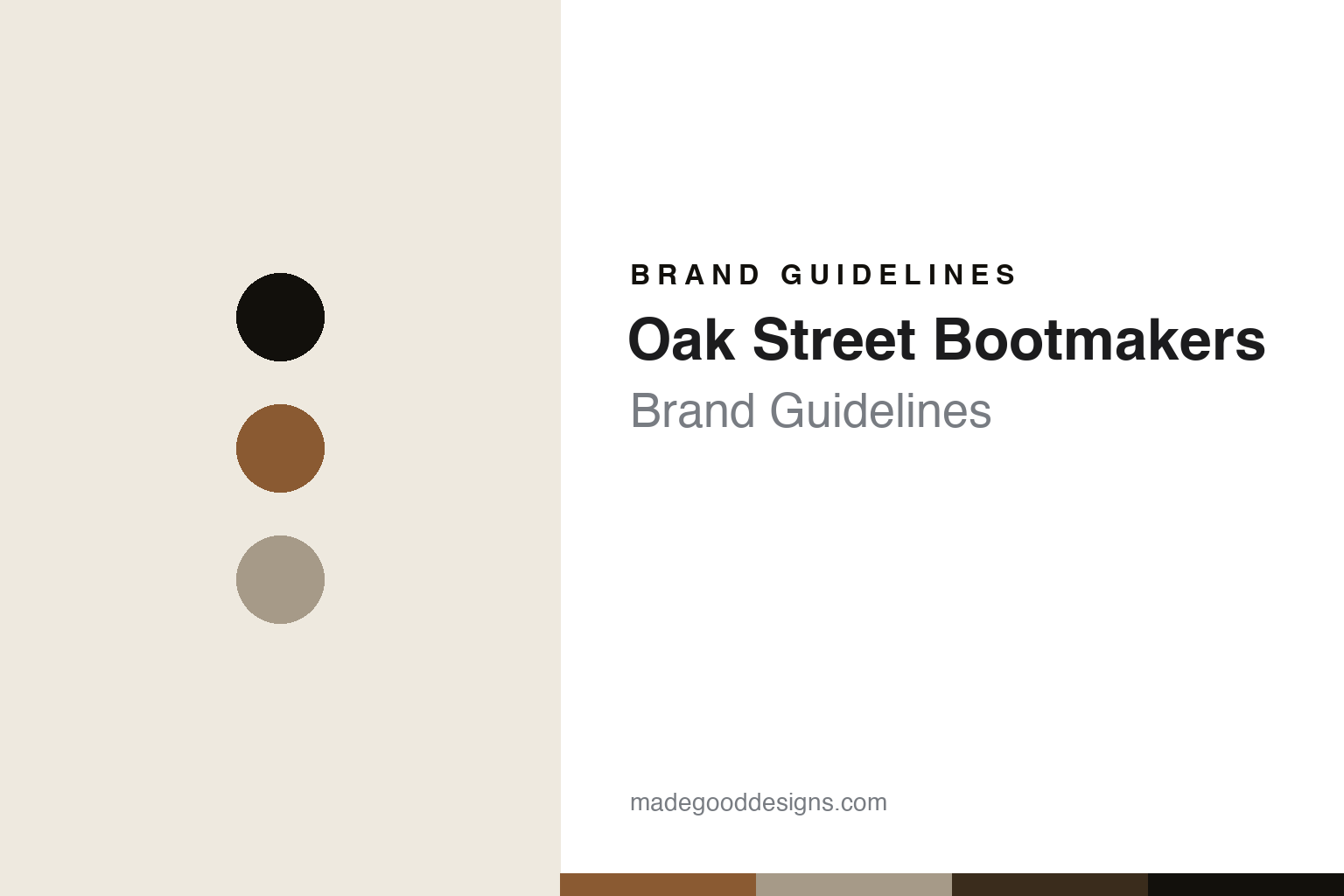
Oak Street Bootmakers Brand Guidelines
The Chicago maker.
Aa
Two constants: a Chromexcel-tan palette and an American-sans register. Abstract homage — not an Oak Street Bootmakers shoe, last or wordmark.
The Chicago maker
Oak Street Bootmakers is a modern Chicago maker, founded 2010 by a cobbler’s son, making welted boots and hand-sewn mocs in the USA.
Oak Street Bootmakers is a lesson in how a modern maker revives a trade rather than inherits it. From its own Chicago factory it makes Goodyear-welted boots and hand-sewn moccasins, in Horween leather, sold direct and built to be recrafted. Its answer to the range of the trade is the modern American maker: not a century-old house, but a new one bringing back the old methods. A workshop that chose to make, in Chicago, from scratch.
Its identity is the modern American welted maker. Oak Street’s Goodyear welting, its Chicago making and its recraftable construction are the work it is known for. A craft, revived by choice. A maker founded by a cobbler’s son.
(Honest notes, so the story stays precise. Oak Street Bootmakers was founded in 2010 by George Vlagos — the son of a Chicago shoe-repair man — so it revives a family trade rather than being a century-old heritage house; we report the founder as a public business figure. Its shoes are genuinely made in its own Chicago factory, though we say “made in the USA with some imported components,” since certain soles and hardware (and some specialty leathers) are imported while the uppers, welting and assembly are Chicago-made; its primary leather is Horween of Chicago, a separate supplier we do not conflate with the brand. Construction varies by model: its Goodyear-welted boots — the Trench Boot is the signature — are now hand-lasted, while its camp moccasins are hand-sewn, so not everything is welted. Its shoes are recraftable. Its designs, models and marks are its IP, described but never reproduced, and there is no official brand hex — these tones are an unofficial interpretation. This is design commentary and does not promote any product.)
Colour
Oak Street Bootmakers lives in a Chromexcel-tan palette. Click a swatch to copy the hex.
Oak Street’s identity is American, sturdy and revivalist — a Chromexcel tan, an ink, a calf sand, an umber, and a chalk. The palette leans Chromexcel tan and sand: the register of an oiled American leather and a Chicago workbench. It signals honest making over heritage theatre. The honest caveat: with no published brand hex, these values are an original, unofficial interpretation, not first-party colours.
The lesson is a Chromexcel-tan palette signals a welted, made-in-Chicago identity. Oak Street’s world is a recraftable, American-made, direct-sold object. For designers, it is a reminder that a warm tan and a soft sand can carry a brand built on reviving a trade — the amber of oiled leather and the sand of the last. Because these tones can fail as small text, keep type dark and let the colour live in the accents, palette and band. The takeaways: make it at home; be honest about imported parts; revive the method openly; and treat any single hex as unofficial.
Typography
The register is an American sans — plain, sturdy, honest.
Oak Street’s identity carries a plain, sturdy, honest spirit — a modern maker, not a heritage act. An American sans captures the mood: solid, even and unfussy, the register of a Chicago factory. Set in a Chromexcel-tan palette, the American sans feels plain and sturdy — exactly the personality the maker carries. It is honest rather than showy, mirroring a Goodyear-welted boot. (Oak Street’s real designs and marks are things we describe but do not reproduce, and the exact typeface is not ours to use.) Because it is not ours to use, the honest description is “an American-sans spirit,” shown here in a stand-in. The type behaves like the maker: plain, sturdy and honest.
Aa
An American-sans spirit — plain and sturdy. (Specimen set in Archivo, an American-sans STAND-IN; NOT the Oak Street Bootmakers wordmark or any shoe design.)
The range of the trade
Oak Street stands for the modern American maker.
Oak Street Bootmakers is a lesson in how a modern maker revives a trade openly. A Chromexcel-tan palette, an American sans and a Goodyear-welted boot make one thing — a recraftable, American-made welted boot — the whole maker: American, sturdy and revivalist. The welt is the craft, and the from-scratch revival is the story. The point is a genuinely made object, produced in a Chicago factory by a new company, not an inherited century-old house.
Put to work, the identity is honest revival as design. A maker in this spirit would build a real factory, make at home, and be candid that it is new and that some parts are imported rather than claim total domestic purity. It would let construction vary honestly by model. A brand learning from it would see that reviving a trade from scratch is a legitimate identity — that “we are new, and we chose to make it the old way in Chicago” is honest and appealing — and that saying “made in the USA with some imported components,” and distinguishing a welted boot from a hand-sewn moc, builds more trust than a blanket claim. A brand learning from it would also credit its suppliers, keeping Horween distinct from itself. It would let recraftability be a promise rather than a footnote, since a boot built to be resoled invites a relationship measured in decades, and a maker that takes its own shoes back for rebuilding stands behind them in a way a disposable brand cannot. The lesson Oak Street teaches is that a welted construction plus an honest modern revival can hold an identity: the method gives it substance, and the candour gives it credibility. The craft is the personality, and the welted boot is the proof.
For designers and brand-builders, Oak Street holds the modern-maker point in this round about the range of the trade: revive the craft openly, and be candid about making. The lessons: build the factory; make at home; disclose imported parts; and never reproduce a protected design. It is also a reminder to stay precise: Oak Street Bootmakers is a Chicago maker founded in 2010, its welted boots and hand-sewn moccasins made in the USA with some imported components — with the palette here an unofficial interpretation. Oak Street revived the trade openly — proof that honesty can be the difference.
Explore & save
Keep Oak Street Bootmakers’s identity on hand — save it to a board in the Made Good inspiration library.
Oak Street Bootmakers identity set
Pin the Chromexcel-tan palette and the American-sans register to your own board.