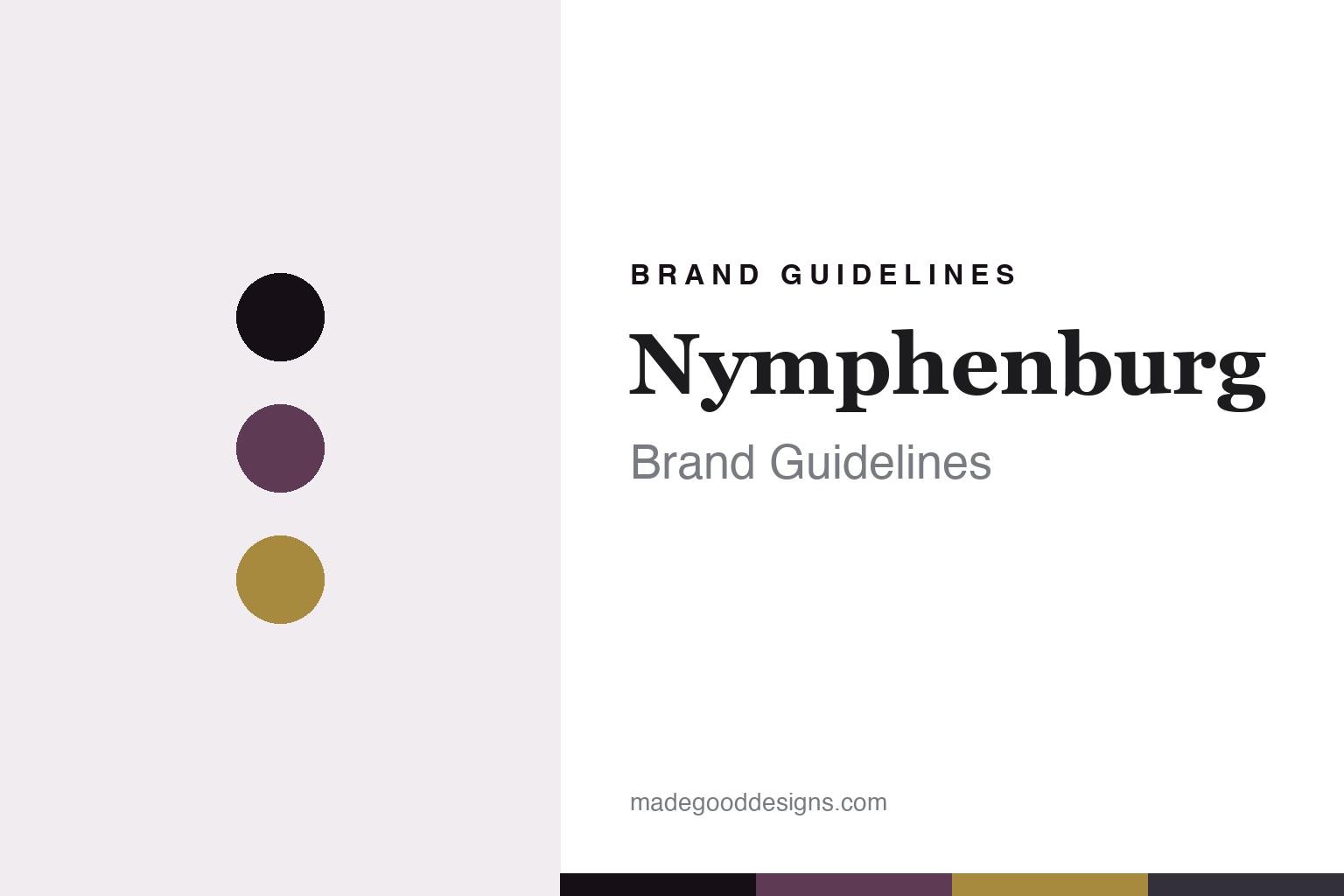
Nymphenburg Brand Guidelines
The royal porcelain.
Aa
Two constants: an aubergine-and-gold palette and a regal serif register. Abstract homage — not a Nymphenburg piece or wordmark.
The royal porcelain
Nymphenburg has hand-made aristocratic porcelain in Munich since 1747.
Nymphenburg is a lesson in aristocratic hand-craft as the identity. A German manufactory at Nymphenburg Palace in Munich, it has made porcelain entirely by hand for nearly three centuries — a royal manufactory still working.
Its identity is the royal porcelain. Nymphenburg’s entirely hand-made porcelain — from Rococo figures to hand-painted tableware, made with moulds passed down since the eighteenth century — is the work it is known for. Porcelain as courtly art. The hand, unbroken.
(Honest notes: Nymphenburg — the Porzellan Manufaktur Nymphenburg — is a German porcelain manufactory in Munich, at Nymphenburg Palace, founded in 1747 by Elector Maximilian III Joseph, initially at Neudeck ob der Au, and moved to the Nymphenburg site in 1761 — so we keep those dates distinct and don’t say it was “founded at Nymphenburg in 1747.” It is inseparably tied to the House of Wittelsbach. Its signature is aristocratic, entirely hand-made porcelain — above all the Rococo commedia dell’arte figures by its modeller Franz Anton Bustelli, who joined in 1754 and worked until his death in 1763 — with hand-painting recognised as protected cultural heritage, alongside contemporary collaborations with designers like Ted Muehling and Hella Jongerius. On production, its Munich site is the world’s only production site for Nymphenburg porcelain, one hundred per cent handmade on original moulds by around fifty artisans. On ownership, an honest note: the manufactory is leased from the Free State of Bavaria and has been operated by Prince Luitpold of Bavaria since 2011. Its Bavarian lozenge-shield mark, the Bustelli figures and its collaborations are IP we describe but don’t reproduce. There’s no official brand hex — these tones are an unofficial interpretation. This is design commentary and does not promote any product.)
Colour
Nymphenburg lives in an aubergine-and-gold palette. Click a swatch to copy the hex.
Nymphenburg’s identity is aristocratic, refined and enduring — an aubergine, an ink, a gold, a graphite, and a porcelain white. The palette leans aubergine and gold — the register of courtly richness and gilded detail on fine porcelain. It signals heritage and craft rather than novelty. The honest caveat: with no published brand hex, these tones are an original, unofficial interpretation, not first-party values.
The lesson is an aubergine-and-gold palette signals royal porcelain. Nymphenburg’s world is an aristocratic, refined, enduring object. For designers, it is a reminder that a lineage — a royal manufactory making by hand for centuries — can be the whole identity, and that a rich, gilded palette signals that heritage. Because a mid aubergine can fail as small text, keep type dark and let the colour live in the accents, palette and band. The takeaways: keep the craft entirely by hand; protect the moulds; commission new design; and treat any single hex as unofficial.
Typography
The register is a regal serif — classical, refined, enduring.
Nymphenburg’s identity carries a classical, refined, enduring spirit — an aristocratic, hand-made object. A classical serif captures the mood: it is dignified and timeless, the register of a courtly manufactory. Set in an aubergine-and-gold palette, the regal serif feels classical and refined — exactly the personality Nymphenburg carries. It is heritage rather than novelty, mirroring hand-made royal porcelain. (Nymphenburg’s real figures, mark and patterns are works we describe but do not reproduce, and the exact typeface is not ours to use.) Because it is not ours to use, the honest description is “a regal serif spirit,” shown here in a stand-in. The type behaves like the brand: classical, refined and enduring.
Aa
A regal serif spirit — classical and refined. (Specimen set in EB Garamond, a classical serif STAND-IN; NOT the Nymphenburg wordmark.)
Aristocratic hand-craft as identity
Nymphenburg stands for the royal porcelain.
Nymphenburg is a lesson in making a lineage the identity. An aubergine-and-gold palette, a regal serif and hand-made porcelain make aristocratic craft the whole brand — classical, refined, enduring. The lineage is the differentiator. The differentiator is an unbroken hand: a royal manufactory making porcelain entirely by hand, on eighteenth-century moulds, at the world’s only site for its porcelain.
Put to work, the identity is heritage as design. A manufactory building in this spirit would protect its craft absolutely — keeping everything hand-made, preserving the original moulds — while inviting contemporary designers in, so the tradition stays alive rather than merely preserved. The lesson Nymphenburg teaches is that a lineage and a standard can build a brand: centuries of hand-craft, an own manufactory, and a classical, refined design language give it an authority no new label can approach, while collaborations keep it current. The heritage is the trust, and the hand is the proof it is still real.
For designers and brand-builders, Nymphenburg offers a clear takeaway: protect the craft absolutely, and keep it living. The lessons: make it by hand; guard the moulds; commission new work; and be honest about the story. It is also a reminder to stay accurate: it was founded in 1747 at Neudeck and moved to Nymphenburg in 1761 — not “founded at Nymphenburg in 1747” — and it is now operated by Prince Luitpold of Bavaria under a lease from the Free State of Bavaria — the palette here is an unofficial interpretation. And it is a reminder that made-where honesty can be a genuine boast: Nymphenburg is hand-made in its own Munich manufactory, and that is worth stating plainly. Nymphenburg made the royal porcelain the brand — proof that a lineage can be the difference.
Explore & save
Keep Nymphenburg’s identity on hand — save it to a board in the Made Good inspiration library.
Nymphenburg identity set
Pin the aubergine-and-gold palette and the regal-serif register to your own board.