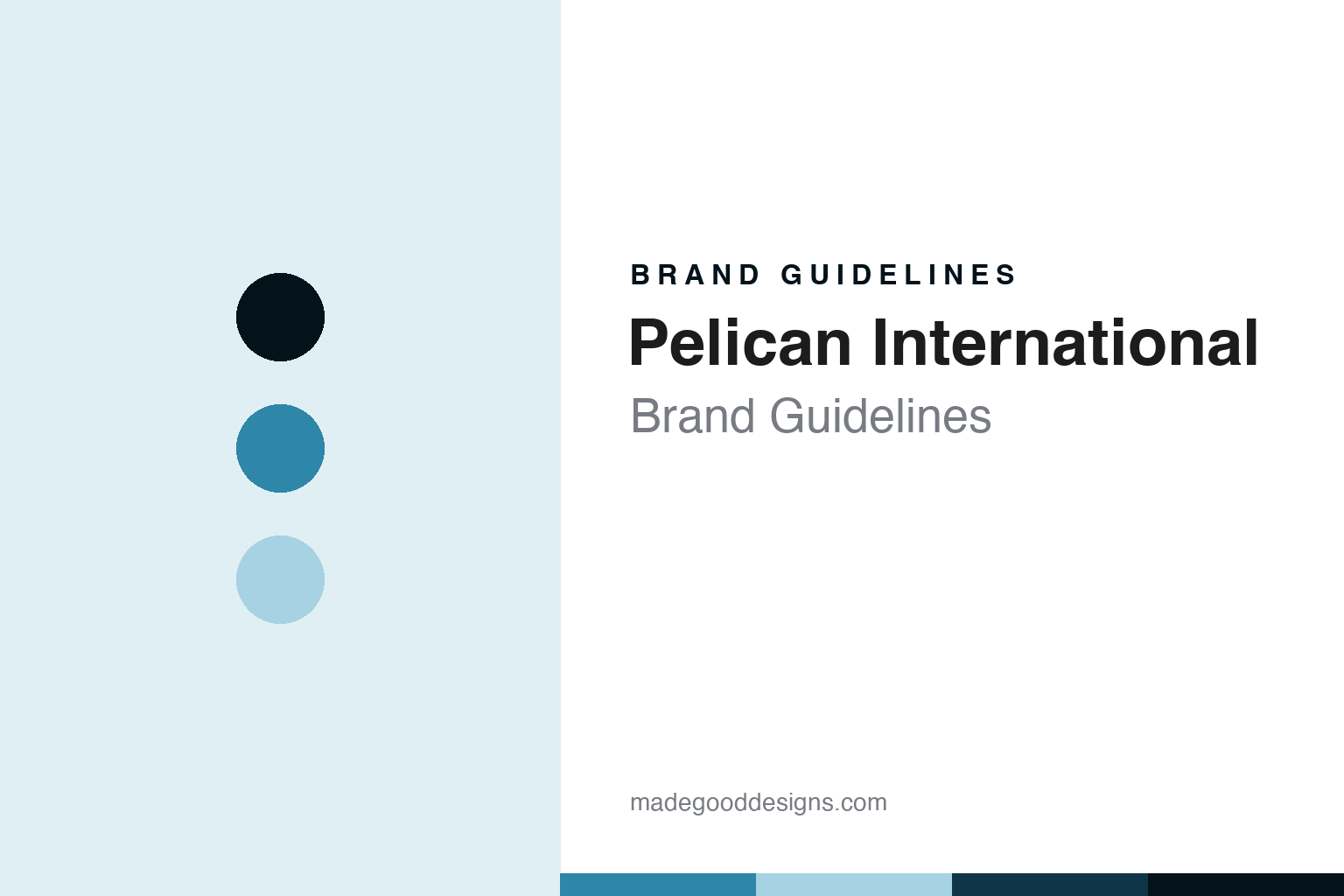
Pelican International Brand Guidelines
The Canadian budget-kayak giant.
Aa
Two constants: a cyan palette and a budget-roto-sans register. Abstract homage — not a Pelican product or mark; no kayak silhouette or logo is reproduced.
The Canadian budget-kayak giant
Pelican International is the Canadian maker of budget rotomoulded kayaks, now owner of the Confluence paddle brands.
Pelican International brings the round its volume giant — the Canadian company, since 1968, that makes budget and recreational kayaks, canoes and paddleboards in moulded polyethylene at scale, from Laval, Quebec, and which now owns the Confluence paddle brands, including a maker from the first paddle round. Pelican makes affordable paddle craft, and its answer to a round about the open water is scale and access — a budget plastic kayak, Canadian-made, from a company that has become an owner of others. A brand, budget.
Its identity is the Canadian budget-kayak giant. The budget plastic, the Canadian making and the brands it now owns are the story here. A brand, budget. The Canadian budget-kayak giant.
(Honest notes, so the story stays precise, and the ownership stays careful. Pelican International, at pelican.com, makes budget and recreational kayaks, canoes, stand-up paddleboards, pedal and fishing boats in a moulded, multilayer polyethylene, which we describe generically rather than by its trademark, with its affordable recreational boats as heroes; we report its performance language as the brand’s own marketing. It has been in business since 1968, headquartered in Laval, Quebec, with North American plants. On where it is made, the star theme of this round, it is Canadian, making at its North American plants. On who owns it, the theme that anchors this round, a 2025 restructuring saw former Pelican executives, backed by a group of private investors, take ownership of the combined Pelican and Confluence business as Pelican International; the exact mechanism is reported variously, as a management buyout or an asset acquisition, so we describe it as a 2025 management-led restructuring without over-specifying. Crucially, it owns the Confluence paddle brands — Wilderness Systems from the first paddle round, plus Perception, Dagger and others — acquired in 2019. We could not confirm it owns Mad River Canoe, so we do not state it. Its designs are IP we describe but do not reproduce; there is no official brand hex; these tones are an unofficial interpretation.)
Colour
Pelican lives in a cyan. Click a swatch to copy the hex.
Pelican’s identity is budget, Canadian and owning — a cyan, an ink, a pale cyan, a deep teal, and a paper. The palette leans cyan and pale cyan: a bright, accessible register that nods to an affordable recreational kayak rather than a loud logo colour. It signals a budget maker at scale. The honest caveat: with no published brand hex, these values are an original, unofficial interpretation, not first-party colours.
The lesson is a cyan signals a budget, Canadian identity. Pelican’s world is a moulded, made object. For designers, it is a reminder that a cyan and a soft pale cyan can carry a kayak brand — the tone of an accessible boat. Because these tones can fail as small text, keep type dark and let the colour live in the accents, palette and band. The takeaways: make it affordable; make it in Canada; describe the ownership carefully; and treat any single hex as unofficial.
Typography
The register is a budget-roto sans — budget, plain, Canadian.
Pelican’s identity carries a budget, plain, Canadian spirit — a volume maker, not a graphics label. A budget-roto sans captures the mood: clean, accessible and confident, the register of an affordable kayak. Set in a cyan palette, the budget-roto sans feels budget and Canadian — exactly the personality Pelican carries. It is a moulded object rather than a logo, mirroring multilayer polyethylene. (Pelican’s real boats are things we describe but do not reproduce, and the exact typeface is not ours to use.) Because it is not ours to use, the honest description is “a budget-roto-sans maker,” shown here in a stand-in. The type behaves like the brand: budget, plain and Canadian.
Aa
A budget-roto-sans maker — budget and Canadian. (Specimen set in Archivo, a budget-roto-sans STAND-IN; NOT the Pelican logo or any kayak.)
The open water
Pelican International stands for the Canadian budget-kayak giant.
Pelican International brings the round its volume giant. A cyan palette, a budget-roto sans and Canadian plants make one thing — the Canadian budget-kayak giant — the whole identity: budget, Canadian and owning. The budget plastic is the pitch, and the brands it now owns are the story. The point is a budget plastic kayak, Canadian-made, from a company that has become an owner of others — including a maker from the first paddle round.
Put to work, the identity is scale told straight, as ownership — with the making stated and the restructuring described carefully. A maker in this spirit would make it affordable, make it in Canada, and describe the ownership carefully. A reader in this spirit would keep the facts right: Pelican makes budget kayaks, canoes, paddleboards and fishing boats in a moulded, multilayer polyethylene, described generically, its affordable recreational boats the heroes; it has been in business since 1968, headquartered in Laval, Quebec, with North American plants; it is Canadian-made; and a 2025 management-led restructuring saw former executives, backed by private investors, take ownership of the combined Pelican and Confluence business, the exact mechanism reported variously, so it is described without over-specifying. It owns the Confluence paddle brands — Wilderness Systems from the first paddle round, plus Perception and Dagger — acquired in 2019, while its ownership of Mad River could not be confirmed and is not stated. Pelican brings the round its management-buyout branch of the who-owns map, and its ownership of Wilderness Systems ties this round back to the first. The honest editorial moves are to date it to 1968, to describe the material generically, to describe the 2025 restructuring without over-specifying, to name the Confluence brands it owns including Wilderness Systems, and to decline the unconfirmed Mad River claim.
For designers and brand-builders, Pelican completes the round’s consolidation picture: make it affordable — and describe the ownership carefully. The lessons: let scale and access be the brand; describe a restructuring reported variously without over-specifying; name the brands a company owns and decline the ones you cannot confirm; describe a trademarked material generically; and never reproduce a kayak. It is also a reminder to stay precise: Pelican International is the Canadian maker of budget rotomoulded kayaks, now owner of the Confluence paddle brands — with the palette here an unofficial interpretation. Read that way, Pelican is less a kayak than a budget scale: moulded, in Canada, owning others. The lesson for a brand is that scale and honest ownership reinforce each other, and describing the restructuring carefully keeps the story earned. Pelican International made the-Canadian-budget-kayak-giant the identity — proof that a volume maker can become an owner, and the round’s tie back to the first paddle round’s Wilderness Systems.
Explore & save
Keep Pelican International’s identity on hand — save it to a board in the Made Good inspiration library.
Pelican identity set
Pin the cyan palette and the budget-roto-sans register to your own board.